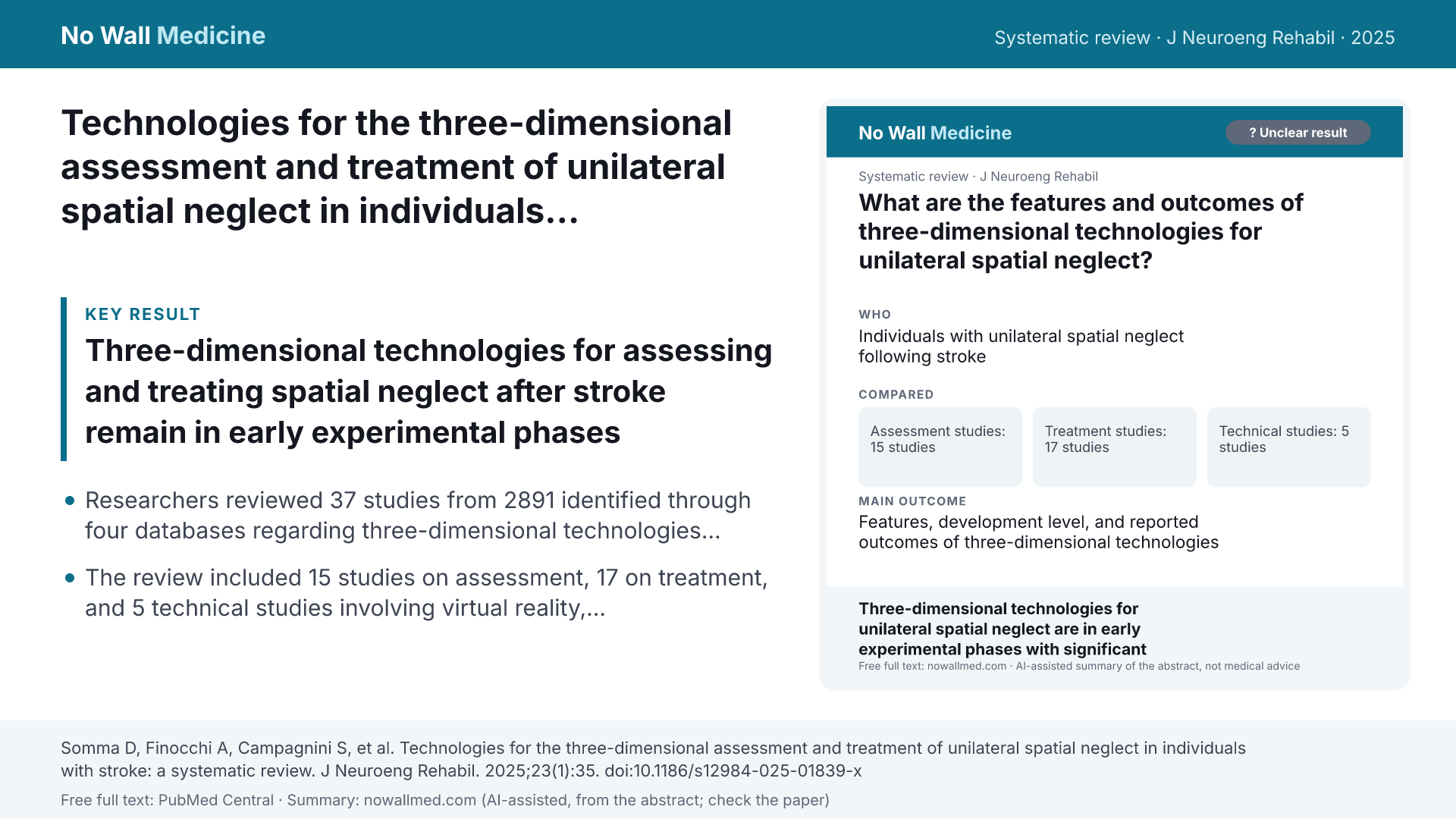
Three-dimensional technologies for assessing and treating spatial neglect after stroke remain in early experimental phases
Technologies for the three-dimensional assessment and treatment of unilateral spatial neglect in individuals with stroke: a systematic review
Systematic reviewUnclear result
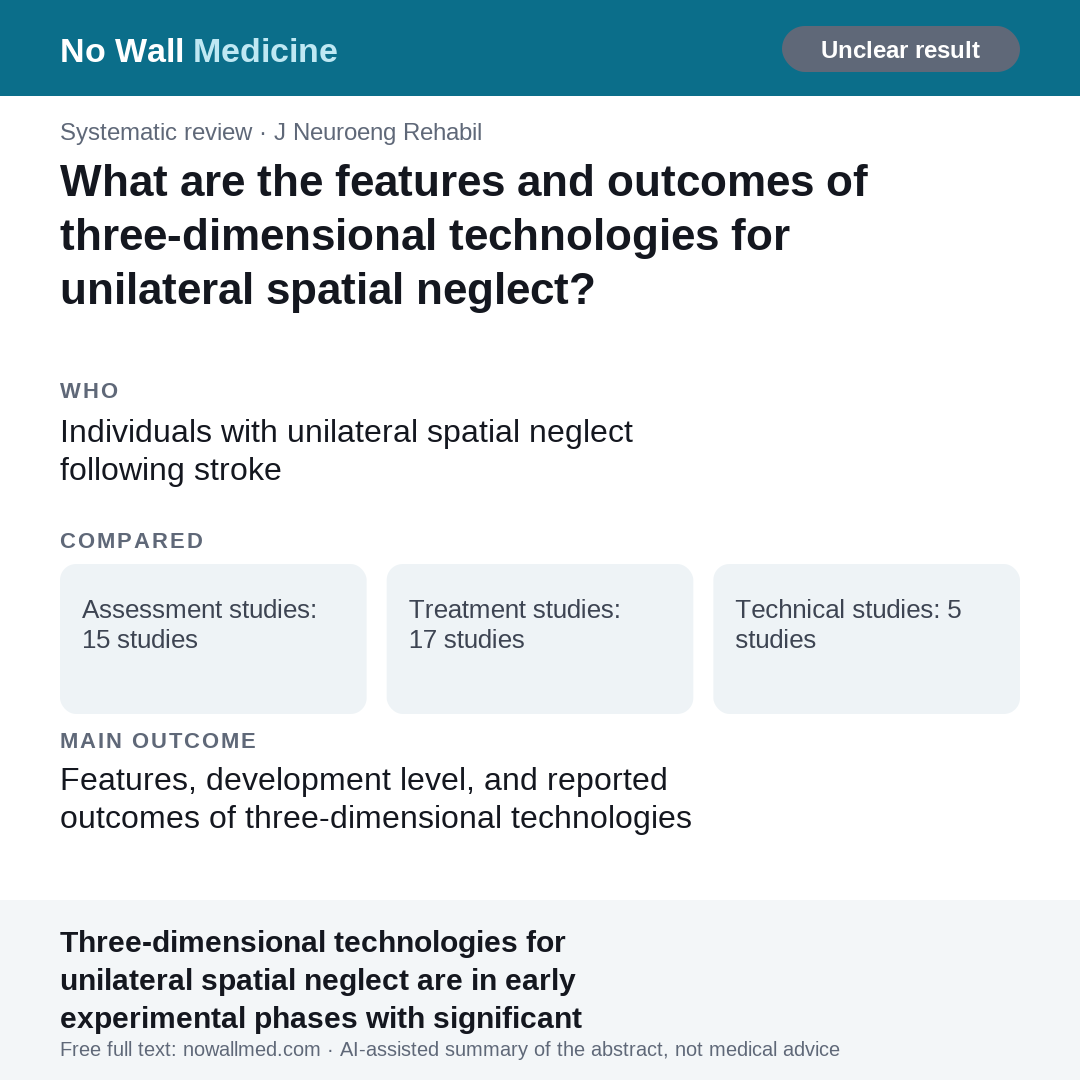
What are the features and outcomes of three-dimensional technologies for unilateral spatial neglect?
Who
Individuals with unilateral spatial neglect following stroke
Compared
Assessment studies: 15 studies
Treatment studies: 17 studies
Technical studies: 5 studies
Main outcome
Features, development level, and reported outcomes of three-dimensional technologies
Bottom line: Three-dimensional technologies for unilateral spatial neglect are in early experimental phases with significant methodological variability.
Limitation: Methodological variability, heterogeneity of technologies and outcomes, and lack of standardized protocols.
J Neuroeng Rehabil · 2025-12-20Download image
Clinical question: What are the features and outcomes of three-dimensional technologies for unilateral spatial neglect?
Why it matters: Doctors lack standardized protocols and consistent evidence for using three-dimensional technologies to assess and treat unilateral spatial neglect in stroke survivors.
Key points
- Researchers reviewed 37 studies from 2891 identified through four databases regarding three-dimensional technologies for unilateral spatial neglect, which is a failure to respond to stimuli in one side of space.
- The review included 15 studies on assessment, 17 on treatment, and 5 technical studies involving virtual reality, robotics, and augmented or mixed reality.
- The technologies are currently in early experimental phases and face challenges such as methodological variability and a lack of standardized protocols.
Headline and key points written with AI from the paper’s abstract, with every number checked against it. Read the paper before relying on them.
Was this summary helpful?
Subject terms
Cite this article
Somma D, Finocchi A, Campagnini S, et al. Technologies for the three-dimensional assessment and treatment of unilateral spatial neglect in individuals with stroke: a systematic review. J Neuroeng Rehabil. 2025. doi:10.1186/s12984-025-01839-x
Spotted a mistake? Suggest a correction