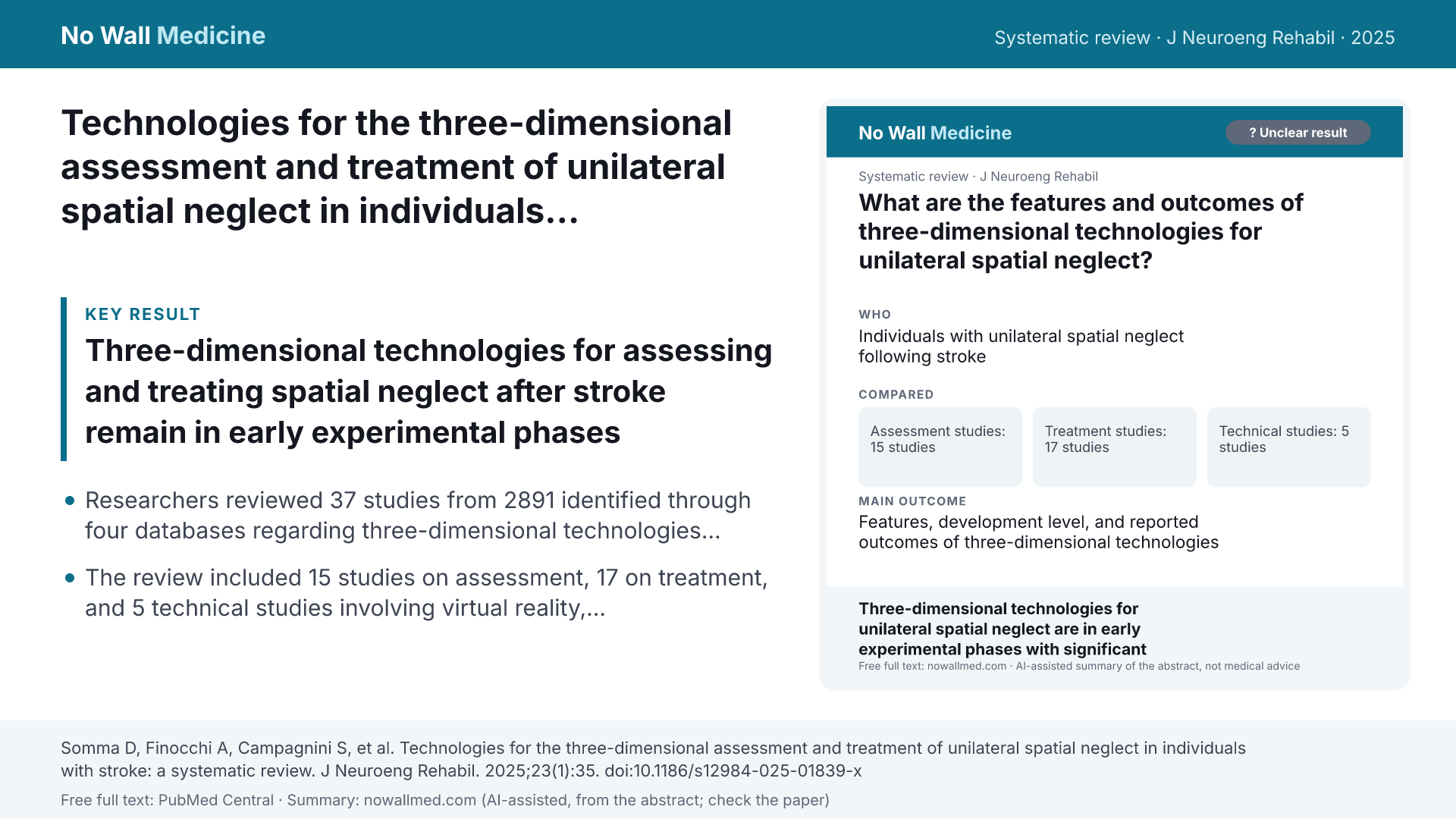
Technologies for the three-dimensional assessment and treatment of unilateral spatial neglect in individuals with stroke: a systematic review
Key result: Three-dimensional technologies for assessing and treating spatial neglect after stroke remain in early experimental phases
Key points
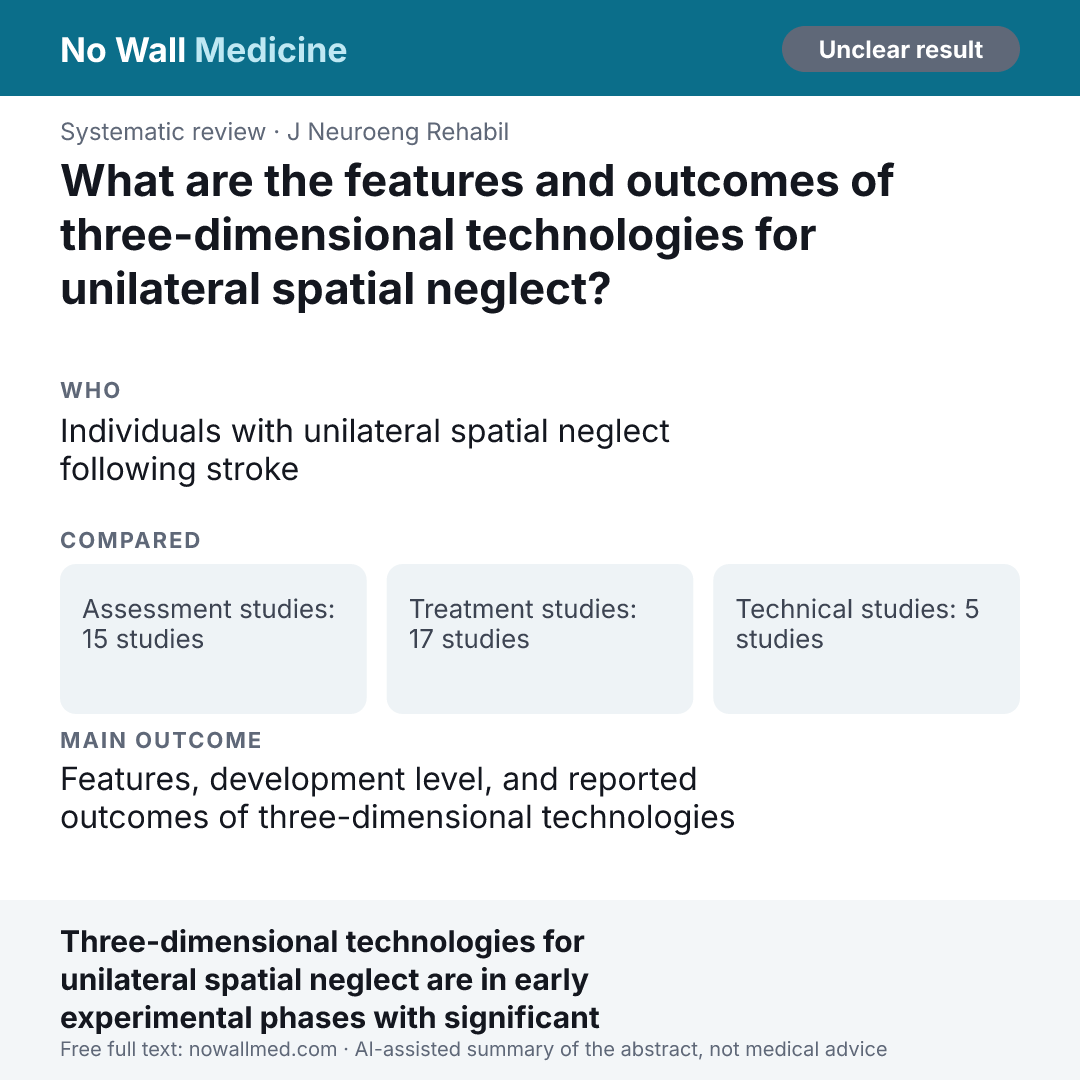
- Researchers reviewed 37 studies from 2891 identified through four databases regarding three-dimensional technologies for unilateral spatial neglect, which is a failure to respond to stimuli in one side of space.
- The review included 15 studies on assessment, 17 on treatment, and 5 technical studies involving virtual reality, robotics, and augmented or mixed reality.
- The technologies are currently in early experimental phases and face challenges such as methodological variability and a lack of standardized protocols.
Why it matters: Doctors lack standardized protocols and consistent evidence for using three-dimensional technologies to assess and treat unilateral spatial neglect in stroke survivors.
Discussion prompts
- Would these patients look like yours? Who was left out?
- Is the main outcome one that matters to patients?
- Is the difference large enough to change what you do?
Cite: Somma D, Finocchi A, Campagnini S, et al. Technologies for the three-dimensional assessment and treatment of unilateral spatial neglect in individuals with stroke: a systematic review. J Neuroeng Rehabil. 2025;23(1):35. doi:10.1186/s12984-025-01839-x
Free full text: PubMed Central · Summary and visual abstract: nowallmed.com/a/technologies-for-the-three-dimensional-assessment-and-treatment-of-7nx0rf/ (AI-assisted from the abstract; check the paper before relying on it).