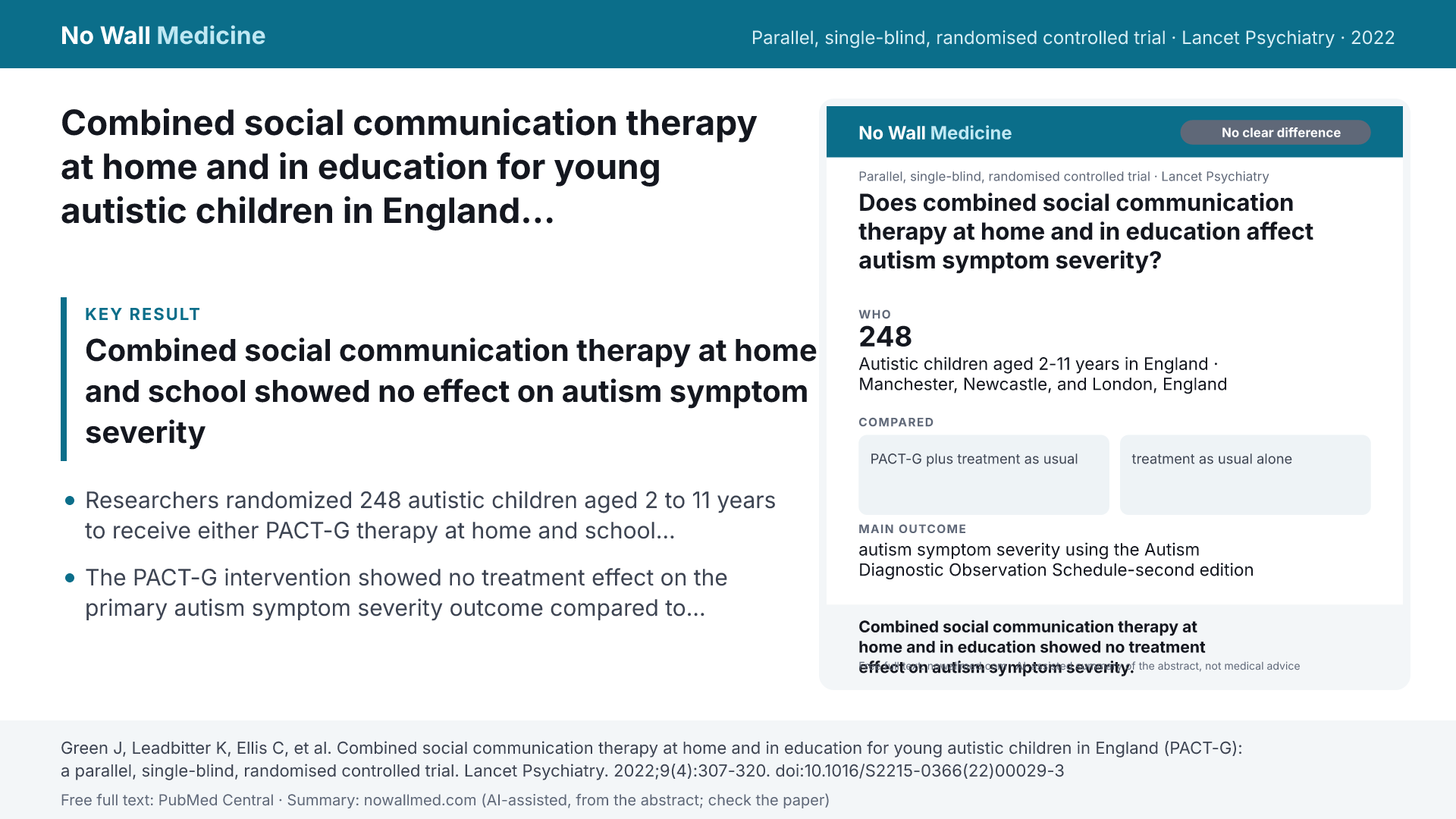
Combined social communication therapy at home and school showed no effect on autism symptom severity
Combined social communication therapy at home and in education for young autistic children in England (PACT-G): a parallel, single-blind, randomised controlled trial
Parallel, single-blind, randomised controlled trialNo clear difference
Does combined social communication therapy at home and in education affect autism symptom severity?
Who
248
Autistic children aged 2-11 years in England · Manchester, Newcastle, and London, England
Compared
PACT-G plus treatment as usual
treatment as usual alone
Main outcome
autism symptom severity using the Autism Diagnostic Observation Schedule-second edition
Result: effect size 0·04 (95% CI -0·19 to 0·26)
Bottom line: Combined social communication therapy at home and in education showed no treatment effect on autism symptom severity.
Lancet Psychiatry · 2022-03-20 · Save PNG
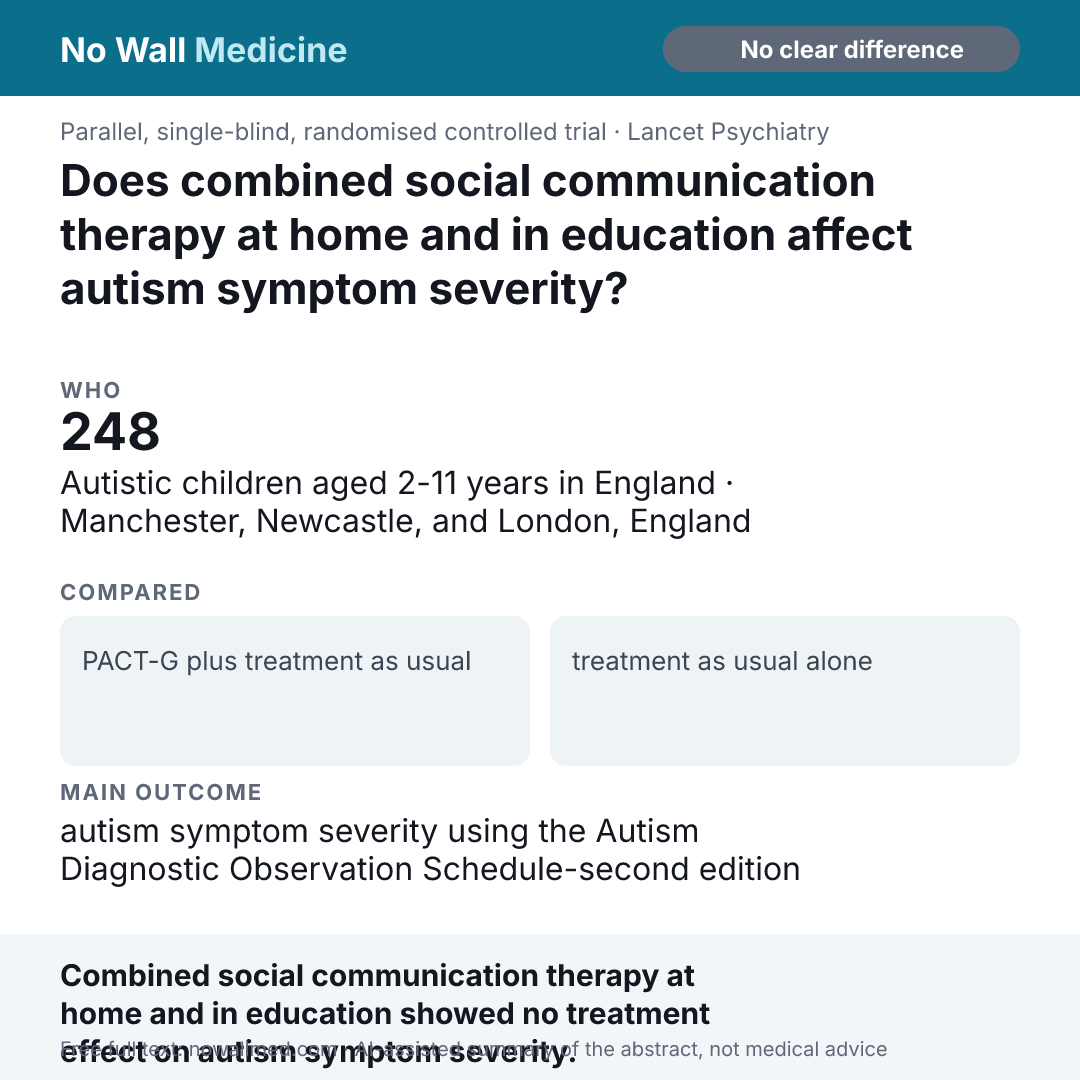
Clinical question: Does combined social communication therapy at home and in education affect autism symptom severity?
Key points
- Researchers randomized 248 autistic children aged 2 to 11 years to receive either PACT-G therapy at home and school or treatment as usual.
- The PACT-G intervention showed no treatment effect on the primary autism symptom severity outcome compared to treatment as usual (effect size 0.04; p=0.74).
- The therapy was associated with improved synchronous response in both parents (0.50) and learning-support assistants (0.33), which mediated increased child communication.
Headline and key points written with AI from the paper’s abstract, with every number checked against it. Read the paper before relying on them.
Was this summary helpful?
Abstract
Background
Autistic children can have difficulty generalising treatment effects beyond the immediate treatment context. Paediatric Autism Communication Therapy (PACT) has been successful when delivered in the clinic. Here we tested the Paediatric Autism Communication Therapy-Generalised (PACT-G) intervention combined between home and education settings for its overall effect and mechanistic transmission of effect across contexts. Methods
In this parallel, single-blind, randomised, controlled trial, we recruited autistic children aged 2-11 years in urban or semi-urban areas in Manchester, Newcastle, and London, England. Children needed to meet core autism criteria on Autism Diagnostic Observation Schedule-second edition (ADOS-2) and parent-rated Social Communication Questionnaire (SCQ-lifetime), and children older than 5 years were included if they had intentional communication but expressive language equivalent of age 4 years or younger. Eligible children were randomly assigned (1:1), using block randomisation (random block sizes of 2 and 4) and stratified for site, age (2-4 years vs 5-11 years), and gender, to either PACT-G plus treatment as usual or treatment as usual alone. Research assessors were masked to treatment allocation. The PACT-G intervention was delivered by a therapist in parallel to the child's parents at home and to learning-support assistants (LSA) at their place of education, using both in-person and remote sessions over a 6 month period, to optimise adult-child social interaction. Treatment as usual included any health support or intervention from education or local community services. The primary outcome was autism symptom severity using the ADOS-2, as measured by researchers, at 12 months versus baseline. Secondary outcomes were Brief Observation of Social Communication Change (BOSCC) and dyadic social interaction between child and adult across contexts, both at 12 months. Other secondary outcome measures were assessed using the following composites: language, anxiety, repetitive behaviour, adaptive behaviour, parental wellbeing, child health-related quality of life, and disruptive behaviour. Assessments were done at baseline, 7 months, and 12 months. We used an intention-to-treat (ITT) analysis of covariance for the efficacy outcome measures. Adverse events were assessed by researchers for all trial families at each contact and by therapists in the PACT-G group at each visit. This study is registered with the ISRCTN Registry, ISRCTN 25378536. Findings
Between Jan 18, 2017, and April 19, 2018, 555 children were referred and 249 were eligible, agreed to participate, and were randomly assigned to either PACT-G (n=122) or treatment as usual (n=127). One child in the PACT-G group withdrew and requested their data be removed from the study, giving an ITT population of 248 children. 51 (21%) of 248 children were female, 197 (79%) were male, 149 (60%) were White, and the mean age was 4·0 years (SD 0·6). The groups were well balanced for demographic and clinical characteristics. In the PACT-G group, parents of children received a median of 10 (IQR 8-12) home sessions and LSAs received a median of 8 (IQR 5-10) education sessions over 6 months. We found no treatment effect on the ADOS-2 primary outcome compared with treatment as usual (effect size 0·04 [95% CI -0·19 to 0·26]; p=0·74), or researcher-assessed BOSCC (0·03 [-0·25 to 0·31]), language composite (-0·03 [-0·15 to 0·10]), repetitive behaviour composite (0·00 [-0·35 to 0·35]), adaptive behaviour composite (0·01 [-0·15 to 0·18]), or child wellbeing (0·09 [-0·15 to 0·34]). PACT-G treatment improved synchronous response in both parent (0·50 [0·36 to 0·65]) and LSA (0·33 [0·16 to 0·50]), mediating increased child communication with parent (0·26 [0·12 to 0·40]) and LSA (0·20 [0·06 to 0·34]). Child dyadic communication change mediated outcome symptom alteration on BOSCC at home (indirect effect -0·78 [SE 0·34; 95% CI -1·44 to -0·11]; p=0·022) although not in education (indirect effect -0·67 [SE 0·37; 95% CI -1·40 to 0·06]; p=0·073); such an effect was not seen on ADOS-2. Treatment with PACT-G also improved the parental wellbeing composite (0·44 [0·08 to 0·79]) and the child disruptive behaviour composite in home and education (0·29 [0·01 to 0·57]). Adverse events on child behaviour and wellbeing were recorded in 13 (10%) of 127 children in the treatment as usual group (of whom four [31%] were girls) and 11 (9%) of 122 in the PACT-G group (of whom three [33%] were girls). One serious adverse event on parental mental health was recorded in the PACT-G group and was possibly study related. Interpretation
Although we found no effect on the primary outcome compared with treatment as usual, adaptation of the 12-month PACT intervention into briefer multicomponent delivery across home and education preserved the positive proximal outcomes, although smaller in effect size, and the original pattern of treatment mediation seen in clinic-delivered therapy, as well as improving parental wellbeing and child disruptive behaviours across home and school. Reasons for this reduced efficacy might be the reduced dose of each component, the effect of remote delivery, and the challenges of the delivery contexts. Caution is needed in assuming that changing delivery methods and context will preserve an original intervention efficacy for autistic children. Funding
National Institute for Health Research and Medical Research Council Efficacy and Mechanism Evaluation Award.
Abstract reproduced under the article’s CC BY licence.
Subject terms
Headline, design, result, key points, caveat and citation as plain text.
Cite this article
Green J, Leadbitter K, Ellis C, et al. Combined social communication therapy at home and in education for young autistic children in England (PACT-G): a parallel, single-blind, randomised controlled trial. Lancet Psychiatry. 2022;9(4):307-320. doi:10.1016/S2215-0366(22)00029-3
Spotted a mistake? Suggest a correction