Chemotherapy and bevacizumab added to atezolizumab improved progression-free survival in metastatic colorectal cancer
COMMIT: A Randomized Study of mFOLFOX6/Bevacizumab/Atezolizumab or Atezolizumab Alone as First-Line Treatment of Deficient DNA Mismatch Repair Metastatic Colorectal Cancer
Randomized, open-label, phase III trialBenefit found
Is combination therapy better than atezolizumab alone for first-line dMMR/MSI-H metastatic colorectal cancer?
Who
102
First-line deficient DNA mismatch repair/microsatellite instability-high metastatic colorectal cancer patients
Compared
46%atezolizumab monotherapy
86.1%mFOLFOX6/bevacizumab/atezolizumab
Main outcome
progression-free survival
Result: hazard ratio 0.439 (95% CI 0.23 to 0.84)
Bottom line: The combination of mFOLFOX6, bevacizumab, and atezolizumab significantly improved progression-free survival compared to atezolizumab alone.
J Clin Oncol · 2026-07-29Download image
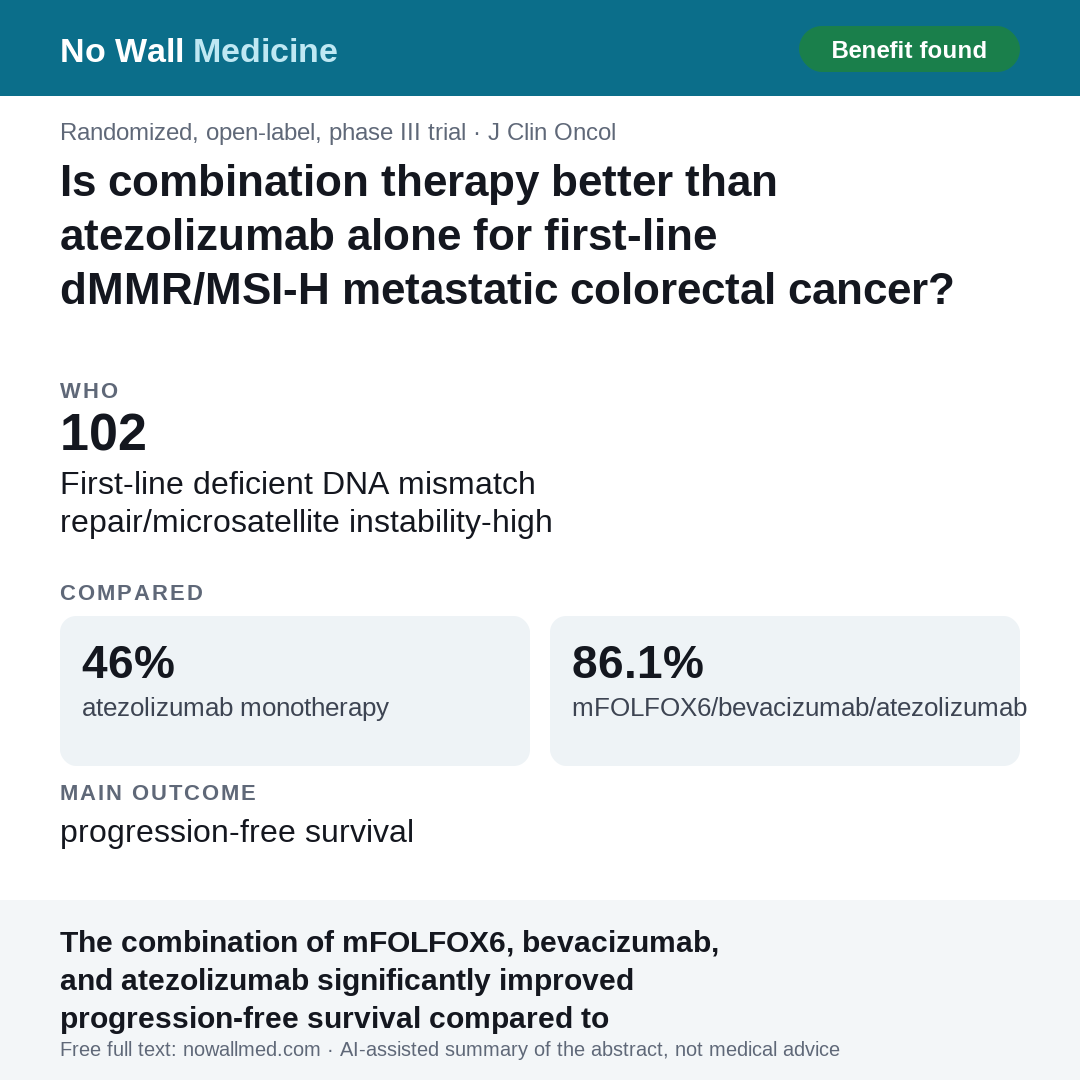
Clinical question: Is combination therapy better than atezolizumab alone for first-line dMMR/MSI-H metastatic colorectal cancer?
Why it matters: Nearly half of patients treated with single-agent PD-1 therapy for this type of colorectal cancer progress within 12 months.
Key points
- The study compared 102 patients with deficient DNA mismatch repair metastatic colorectal cancer receiving either atezolizumab alone or a combination of chemotherapy, bevacizumab, and atezolizumab.
- The combination therapy group showed superior progression-free survival compared to atezolizumab alone with a hazard ratio of 0.439 and an objective response rate of 86.1% versus 46%.
- Grade 3 or higher adverse events occurred in 34 patients in the combination arm and 18 patients in the atezolizumab-only arm.
Headline and key points written with AI from the paper’s abstract, with every number checked against it. Read the paper before relying on them.
Topics
Spotted a mistake? Suggest a correction