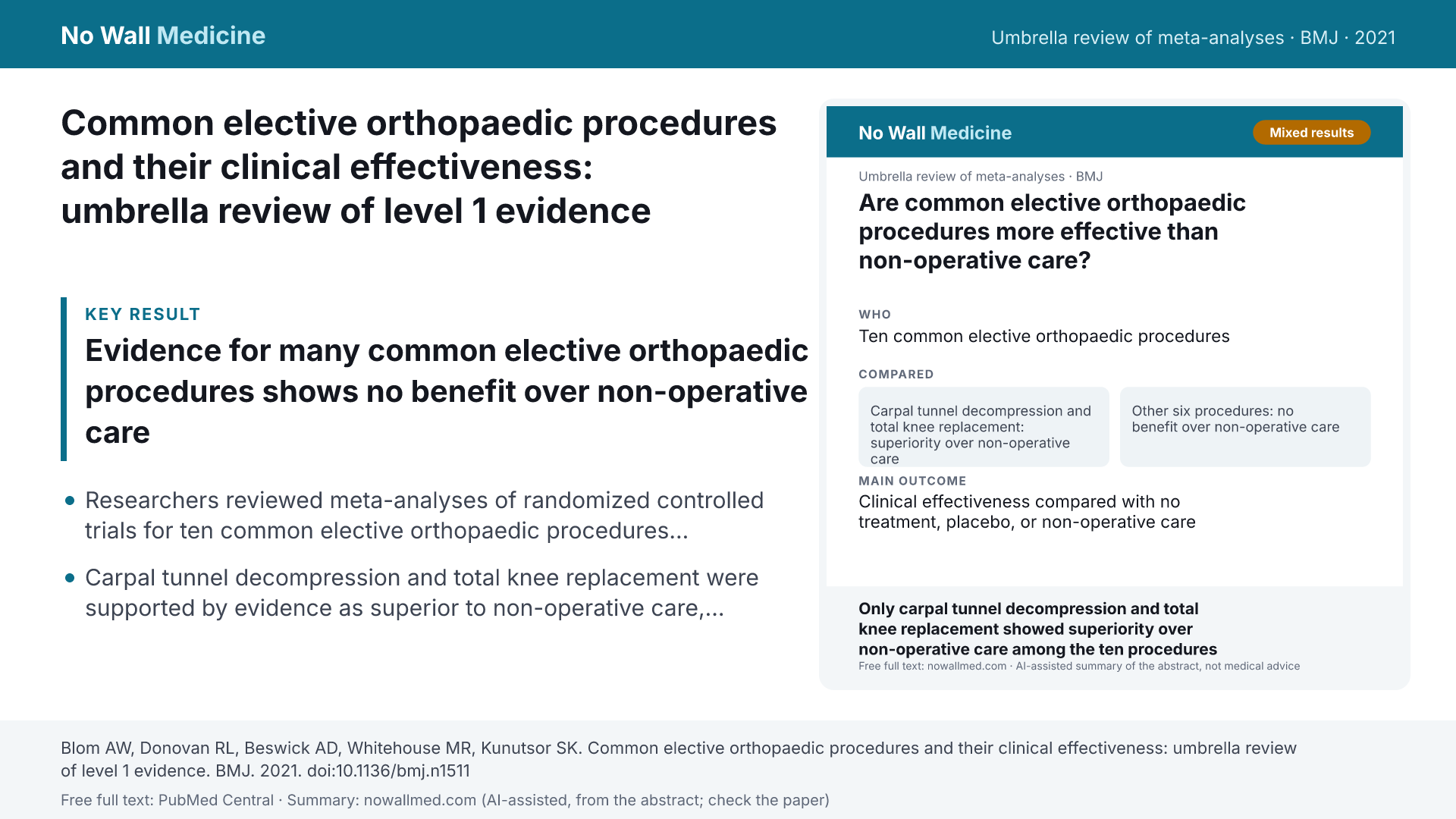
Evidence for many common elective orthopaedic procedures shows no benefit over non-operative care
Common elective orthopaedic procedures and their clinical effectiveness: umbrella review of level 1 evidence
Umbrella review of meta-analysesMixed results
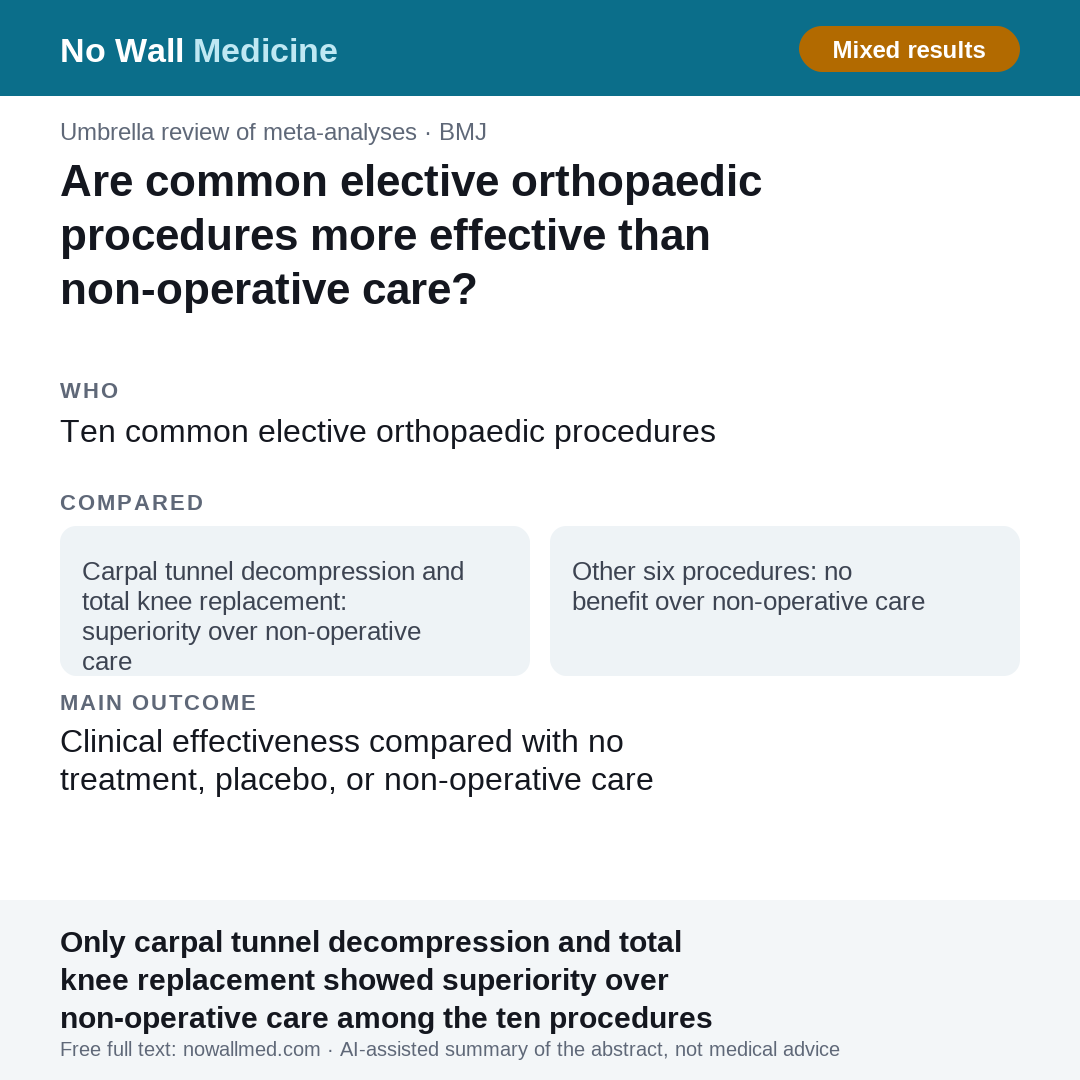
Are common elective orthopaedic procedures more effective than non-operative care?
Who
Ten common elective orthopaedic procedures
Compared
Carpal tunnel decompression and total knee replacement: superiority over non-operative care
Other six procedures: no benefit over non-operative care
Main outcome
Clinical effectiveness compared with no treatment, placebo, or non-operative care
Bottom line: Only carpal tunnel decompression and total knee replacement showed superiority over non-operative care among the ten procedures studied.
BMJ · 2021-07-07Download image
Clinical question: Are common elective orthopaedic procedures more effective than non-operative care?
Why it matters: It was unknown if the evidence supporting common elective orthopaedic procedures matches the recommendations found in national clinical guidelines.
Key points
- Researchers reviewed meta-analyses of randomized controlled trials for ten common elective orthopaedic procedures compared to no treatment, placebo, or non-operative care.
- Carpal tunnel decompression and total knee replacement were supported by evidence as superior to non-operative care, while six other procedures showed no benefit.
- No randomized controlled trials specifically compared total hip replacement or meniscal repair with non-operative care.
Headline and key points written with AI from the paper’s abstract, with every number checked against it. Read the paper before relying on them.
Was this summary helpful?
Abstract
Objective
To determine the clinical effectiveness of common elective orthopaedic procedures compared with no treatment, placebo, or non-operative care and assess the impact on clinical guidelines. Design
Umbrella review of meta-analyses of randomised controlled trials or other study designs in the absence of meta-analyses of randomised controlled trials. Data sources
Ten of the most common elective orthopaedic procedures-arthroscopic anterior cruciate ligament reconstruction, arthroscopic meniscal repair of the knee, arthroscopic partial meniscectomy of the knee, arthroscopic rotator cuff repair, arthroscopic subacromial decompression, carpal tunnel decompression, lumbar spine decompression, lumbar spine fusion, total hip replacement, and total knee replacement-were studied. Medline, Embase, Cochrane Library, and bibliographies were searched until September 2020. Eligibility criteria for selecting studies
Meta-analyses of randomised controlled trials (or in the absence of meta-analysis other study designs) that compared the clinical effectiveness of any of the 10 orthopaedic procedures with no treatment, placebo, or non-operative care. Data extraction and synthesis
Summary data were extracted by two independent investigators, and a consensus was reached with the involvement of a third. The methodological quality of each meta-analysis was assessed using the Assessment of Multiple Systematic Reviews instrument. The Jadad decision algorithm was used to ascertain which meta-analysis represented the best evidence. The National Institute for Health and Care Excellence Evidence search was used to check whether recommendations for each procedure reflected the body of evidence. Main outcome measures
Quality and quantity of evidence behind common elective orthopaedic interventions and comparisons with the strength of recommendations in relevant national clinical guidelines. Results
Randomised controlled trial evidence supports the superiority of carpal tunnel decompression and total knee replacement over non-operative care. No randomised controlled trials specifically compared total hip replacement or meniscal repair with non-operative care. Trial evidence for the other six procedures showed no benefit over non-operative care. Conclusions
Although they may be effective overall or in certain subgroups, no strong, high quality evidence base shows that many commonly performed elective orthopaedic procedures are more effective than non-operative alternatives. Despite the lack of strong evidence, some of these procedures are still recommended by national guidelines in certain situations. Systematic review registration
PROSPERO CRD42018115917.
Abstract reproduced under the article’s CC BY licence.
Subject terms
Cite this article
Blom AW, Donovan RL, Beswick AD, Whitehouse MR, Kunutsor SK. Common elective orthopaedic procedures and their clinical effectiveness: umbrella review of level 1 evidence. BMJ. 2021. doi:10.1136/bmj.n1511
Spotted a mistake? Suggest a correction
Top studies every Monday
The week’s key trials and guidelines in your specialties, plus any topics you follow. By email, free.
Get the weekly digest