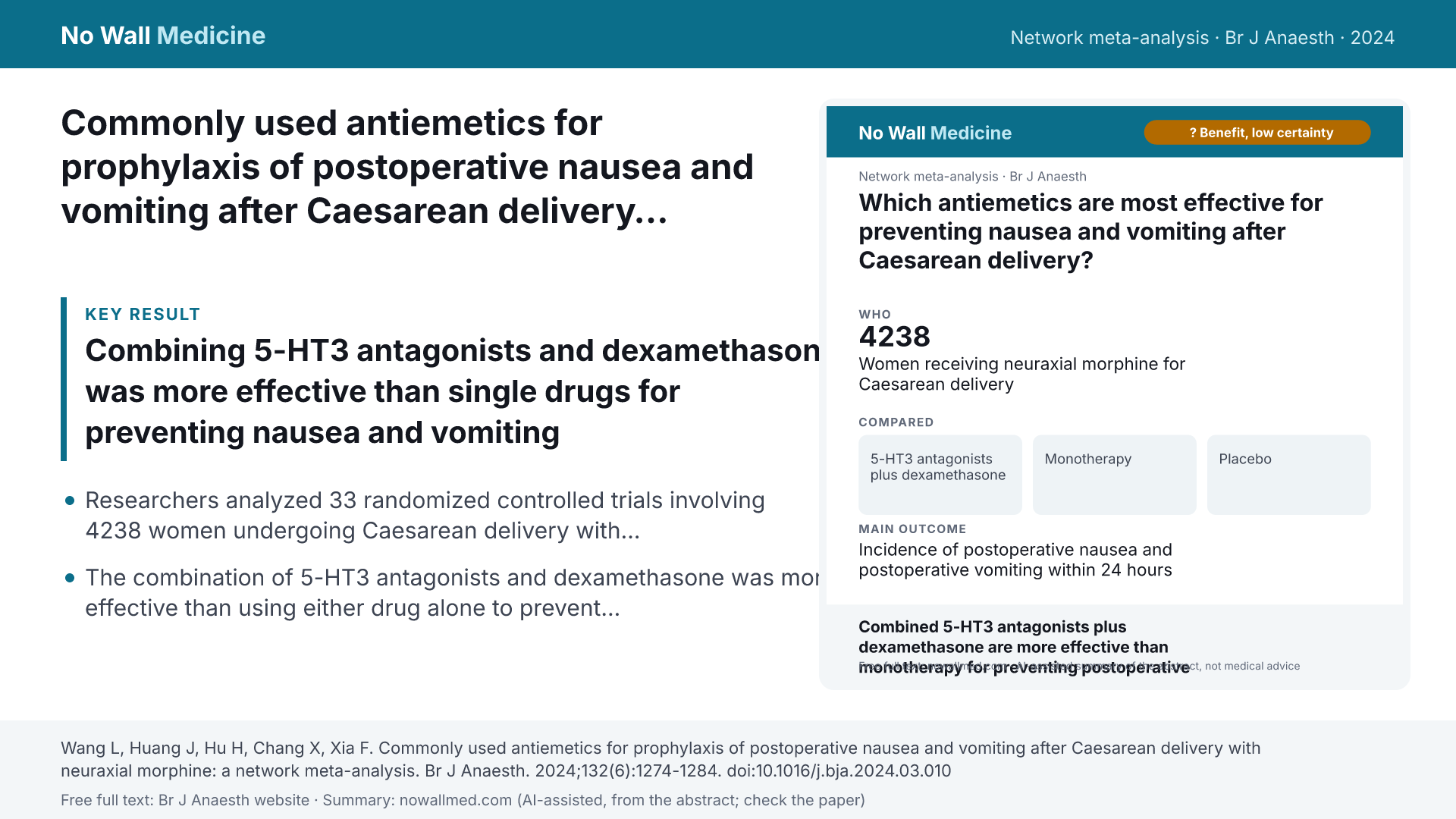
Combining 5-HT3 antagonists and dexamethasone was more effective than single drugs for preventing nausea and vomiting
Commonly used antiemetics for prophylaxis of postoperative nausea and vomiting after Caesarean delivery with neuraxial morphine: a network meta-analysis
Network meta-analysisBenefit found
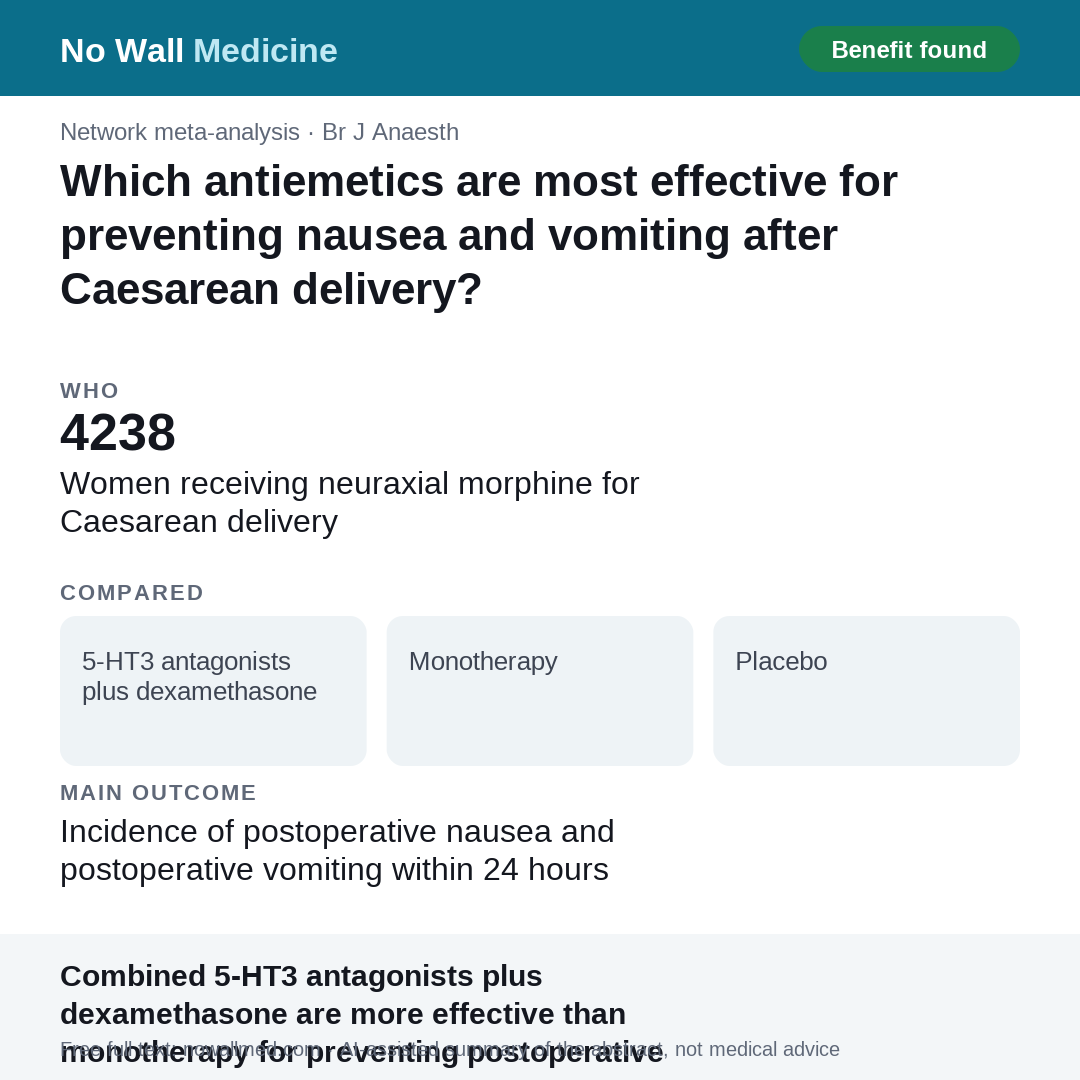
Which antiemetics are most effective for preventing nausea and vomiting after Caesarean delivery?
Who
4238
Women receiving neuraxial morphine for Caesarean delivery
Compared
5-HT3 antagonists plus dexamethasone
Monotherapy
Placebo
Main outcome
Incidence of postoperative nausea and postoperative vomiting within 24 hours
Bottom line: Combined 5-HT3 antagonists plus dexamethasone are more effective than monotherapy for preventing postoperative nausea and vomiting.
Limitation: Most included studies had some concerns or high risk of bias and low certainty of evidence.
Br J Anaesth · 2024-04-15Download image
Clinical question: Which antiemetics are most effective for preventing nausea and vomiting after Caesarean delivery?
Why it matters: The superiority of specific drug classes for preventing nausea and vomiting after Caesarean delivery with neuraxial morphine has not been established.
Key points
- Researchers analyzed 33 randomized controlled trials involving 4238 women undergoing Caesarean delivery with neuraxial morphine, which is pain relief injected near the spinal cord.
- The combination of 5-HT3 antagonists and dexamethasone was more effective than using either drug alone to prevent postoperative nausea and vomiting.
- The effectiveness of these drugs was seen in women receiving epidural or intrathecal morphine alone, but not in those receiving intrathecal morphine with fentanyl or sufentanil.
Limitation the authors note: Most included studies had some concerns or a high risk of bias, and the overall certainty of the evidence was low or very low.
Headline and key points written with AI from the paper’s abstract, with every number checked against it. Read the paper before relying on them.
Was this summary helpful?
Subject terms
Cite this article
Wang L, Huang J, Hu H, Chang X, Xia F. Commonly used antiemetics for prophylaxis of postoperative nausea and vomiting after Caesarean delivery with neuraxial morphine: a network meta-analysis. Br J Anaesth. 2024. doi:10.1016/j.bja.2024.03.010
Spotted a mistake? Suggest a correction