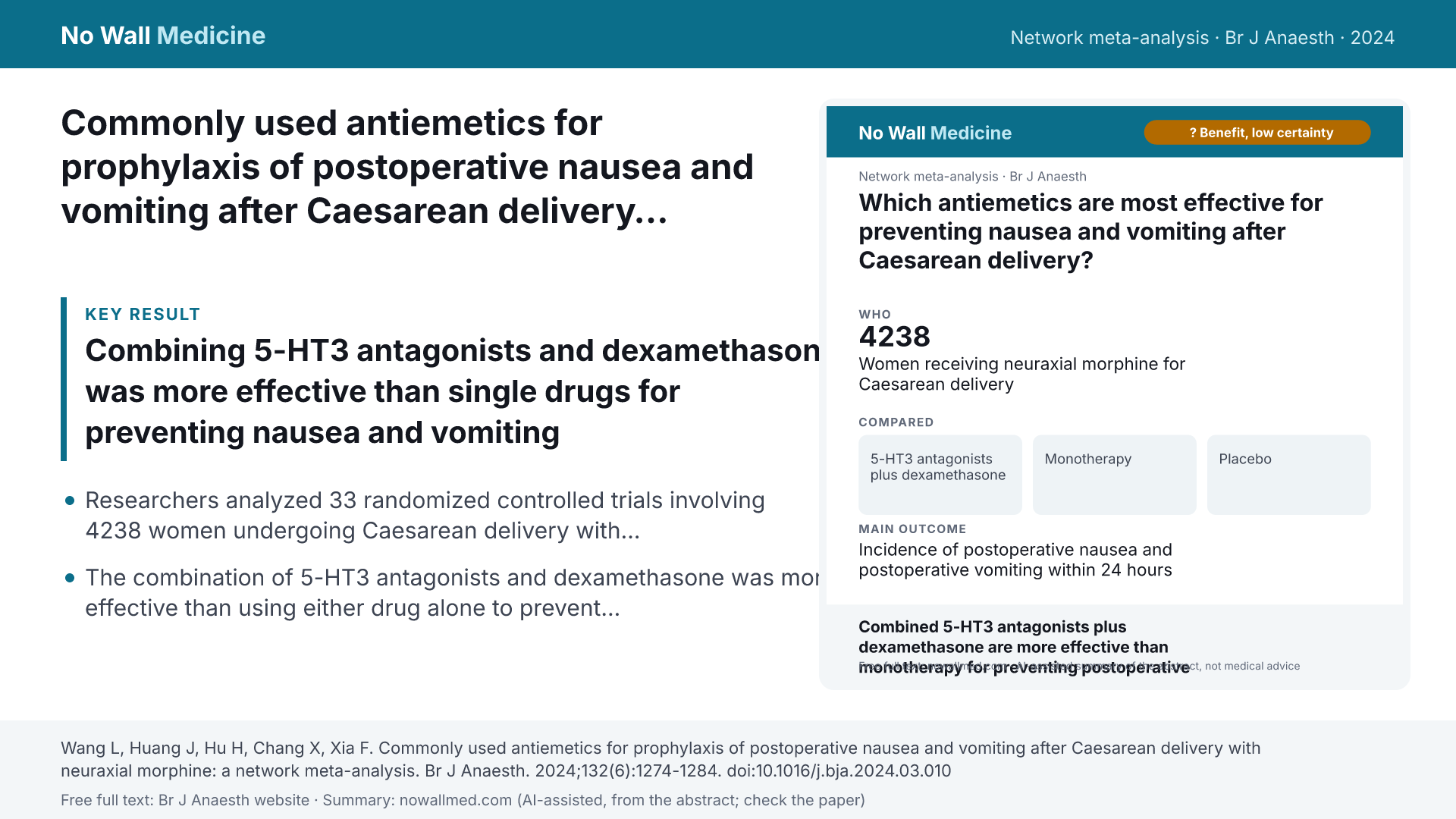
Commonly used antiemetics for prophylaxis of postoperative nausea and vomiting after Caesarean delivery with neuraxial morphine: a network meta-analysis
Key result: Combining 5-HT3 antagonists and dexamethasone was more effective than single drugs for preventing nausea and vomiting
Key points
- Researchers analyzed 33 randomized controlled trials involving 4238 women undergoing Caesarean delivery with neuraxial morphine, which is pain relief injected near the spinal cord.
- The combination of 5-HT3 antagonists and dexamethasone was more effective than using either drug alone to prevent postoperative nausea and vomiting.
- The effectiveness of these drugs was seen in women receiving epidural or intrathecal morphine alone, but not in those receiving intrathecal morphine with fentanyl or sufentanil.
Why it matters: The superiority of specific drug classes for preventing nausea and vomiting after Caesarean delivery with neuraxial morphine has not been established.
Limitation the authors note: Most included studies had some concerns or a high risk of bias, and the overall certainty of the evidence was low or very low.
Discussion prompts
- Would these patients look like yours? Who was left out?
- Is the main outcome one that matters to patients?
- Is the difference large enough to change what you do?
Cite: Wang L, Huang J, Hu H, Chang X, Xia F. Commonly used antiemetics for prophylaxis of postoperative nausea and vomiting after Caesarean delivery with neuraxial morphine: a network meta-analysis. Br J Anaesth. 2024;132(6):1274-1284. doi:10.1016/j.bja.2024.03.010
Free full text: Br J Anaesth website · Summary and visual abstract: nowallmed.com/a/commonly-used-antiemetics-for-prophylaxis-of-postoperative-nausea-and-15c9req/ (AI-assisted from the abstract; check the paper before relying on it).