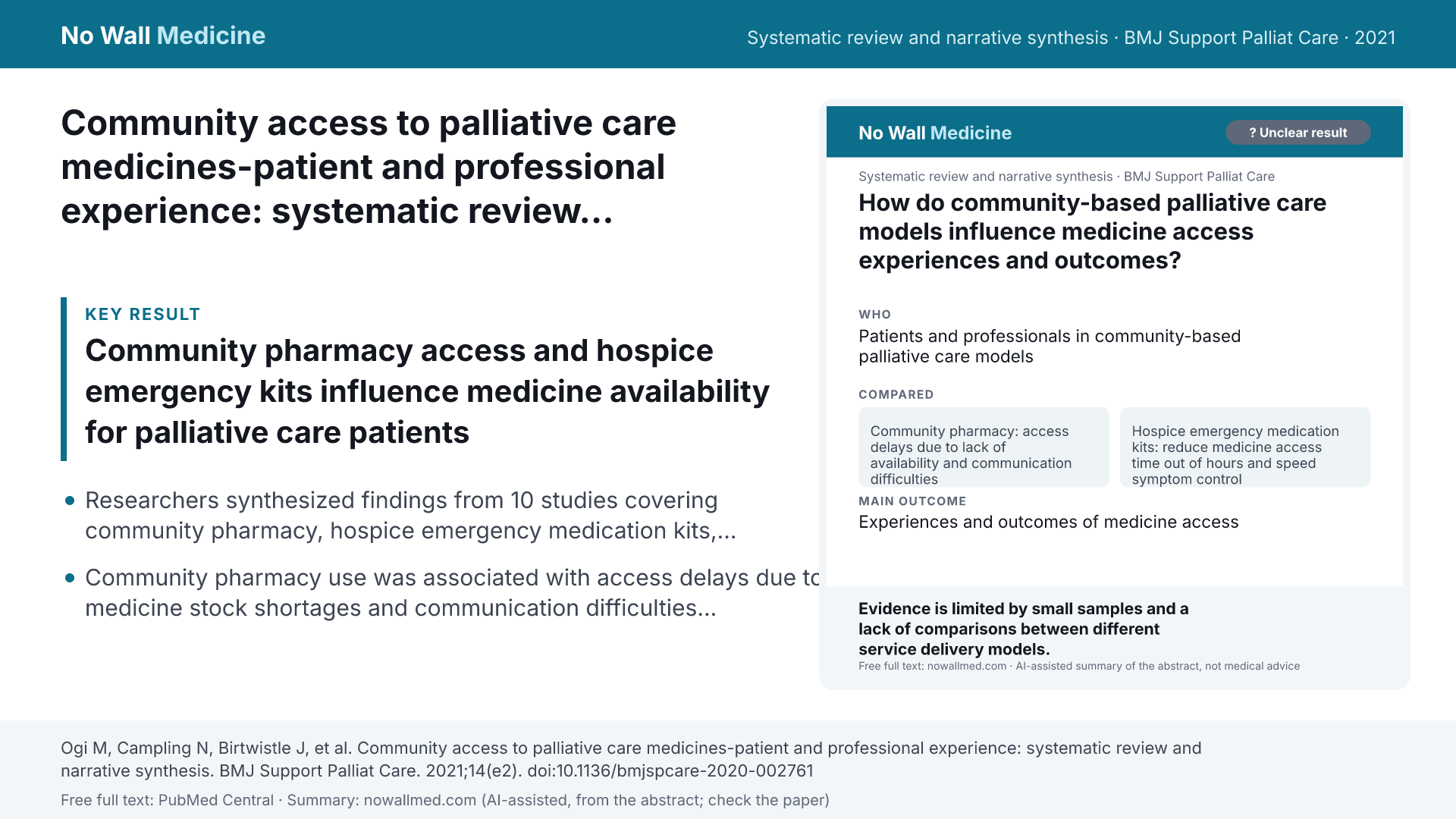
Community pharmacy access and hospice emergency kits influence medicine availability for palliative care patients
Community access to palliative care medicines-patient and professional experience: systematic review and narrative synthesis
Systematic review and narrative synthesisUnclear result
How do community-based palliative care models influence medicine access experiences and outcomes?
Who
Patients and professionals in community-based palliative care models
Compared
Community pharmacy: access delays due to lack of availability and communication difficulties
Hospice emergency medication kits: reduce medicine access time out of hours and speed symptom control
Main outcome
Experiences and outcomes of medicine access
Bottom line: Evidence is limited by small samples and a lack of comparisons between different service delivery models.
Limitation: Small, local samples, largely limited to self-reports of health professionals and a lack of outcome data.
BMJ Support Palliat Care · 2021-03-28 · Save PNG
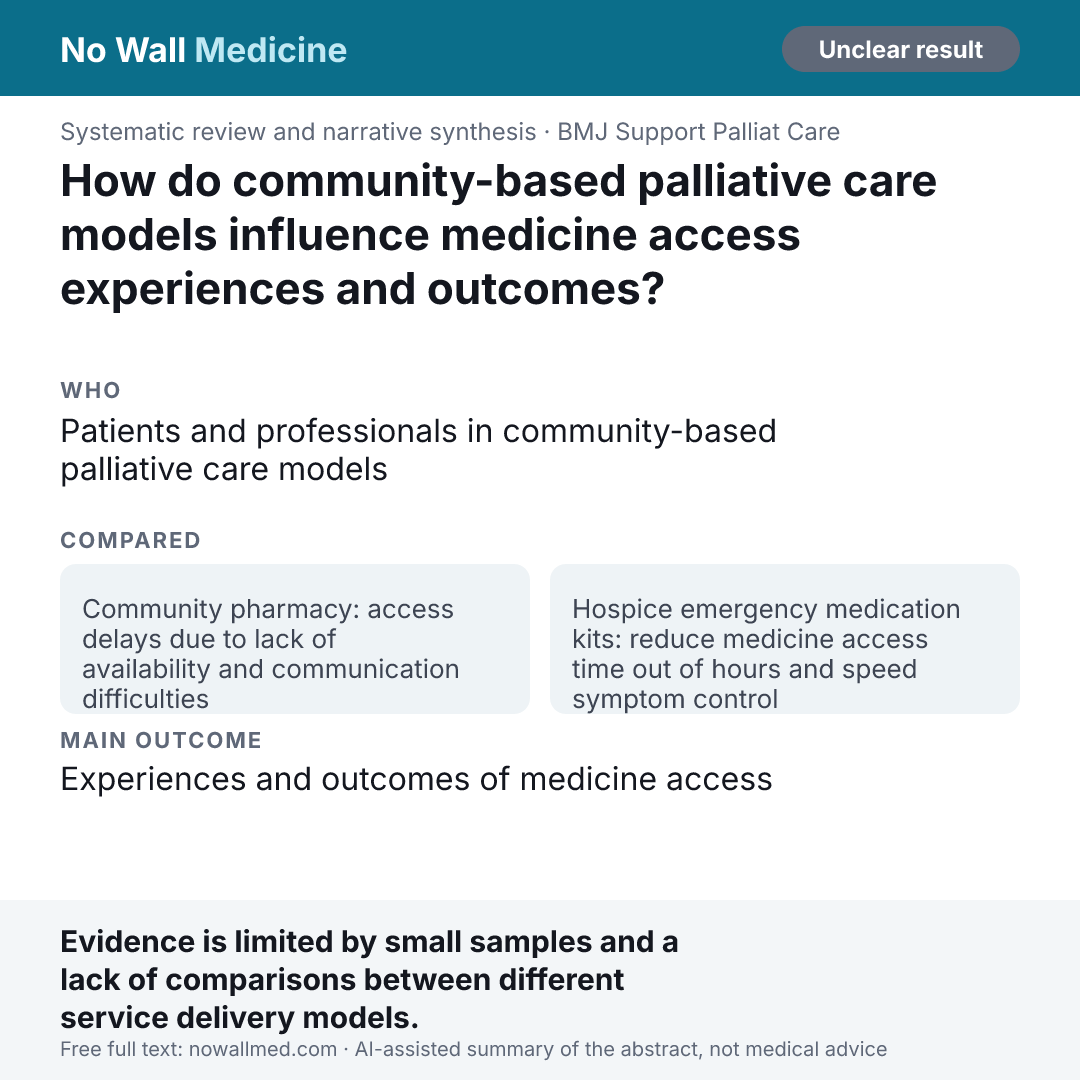
Clinical question: How do community-based palliative care models influence medicine access experiences and outcomes?
Key points
- Researchers synthesized findings from 10 studies covering community pharmacy, hospice emergency medication kits, nurse prescribers, and general practice.
- Community pharmacy use was associated with access delays due to medicine stock shortages and communication difficulties between professionals.
- Hospice emergency medication kits, which are pre-prepared sets of medicines kept in the home, were associated with faster symptom control and reduced access time out of hours.
Limitation the authors note: The majority of studies used small, local samples and were largely limited to self-reports from health professionals.
Headline and key points written with AI from the paper’s abstract, with every number checked against it. Read the paper before relying on them.
Was this summary helpful?
Abstract
Background
Providing palliative care patients living at home with timely access to medicines is critical to enable effective symptom management, minimise burden and reduce unplanned use of healthcare services. Little is known about how diverse community-based palliative care models influence medicine access. Objective
To produce a critical overview of research on experiences and outcomes of medicine access in community-based palliative care models of service delivery through a systematic review and narrative synthesis. Methods
MEDLINE, CINAHL, EMBASE, PsycINFO, Cochrane Library databases and grey literature were systematically searched for all types of studies. Study quality was assessed using the Mixed Methods Appraisal Tool; a narrative synthesis was used to integrate and summarise findings. Results
3331 articles were screened; 10 studies were included in the final sample. Studies included a focus on community pharmacy (n=4), hospice emergency medication kits (HEMKs) in the home (n=3), specialist community nurse prescribers (n=1), general practice (n=1) and one study included multiple service delivery components. Community pharmacy was characterised by access delays due to lack of availability of medicine stock and communication difficulties between the pharmacy and other healthcare professionals. HEMKs were perceived to reduce medicine access time out of hours and speed symptom control. However, the majority of studies comprised small, local samples, largely limited to self-reports of health professionals. There was a lack of data on outcomes, and no comparisons between service delivery models. Conclusions
Further research is required to understand which models facilitate rapid and efficient access to medicines for community-based palliative care patients.
Abstract reproduced under the article’s CC BY licence.
Headline, design, result, key points, caveat and citation as plain text.
Cite this article
Ogi M, Campling N, Birtwistle J, et al. Community access to palliative care medicines-patient and professional experience: systematic review and narrative synthesis. BMJ Support Palliat Care. 2021. doi:10.1136/bmjspcare-2020-002761
Spotted a mistake? Suggest a correction