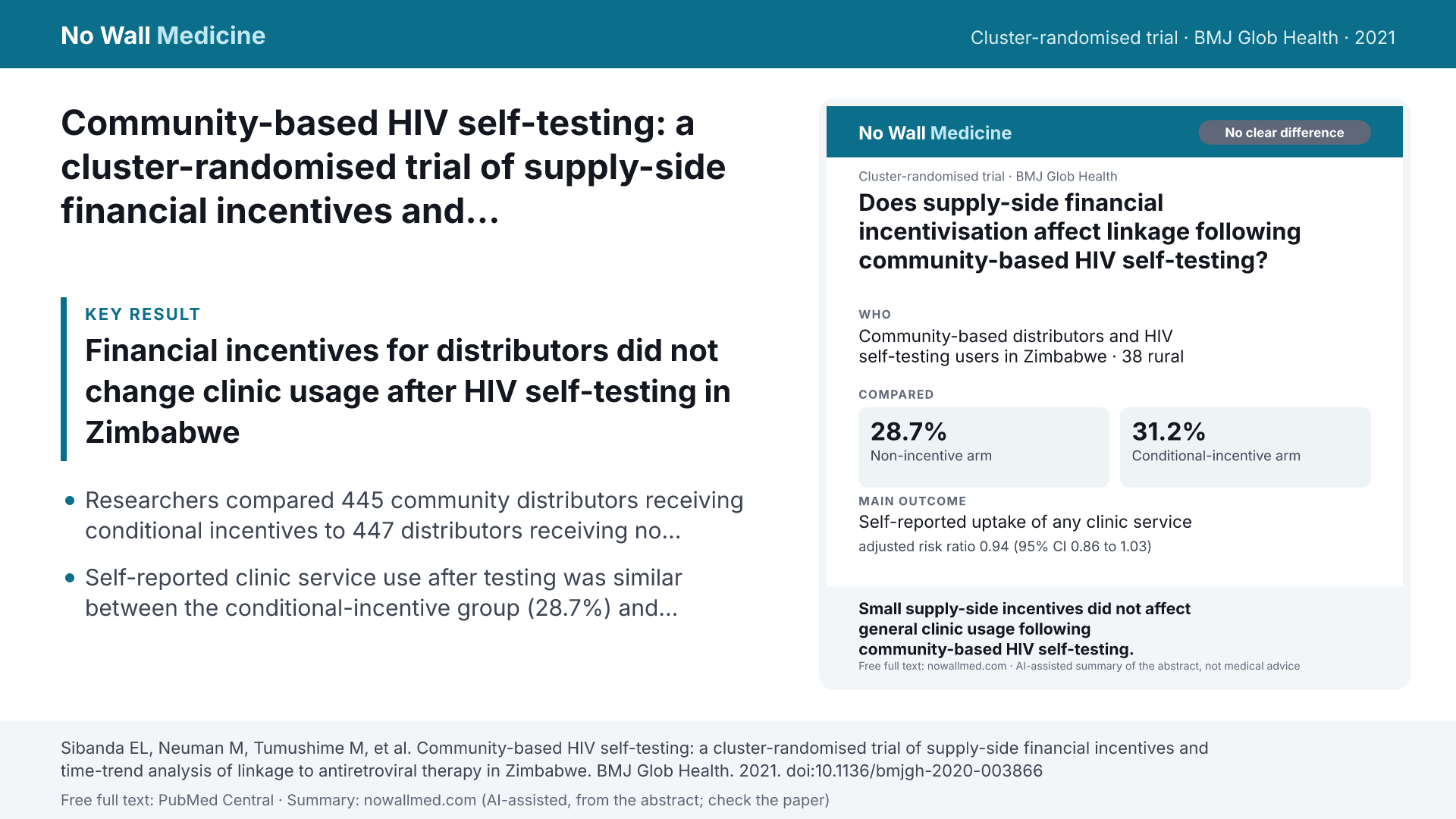
Financial incentives for distributors did not change clinic usage after HIV self-testing in Zimbabwe
Community-based HIV self-testing: a cluster-randomised trial of supply-side financial incentives and time-trend analysis of linkage to antiretroviral therapy in Zimbabwe
Cluster-randomised trialNo clear difference
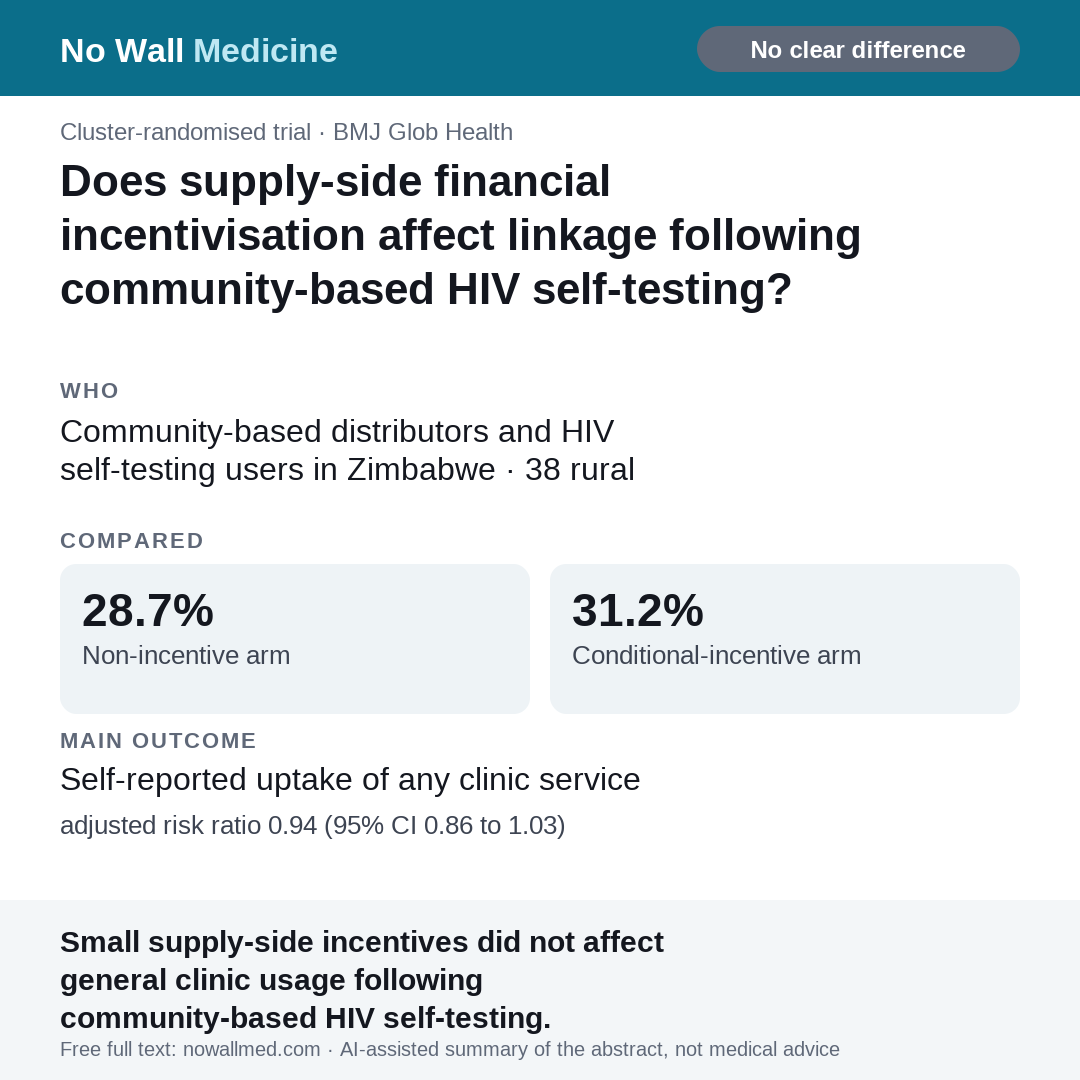
Does supply-side financial incentivisation affect linkage following community-based HIV self-testing?
Who
Community-based distributors and HIV self-testing users in Zimbabwe · 38 rural Zimbabwean communities
Compared
28.7%Non-incentive arm (1062/3698)
31.2%Conditional-incentive arm (1075/3448)
Main outcome
Self-reported uptake of any clinic service
Result: adjusted risk ratio 0.94 (95% CI 0.86 to 1.03)
Bottom line: Small supply-side incentives did not affect general clinic usage following community-based HIV self-testing.
Limitation: The study used a non-randomised difference-in-differences analysis for antiretroviral therapy initiations.
BMJ Glob Health · 2021-07-19Download image
Clinical question: Does supply-side financial incentivisation affect linkage following community-based HIV self-testing?
Why it matters: It is unknown if providing small financial incentives to distributors can increase the number of people who link to medical services after using HIV self-test kits.
Key points
- Researchers compared 445 community distributors receiving conditional incentives to 447 distributors receiving no extra incentives across 38 rural Zimbabwean communities.
- Self-reported clinic service use after testing was similar between the conditional-incentive group (28.7%) and the non-incentive group (31.2%).
- Confirmatory testing for newly diagnosed individuals was higher in the conditional-incentive arm (75.8%) compared to the non-incentive arm (50.0%).
Headline and key points written with AI from the paper’s abstract, with every number checked against it. Read the paper before relying on them.
Was this summary helpful?
Subject terms
Cite this article
Sibanda EL, Neuman M, Tumushime M, Mangenah C, Hatzold K, Watadzaushe C. Community-based HIV self-testing: a cluster-randomised trial of supply-side financial incentives and time-trend analysis of linkage to antiretroviral therapy in Zimbabwe. BMJ Glob Health. 2021. doi:10.1136/bmjgh-2020-003866
Spotted a mistake? Suggest a correction
Top studies every Monday
The week’s key trials and guidelines in your specialties, plus any topics you follow. By email, free.
Get the weekly digest