Community-based HIV self-testing: a cluster-randomised trial of supply-side financial incentives and time-trend analysis of linkage to antiretroviral therapy in Zimbabwe
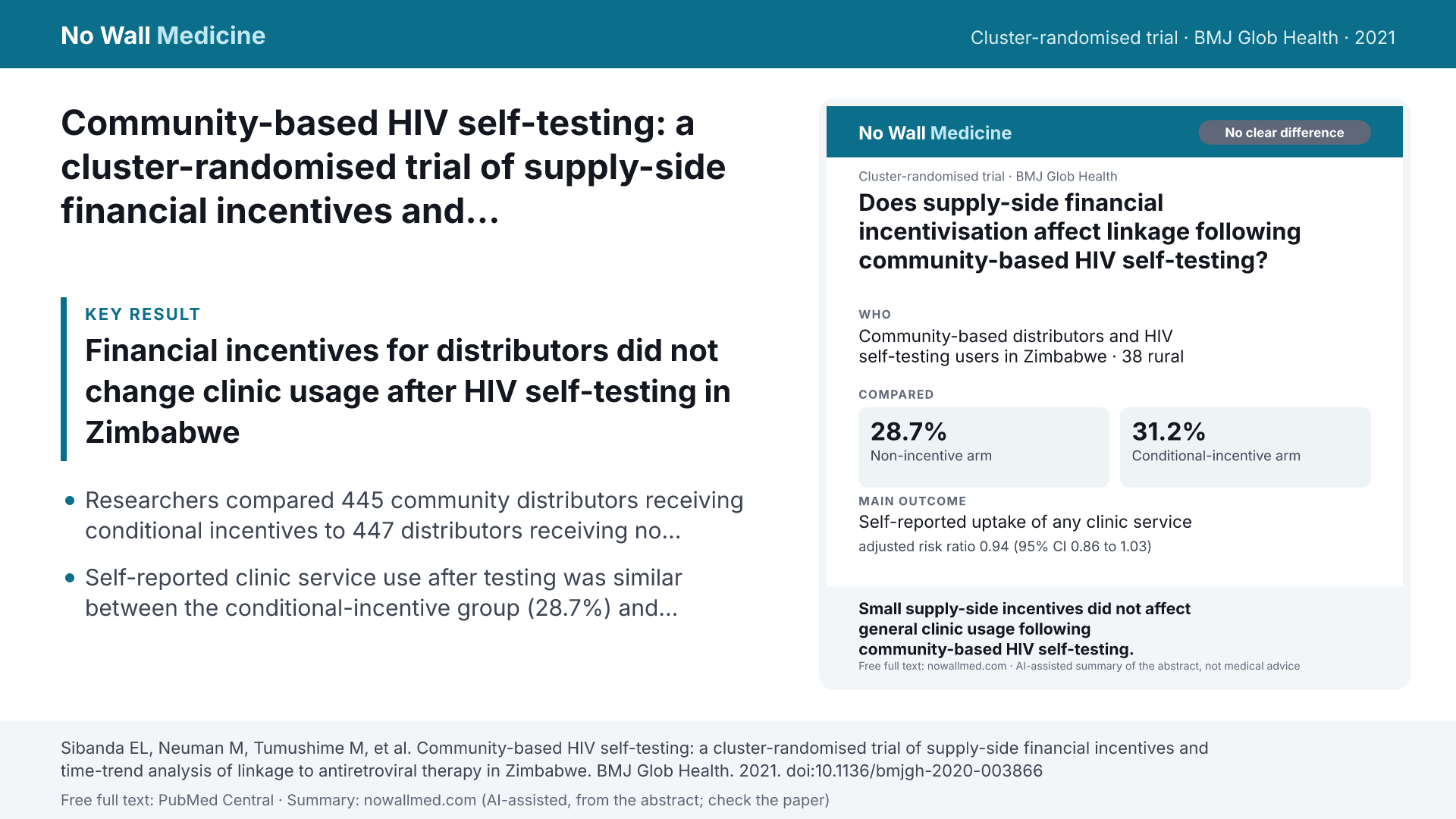
Key result: Financial incentives for distributors did not change clinic usage after HIV self-testing in Zimbabwe
Key points
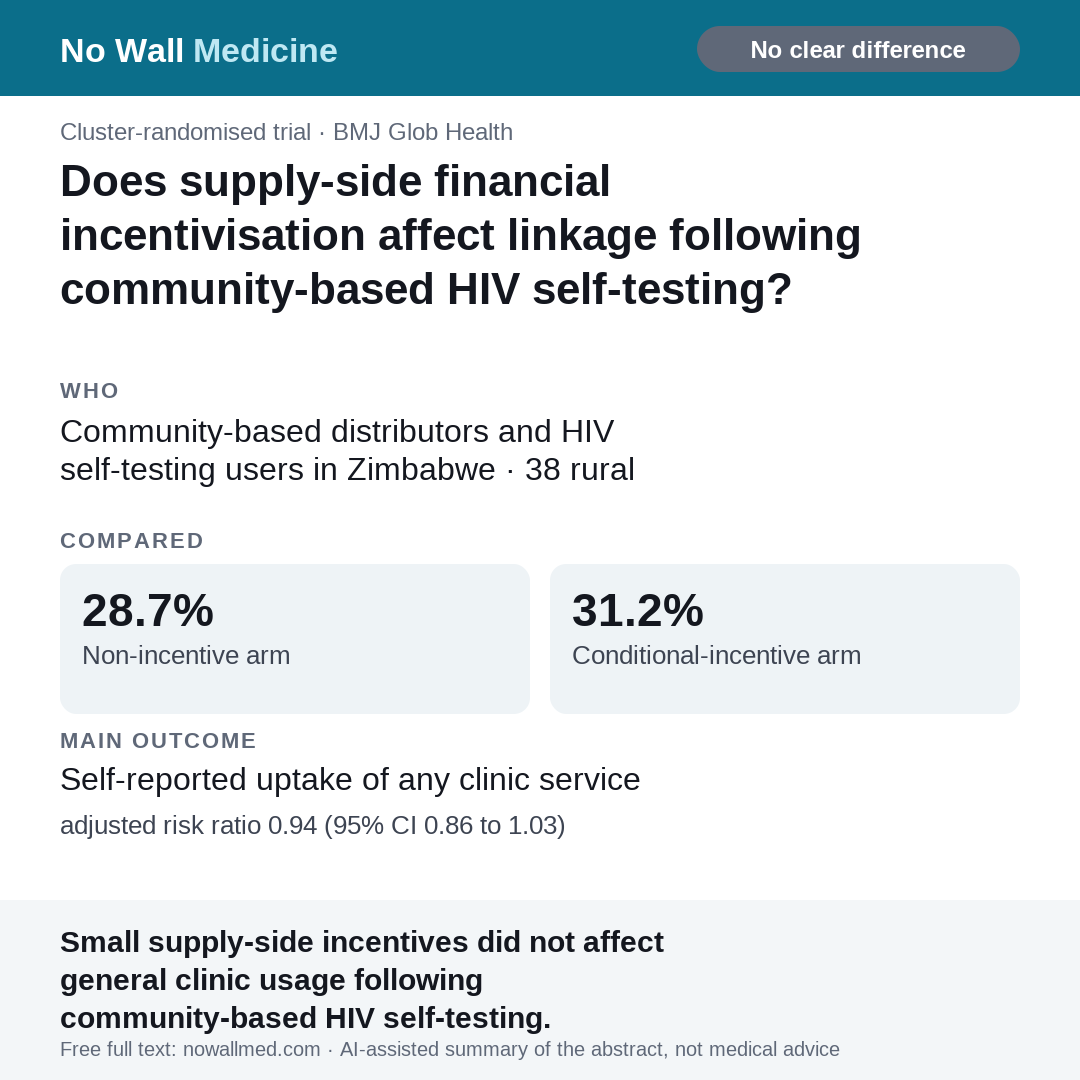
- Researchers compared 445 community distributors receiving conditional incentives to 447 distributors receiving no extra incentives across 38 rural Zimbabwean communities.
- Self-reported clinic service use after testing was similar between the conditional-incentive group (28.7%) and the non-incentive group (31.2%).
- Confirmatory testing for newly diagnosed individuals was higher in the conditional-incentive arm (75.8%) compared to the non-incentive arm (50.0%).
Why it matters: It is unknown if providing small financial incentives to distributors can increase the number of people who link to medical services after using HIV self-test kits.
Discussion prompts
- Would these patients look like yours? Who was left out?
- Is the main outcome one that matters to patients?
- Is the difference large enough to change what you do?
Cite: Sibanda EL, Neuman M, Tumushime M, Mangenah C, Hatzold K, Watadzaushe C. Community-based HIV self-testing: a cluster-randomised trial of supply-side financial incentives and time-trend analysis of linkage to antiretroviral therapy in Zimbabwe. BMJ Glob Health. 2021. doi:10.1136/bmjgh-2020-003866
Free full text: PubMed Central · Summary and visual abstract: nowallmed.com/a/community-based-hiv-self-testing-a-cluster-randomised-trial-of-supply-13yqgbx/ (AI-assisted from the abstract; check the paper before relying on it).