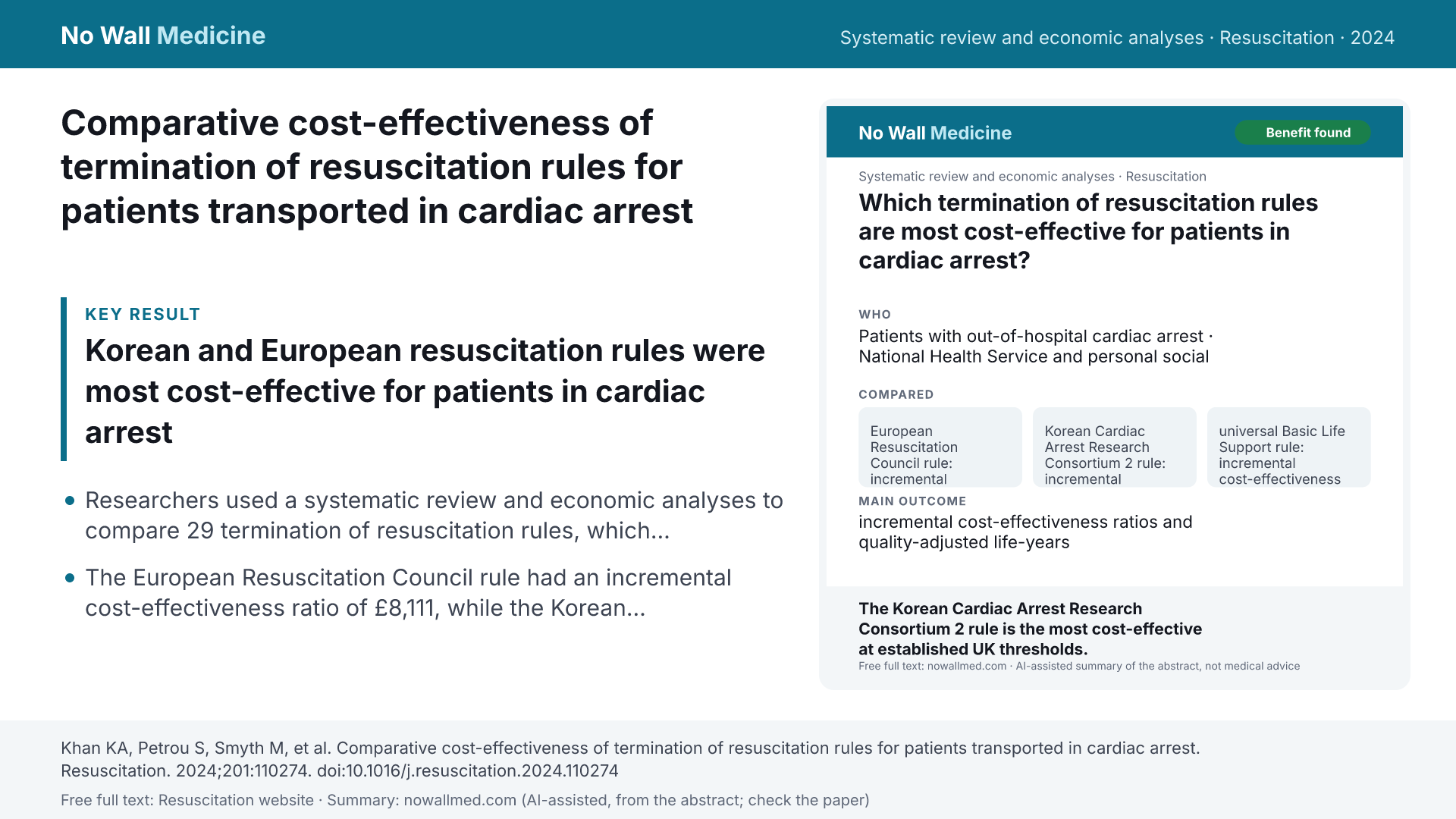
Korean and European resuscitation rules were most cost-effective for patients in cardiac arrest
Comparative cost-effectiveness of termination of resuscitation rules for patients transported in cardiac arrest
Systematic review and economic analysesBenefit found
Which termination of resuscitation rules are most cost-effective for patients in cardiac arrest?
Who
Patients with out-of-hospital cardiac arrest · National Health Service and personal social services perspective
Compared
European Resuscitation Council rule: incremental cost-effectiveness ratio of £8,111
Korean Cardiac Arrest Research Consortium 2 rule: incremental cost-effectiveness ratio of £17,548
universal Basic Life Support rule: incremental cost-effectiveness ratio of £19,498,216
Main outcome
incremental cost-effectiveness ratios and quality-adjusted life-years
Bottom line: The Korean Cardiac Arrest Research Consortium 2 rule is the most cost-effective at established UK thresholds.
Resuscitation · 2024-06-13 · Save PNG
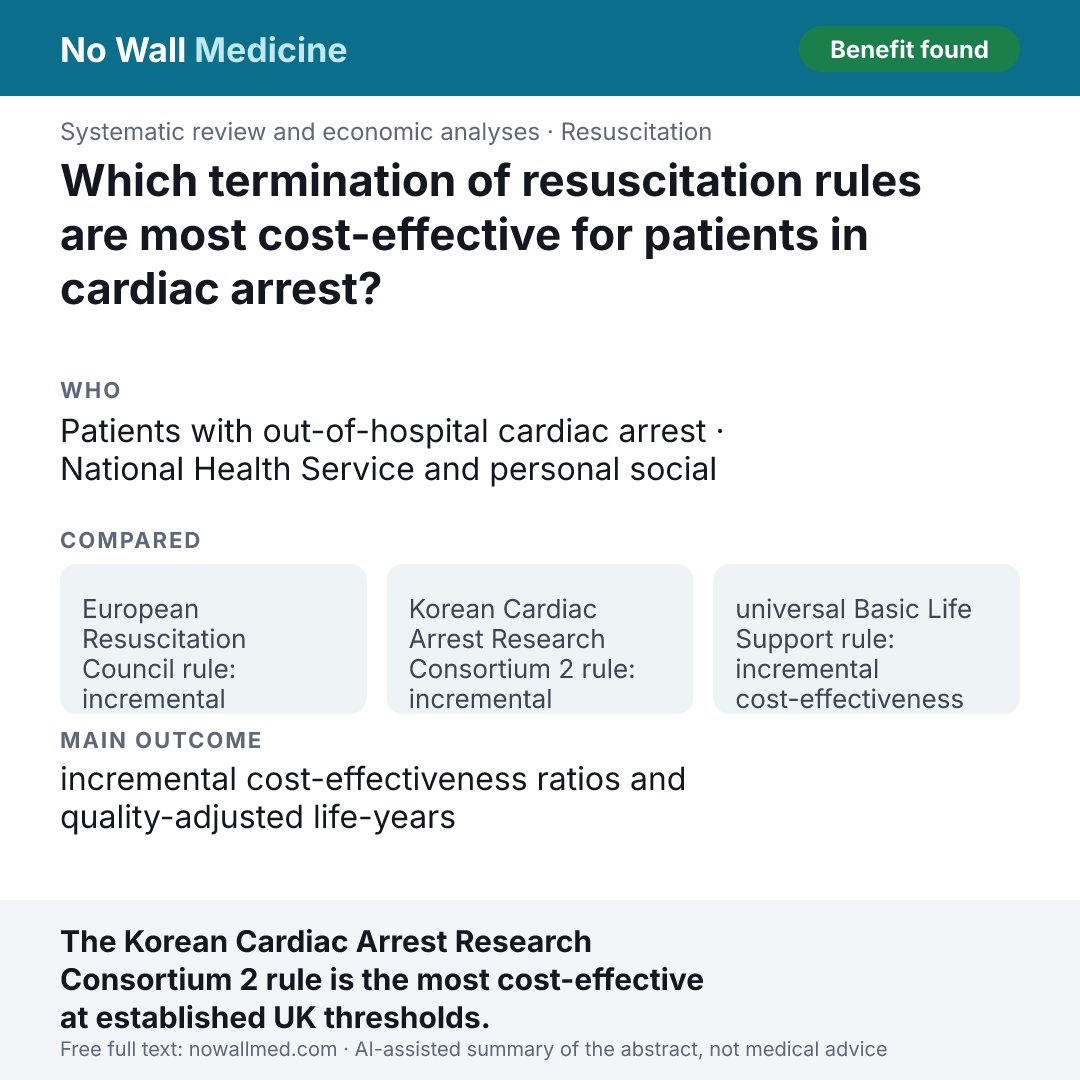
Clinical question: Which termination of resuscitation rules are most cost-effective for patients in cardiac arrest?
Key points
- Researchers used a systematic review and economic analyses to compare 29 termination of resuscitation rules, which are protocols for stopping life-saving efforts, against current practice.
- The European Resuscitation Council rule had an incremental cost-effectiveness ratio of £8,111, while the Korean Cardiac Arrest Research Consortium 2 rule was £17,548.
- The Korean rule was considered cost-effective at the established threshold of £20,000-£30,000 per quality-adjusted life-year, a measure used to value health gains.
Headline and key points written with AI from the paper’s abstract, with every number checked against it. Read the paper before relying on them.
Was this summary helpful?
Subject terms
Headline, design, result, key points, caveat and citation as plain text.
Cite this article
Khan KA, Petrou S, Smyth M, et al. Comparative cost-effectiveness of termination of resuscitation rules for patients transported in cardiac arrest. Resuscitation. 2024;201:110274. doi:10.1016/j.resuscitation.2024.110274
Spotted a mistake? Suggest a correction