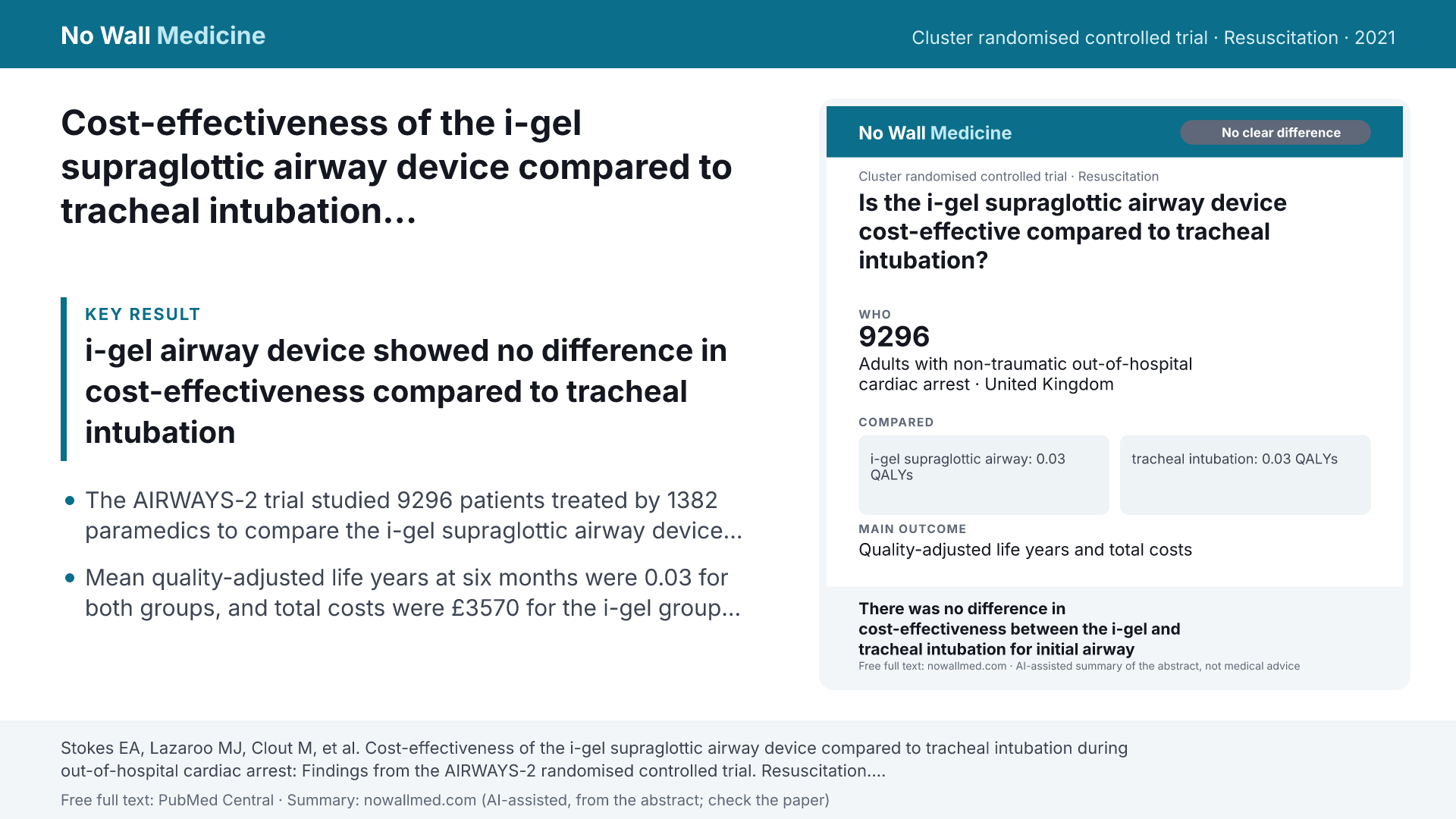
i-gel airway device showed no difference in cost-effectiveness compared to tracheal intubation
Cost-effectiveness of the i-gel supraglottic airway device compared to tracheal intubation during out-of-hospital cardiac arrest: Findings from the AIRWAYS-2 randomised controlled trial
Cluster randomised controlled trialNo clear difference
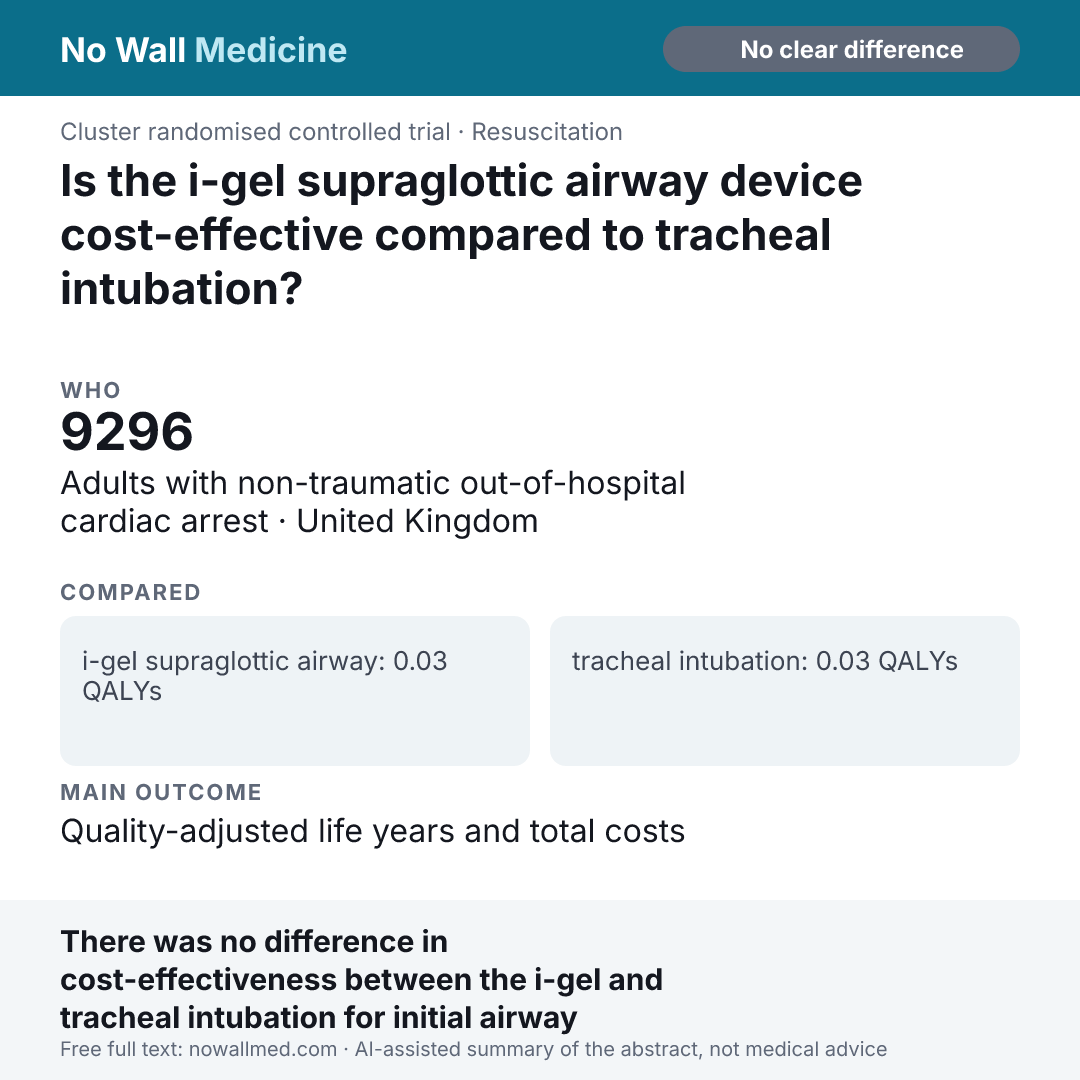
Is the i-gel supraglottic airway device cost-effective compared to tracheal intubation?
Who
9296
Adults with non-traumatic out-of-hospital cardiac arrest · United Kingdom
Compared
i-gel supraglottic airway: 0.03 QALYs
tracheal intubation: 0.03 QALYs
Main outcome
Quality-adjusted life years and total costs
Result: difference -0.0015 (95% CI -0.0059 to 0.0028) for QALYs
Bottom line: There was no difference in cost-effectiveness between the i-gel and tracheal intubation for initial airway management.
Limitation: Differences were small and there was great uncertainty around these results.
Resuscitation · 2021-06-11 · Save PNG
Clinical question: Is the i-gel supraglottic airway device cost-effective compared to tracheal intubation?
Key points
- The AIRWAYS-2 trial studied 9296 patients treated by 1382 paramedics to compare the i-gel supraglottic airway device with tracheal intubation.
- Mean quality-adjusted life years at six months were 0.03 for both groups, and total costs were £3570 for the i-gel group and £3413 for the tracheal intubation group.
- While tracheal intubation was estimated to be more effective and less costly, the differences were small and showed great uncertainty.
Headline and key points written with AI from the paper’s abstract, with every number checked against it. Read the paper before relying on them.
Was this summary helpful?
Subject terms
Headline, design, result, key points, caveat and citation as plain text.
Cite this article
Stokes EA, Lazaroo MJ, Clout M, et al. Cost-effectiveness of the i-gel supraglottic airway device compared to tracheal intubation during out-of-hospital cardiac arrest: Findings from the AIRWAYS-2 randomised controlled trial. Resuscitation. 2021;167:1-9. doi:10.1016/j.resuscitation.2021.06.002
Spotted a mistake? Suggest a correction