Pressure support techniques increase successful breathing trials and extubation rates compared to T-piece methods
Comparative effectiveness of alternative spontaneous breathing trial techniques: a systematic review and network meta-analysis of randomized trials
Critical CareAdult and pediatric
Network meta-analysis of 40 randomized trialsMixed results
Which spontaneous breathing trial technique best balances successful extubation and reintubation risk?
Who
6716
Critically ill adults and children
Compared
Pressure augmentation (PS, ATC, PS/ATC): increased initial successful SBT and successful extubation rates
Without pressure augmentation (T-piece, CPAP)
Main outcome
initial spontaneous breathing trial success, successful extubation, and reintubation
Bottom line: Pressure augmentation increases successful extubation but may increase reintubation rates compared to high flow nasal cannulae.
Crit Care · 2024-06-08Download image
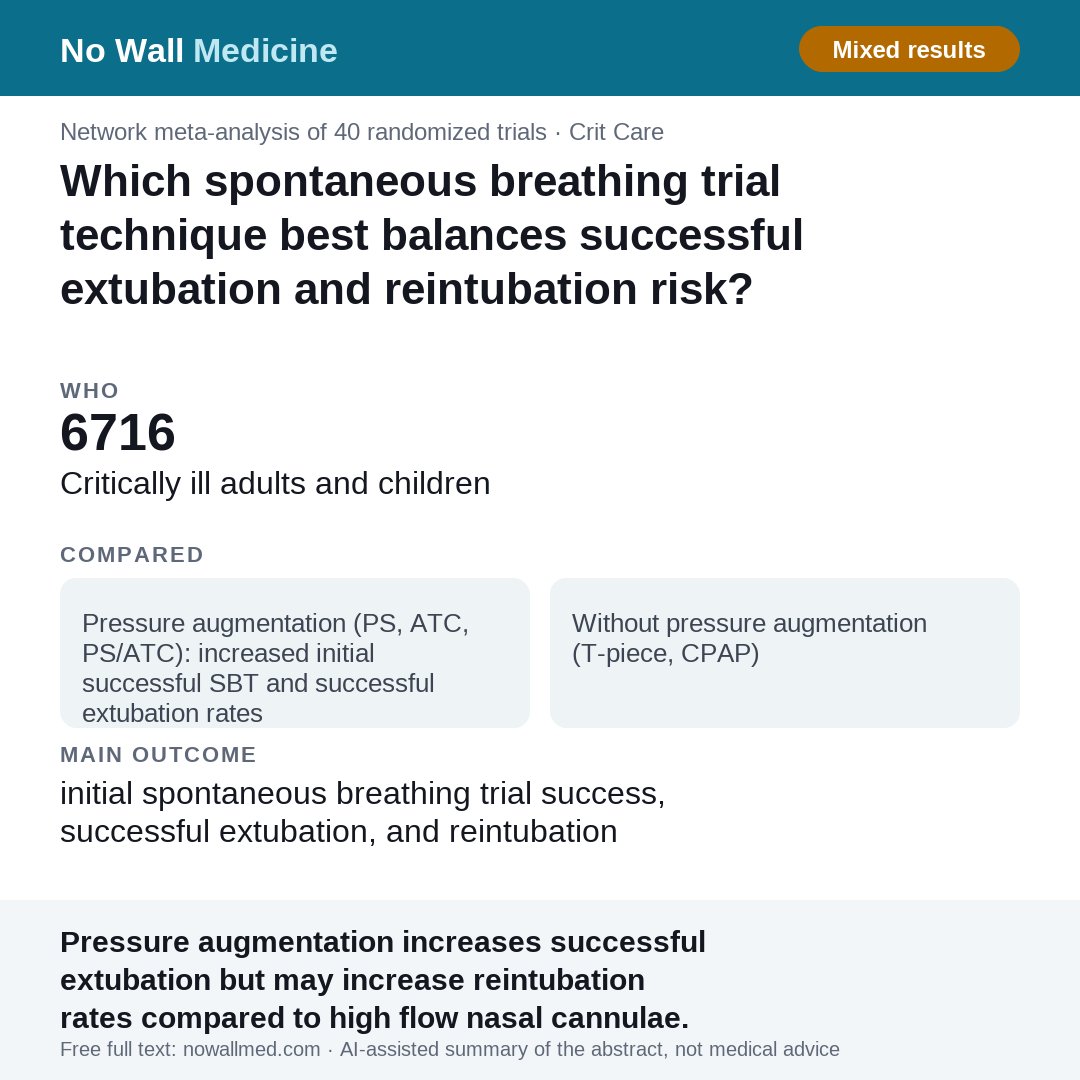
Clinical question: Which spontaneous breathing trial technique best balances successful extubation and reintubation risk?
Why it matters: It is unknown which spontaneous breathing trial technique best balances successful removal of a breathing tube with the risk of needing it again.
Key points
- Researchers analyzed 40 randomized controlled trials involving 6716 critically ill adults and children to compare different spontaneous breathing trial techniques.
- Compared to T-piece methods, pressure support (PS) increased initial successful breathing trial rates (RR 1.08, 95% CI 1.05-1.11) and successful extubation rates (RR 1.06, 95% CI 1.03-1.09).
- While pressure support and automatic tube compensation (ATC) were linked to higher reintubation rates than high flow nasal cannulae (RR 2.84, 95% CI 1.61-5.03 and RR 2.95, 95% CI 1.57-5.56), PS versus T-piece showed no significant difference (RR 1.05, 95% CI 0.91-1.21).
Headline and key points written with AI from the paper’s abstract, with every number checked against it. Read the paper before relying on them.
Was this summary helpful?
Subject terms
Cite this article
Burns KEA, Sadeghirad B, Ghadimi M, Khan J, Phoophiboon V, Trivedi V. Comparative effectiveness of alternative spontaneous breathing trial techniques: a systematic review and network meta-analysis of randomized trials. Crit Care. 2024. doi:10.1186/s13054-024-04958-4
Spotted a mistake? Suggest a correction
Top studies every Monday
The week’s key trials and guidelines in your specialties, plus any topics you follow. By email, free.
Get the weekly digest