High-flow nasal cannula oxygenation lowered reintubation risk after extubation
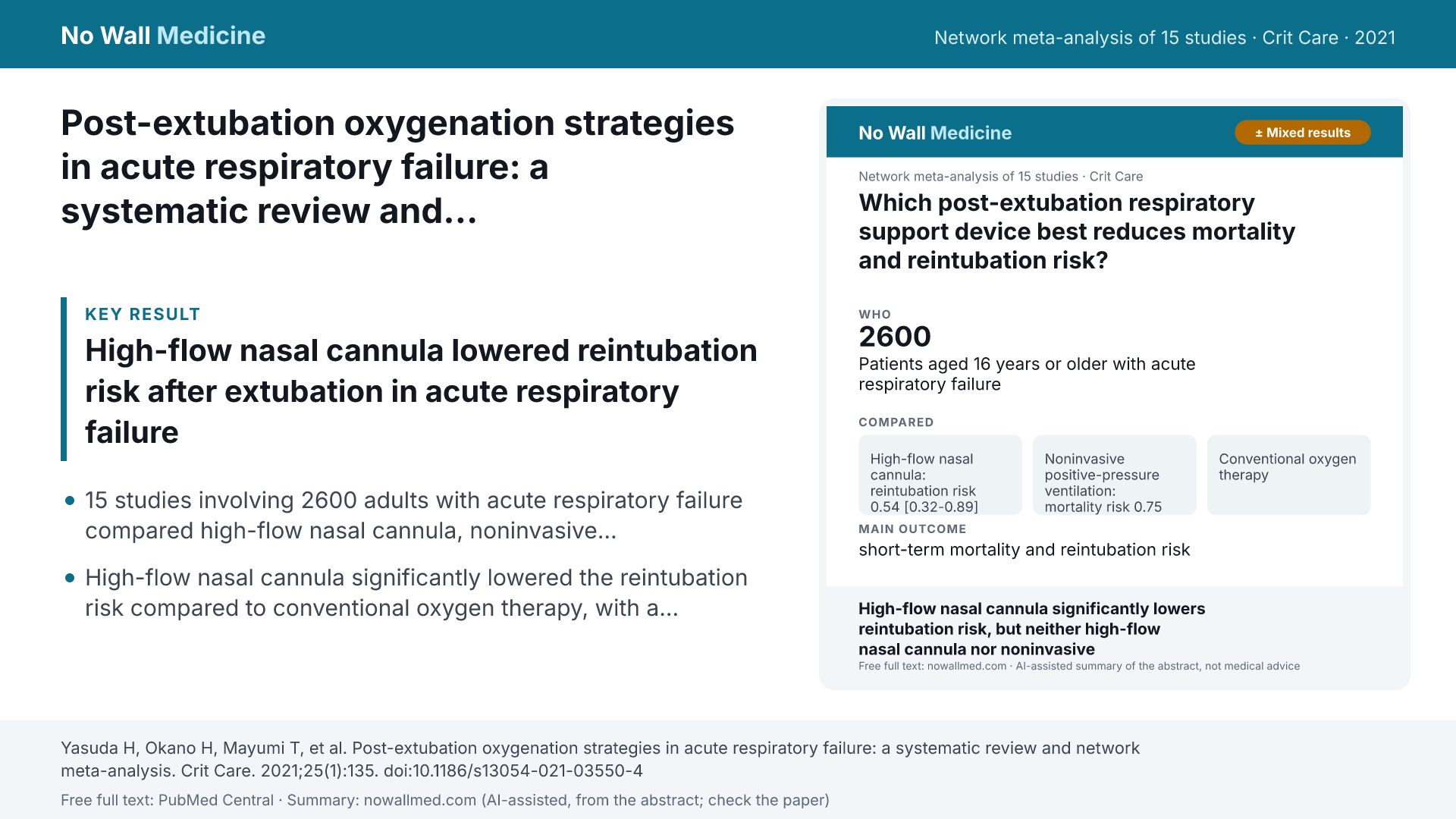
Post-extubation oxygenation strategies in acute respiratory failure: a systematic review and network meta-analysis
Network meta-analysis of 15 studiesMixed results
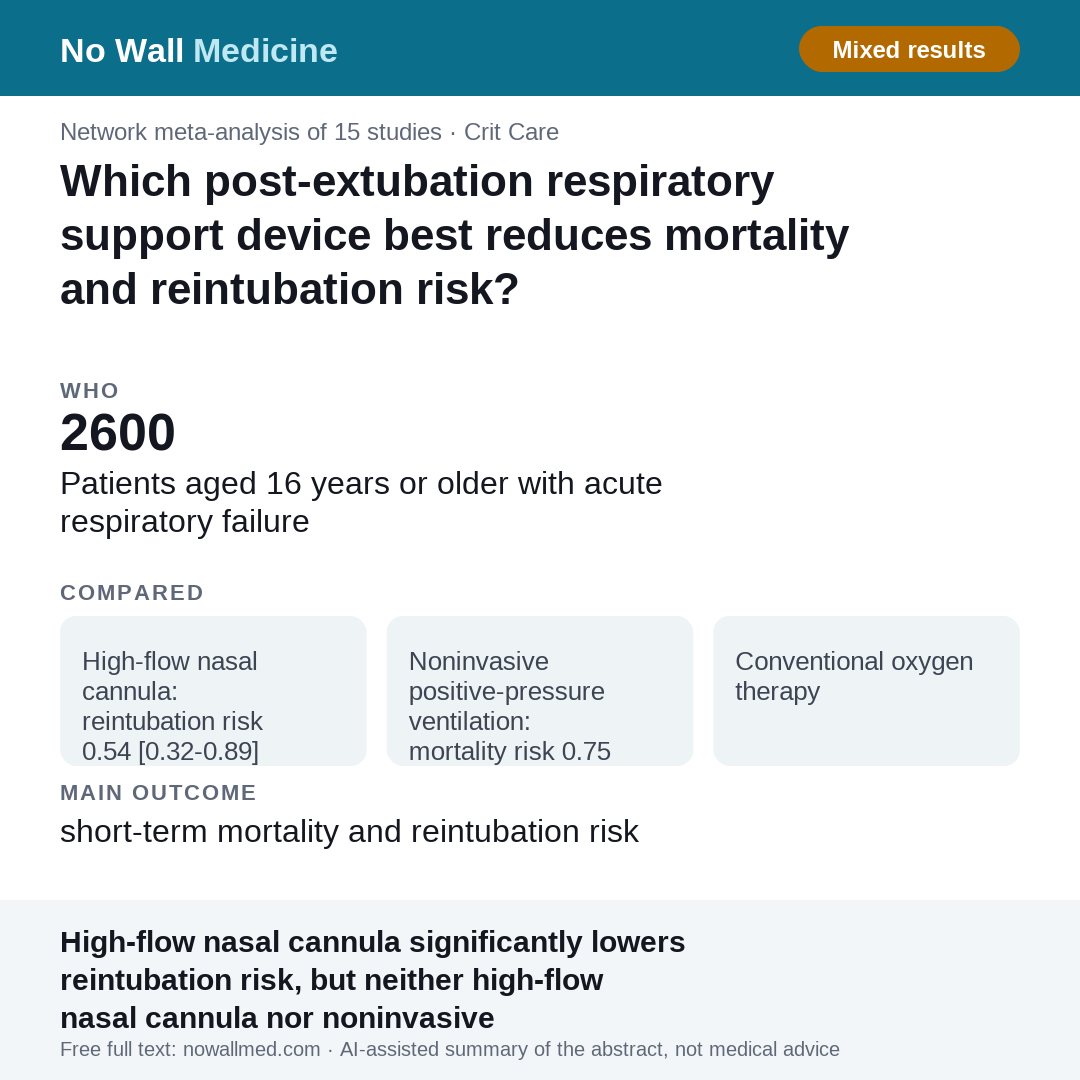
Which post-extubation respiratory support device best reduces mortality and reintubation risk?
Who
2600
Patients aged 16 years or older with acute respiratory failure
Compared
High-flow nasal cannula: reintubation risk 0.54 [0.32-0.89]
Noninvasive positive-pressure ventilation: mortality risk 0.75 [0.53-1.06]
Conventional oxygen therapy
Main outcome
short-term mortality and reintubation risk
Result: reintubation risk 0.54 [0.32-0.89] for high-flow nasal cannula versus conventional oxygen therapy
Bottom line: High-flow nasal cannula significantly lowers reintubation risk, but neither high-flow nasal cannula nor noninvasive positive-pressure ventilation significantly reduces mortality.
Limitation: low, moderate, and very low certainty of evidence for some outcomes
Crit Care · 2021-04-09Download image
Clinical question: Which post-extubation respiratory support device best reduces mortality and reintubation risk?
Why it matters: It was unknown whether high-flow nasal cannula oxygenation or noninvasive positive-pressure ventilation reduce mortality and reintubation risk better than conventional oxygen therapy
Key points
- 2600 patients with acute respiratory failure were studied in 15 trials.
- High-flow nasal cannula oxygenation lowered reintubation risk to 0.54 [0.32-0.89] compared to conventional oxygen therapy.
- Noninvasive positive-pressure ventilation and high-flow nasal cannula oxygenation did not significantly lower mortality risk.
Limitation the authors note: The certainty of evidence for some outcomes was low or very low
Headline and key points written with AI from the paper’s abstract, with every number checked against it. Read the paper before relying on them.
Was this summary helpful?
Abstract
Background
High-flow nasal cannula oxygenation (HFNC) and noninvasive positive-pressure ventilation (NPPV) possibly decrease tracheal reintubation rates better than conventional oxygen therapy (COT); however, few large-scale studies have compared HFNC and NPPV. We conducted a network meta-analysis (NMA) to compare the effectiveness of three post-extubation respiratory support devices (HFNC, NPPV, and COT) in reducing the mortality and reintubation risk. Methods
The Cochrane Central Register of Controlled Trials, MEDLINE, EMBASE, and Ichushi databases were searched. COT, NPPV, and HFNC use were assessed in patients who were aged ≥ 16 years, underwent invasive mechanical ventilation for > 12 h for acute respiratory failure, and were scheduled for extubation after spontaneous breathing trials. The GRADE Working Group Approach was performed using a frequentist-based approach with multivariate random-effect meta-analysis. Short-term mortality and reintubation and post-extubation respiratory failure rates were compared. Results
After evaluating 4631 records, 15 studies and 2600 patients were included. The main cause of acute hypoxic respiratory failure was pneumonia. Although NPPV/HFNC use did not significantly lower the mortality risk (relative risk [95% confidence interval] 0.75 [0.53-1.06] and 0.92 [0.67-1.27]; low and moderate certainty, respectively), HFNC use significantly lowered the reintubation risk (0.54 [0.32-0.89]; high certainty) compared to COT use. The associations of mortality with NPPV and HFNC use with respect to either outcome did not differ significantly (short-term mortality and reintubation, relative risk [95% confidence interval] 0.81 [0.61-1.08] and 1.02 [0.53-1.97]; moderate and very low certainty, respectively). Conclusion
NPPV or HFNC use may not reduce the risk of short-term mortality; however, they may reduce the risk of endotracheal reintubation. Trial registration number and date of registration
PROSPERO (registration number: CRD42020139112, 01/21/2020).
Abstract reproduced under the article’s CC BY licence.
Subject terms
Cite this article
Yasuda H, Okano H, Mayumi T, et al. Post-extubation oxygenation strategies in acute respiratory failure: a systematic review and network meta-analysis. Crit Care. 2021. doi:10.1186/s13054-021-03550-4
Spotted a mistake? Suggest a correction