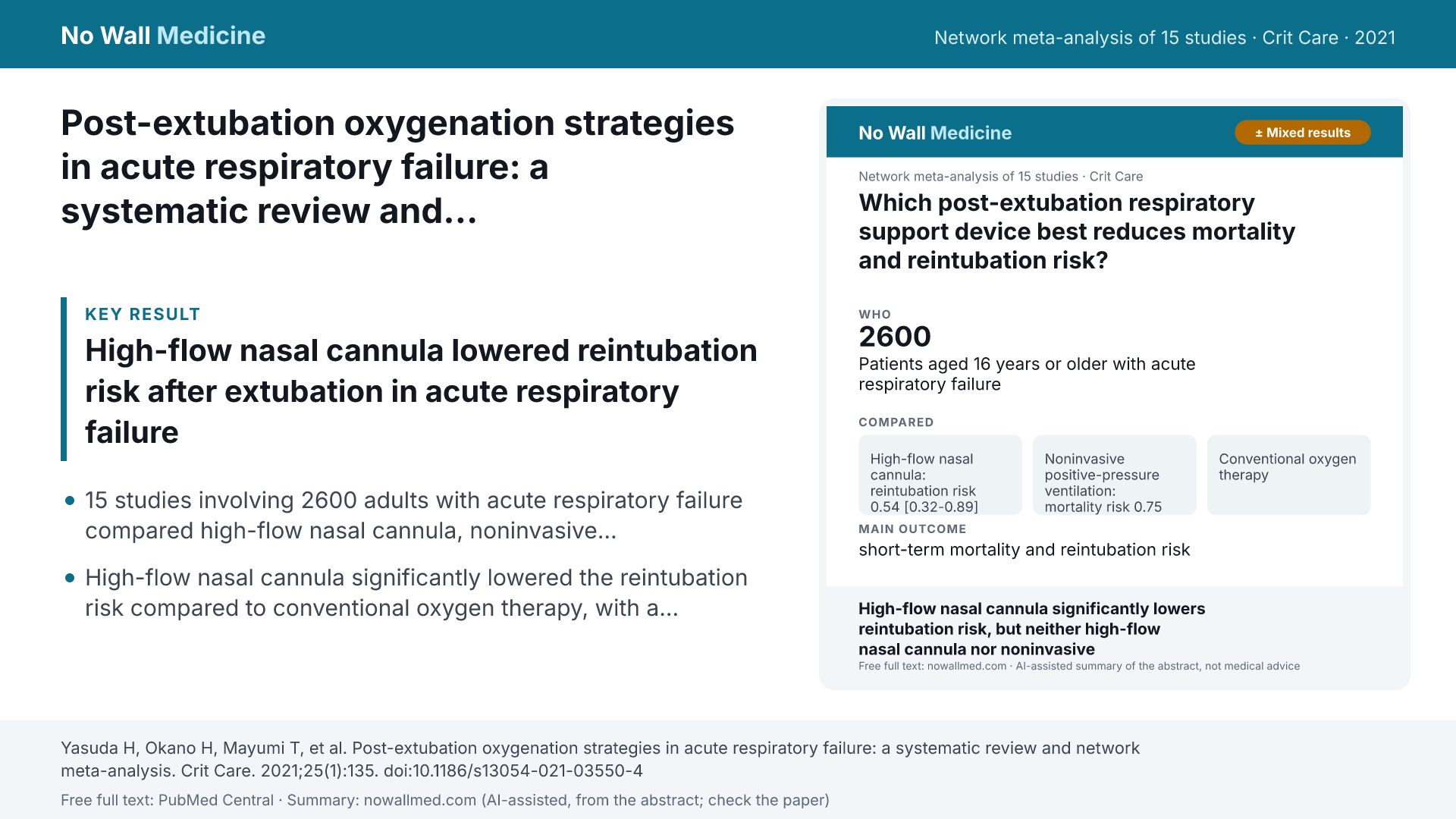
Post-extubation oxygenation strategies in acute respiratory failure: a systematic review and network meta-analysis
Key result: High-flow nasal cannula lowered reintubation risk after extubation in acute respiratory failure
Key points
- 15 studies involving 2600 adults with acute respiratory failure compared high-flow nasal cannula, noninvasive positive-pressure ventilation, and conventional oxygen therapy.
- High-flow nasal cannula significantly lowered the reintubation risk compared to conventional oxygen therapy, with a relative risk of 0.54 (95% CI 0.32-0.89).
- Neither high-flow nasal cannula nor noninvasive positive-pressure ventilation significantly lowered the risk of short-term mortality compared to conventional oxygen therapy.
Why it matters: Few large-scale studies have directly compared high-flow nasal cannula and noninvasive positive-pressure ventilation for reducing mortality and reintubation after extubation.
Limitation the authors note: The certainty of evidence for the mortality outcomes was rated as low to moderate, and for the direct comparison of reintubation risk it was very low.
Discussion prompts
- Would these patients look like yours? Who was left out?
- Is the main outcome one that matters to patients?
- Is the difference large enough to change what you do?
Cite: Yasuda H, Okano H, Mayumi T, et al. Post-extubation oxygenation strategies in acute respiratory failure: a systematic review and network meta-analysis. Crit Care. 2021;25(1):135. doi:10.1186/s13054-021-03550-4
Free full text: PubMed Central · Summary and visual abstract: nowallmed.com/a/post-extubation-oxygenation-strategies-in-acute-respiratory-failure-a-7w63d8/ (AI-assisted from the abstract; check the paper before relying on it).