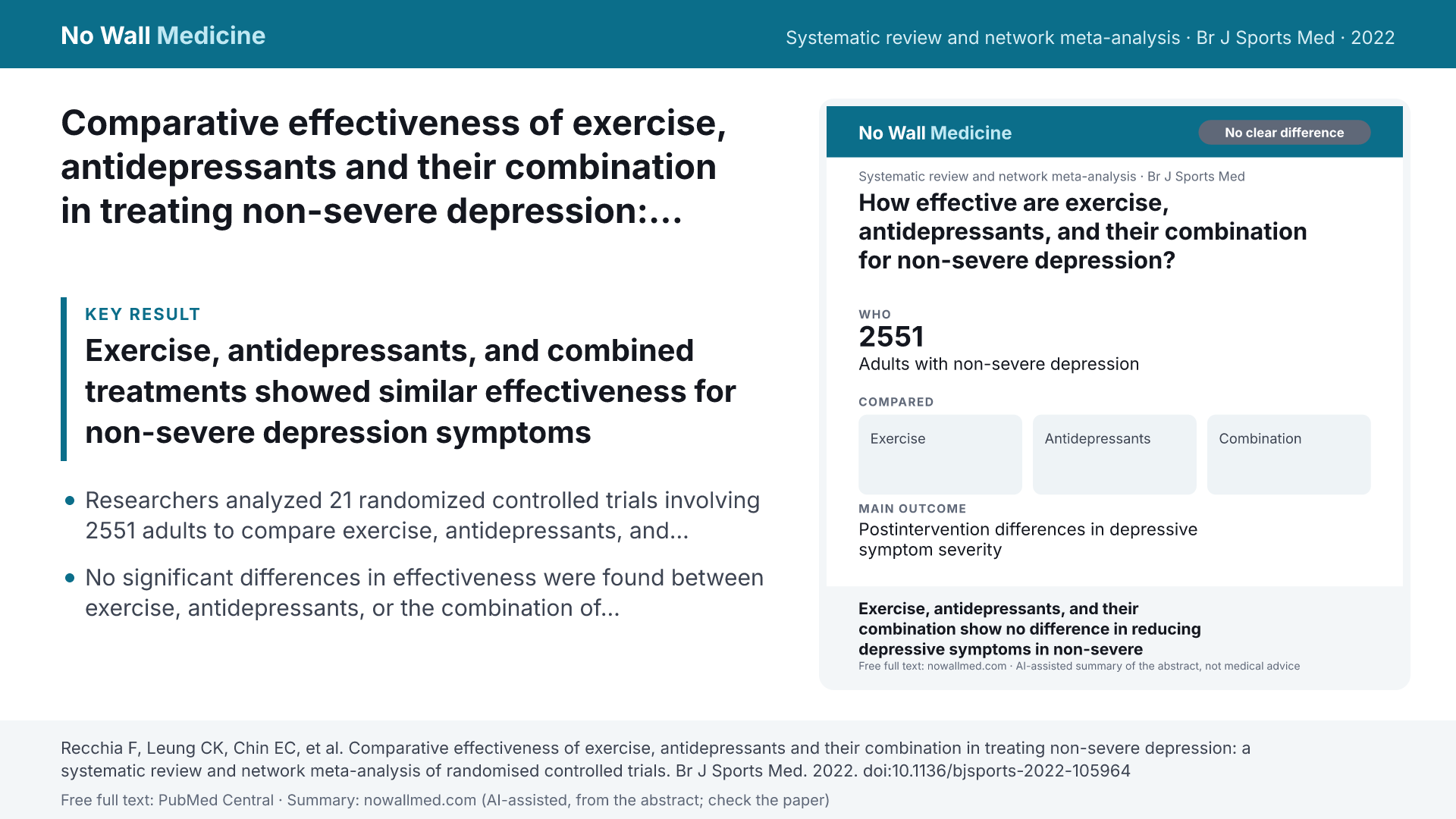
Exercise, antidepressants, and combined treatments showed similar effectiveness for non-severe depression symptoms
Comparative effectiveness of exercise, antidepressants and their combination in treating non-severe depression: a systematic review and network meta-analysis of randomised controlled trials
Systematic review and network meta-analysisNo clear difference
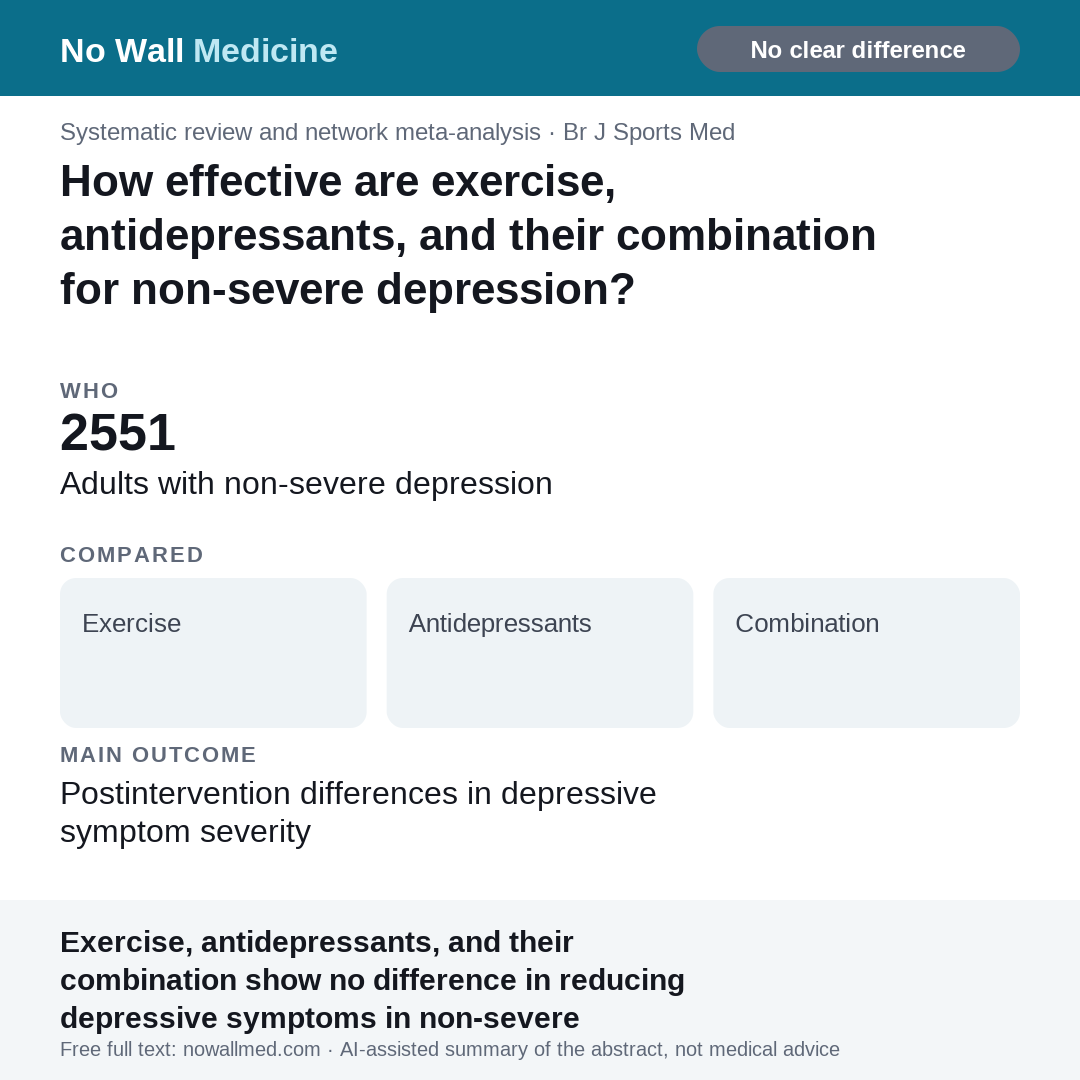
How effective are exercise, antidepressants, and their combination for non-severe depression?
Who
2551
Adults with non-severe depression
Compared
Exercise
Antidepressants
Combination
Main outcome
Postintervention differences in depressive symptom severity
Result: standardised mean differences: exercise vs antidepressants -0.12 (95% CI -0.33 to 0.10)
Bottom line: Exercise, antidepressants, and their combination show no difference in reducing depressive symptoms in non-severe depression.
Br J Sports Med · 2022-09-16Download image
Clinical question: How effective are exercise, antidepressants, and their combination for non-severe depression?
Why it matters: It was unknown whether exercise, antidepressants, or a combination of both are more effective for alleviating symptoms in adults with non-severe depression.
Key points
- Researchers analyzed 21 randomized controlled trials involving 2551 adults to compare exercise, antidepressants, and their combination for non-severe depression.
- No significant differences in effectiveness were found between exercise, antidepressants, or the combination of both treatments.
- Exercise interventions were associated with higher drop-out rates compared to antidepressant interventions, with a risk ratio of 1.31.
Headline and key points written with AI from the paper’s abstract, with every number checked against it. Read the paper before relying on them.
Was this summary helpful?
Abstract
Objective
To assess the comparative effectiveness of exercise, antidepressants and their combination for alleviating depressive symptoms in adults with non-severe depression. Design
Systematic review and network meta-analysis. Data sources
Embase, MEDLINE, PsycINFO, Cochrane Library, Web of Science, Scopus and SportDiscus. Eligibility criteria
Randomised controlled trials (1990-present) that examined the effectiveness of an exercise, antidepressant or combination intervention against either treatment alone or a control/placebo condition in adults with non-severe depression. Study selection and analysis
Risk of bias, indirectness and the overall confidence in the network were assessed by two independent investigators. A frequentist network meta-analysis was performed to examine postintervention differences in depressive symptom severity between groups. Intervention drop-out was assessed as a measure of treatment acceptability. Results
Twenty-one randomised controlled trials (n=2551) with 25 comparisons were included in the network. There were no differences in treatment effectiveness among the three main interventions (exercise vs antidepressants: standardised mean differences, SMD, -0.12; 95% CI -0.33 to 0.10, combination versus exercise: SMD, 0.00; 95% CI -0.33 to 0.33, combination vs antidepressants: SMD, -0.12; 95% CI -0.40 to 0.16), although all treatments were more beneficial than controls. Exercise interventions had higher drop-out rates than antidepressant interventions (risk ratio 1.31; 95% CI 1.09 to 1.57). Heterogeneity in the network was moderate (τ2=0.03; I2=46%). Conclusions
The results suggest no difference between exercise and pharmacological interventions in reducing depressive symptoms in adults with non-severe depression. These findings support the adoption of exercise as an alternative or adjuvant treatment for non-severe depression in adults. Systematic review registration
PROSPERO CRD4202122656.
Abstract reproduced under the article’s CC BY NC licence.
Subject terms
Cite this article
Recchia F, Leung CK, Chin EC, et al. Comparative effectiveness of exercise, antidepressants and their combination in treating non-severe depression: a systematic review and network meta-analysis of randomised controlled trials. Br J Sports Med. 2022. doi:10.1136/bjsports-2022-105964
Spotted a mistake? Suggest a correction