Tirzepatide and CagriSema showed high effectiveness for blood sugar and weight in type 2 diabetes
Comparative effectiveness of GLP-1 receptor agonists on glycaemic control, body weight, and lipid profile for type 2 diabetes: systematic review and network meta-analysis
Systematic review and network meta-analysisBenefit found
How effective are glucagon-like peptide-1 receptor agonists for glycaemic control, weight, and lipids in type 2 diabetes?
Who
39246
Adults with type 2 diabetes
Compared
Glucagon-like peptide-1 receptor agonists
Placebo
Main outcome
haemoglobin A1c, fasting plasma glucose, body weight, and lipid profile
Result: Tirzepatide haemoglobin A1c mean difference -2.10% (95% confidence interval -2.47% to -1.74%)
Bottom line: Glucagon-like peptide-1 receptor agonists effectively improve glycaemic control and weight, with tirzepatide and CagriSema showing superior results.
BMJ · 2024-01-29Download image
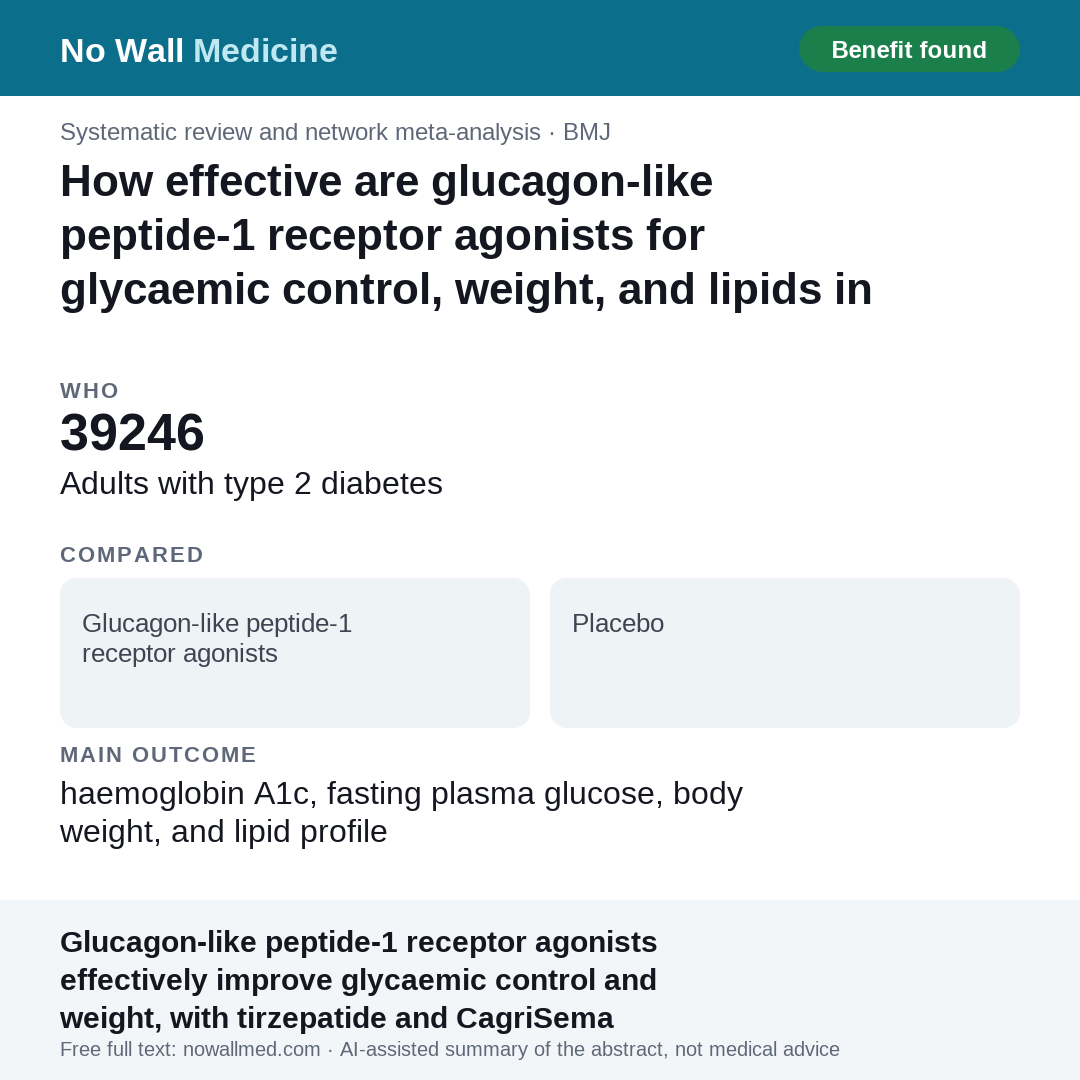
Clinical question: How effective are glucagon-like peptide-1 receptor agonists for glycaemic control, weight, and lipids in type 2 diabetes?
Why it matters: Clinicians need to compare the effectiveness of different glucagon-like peptide-1 receptor agonists for blood sugar, weight, and lipid profiles in adults with type 2 diabetes.
Key points
- Researchers analyzed 76 randomized controlled trials involving 39,246 participants to compare 15 glucagon-like peptide-1 receptor agonists against placebo.
- Tirzepatide had the largest reduction in hemoglobin A1c by -2.10% and fasting plasma glucose by -3.12 mmol/L.
- CagriSema resulted in the highest weight loss at -14.03 kg, while semaglutide was effective in lowering low density lipoprotein and total cholesterol.
Headline and key points written with AI from the paper’s abstract, with every number checked against it. Read the paper before relying on them.
Abstract
Objective
To evaluate the comparative efficacy and safety of glucagon-like peptide-1 receptor agonists (GLP-1RAs) on glycaemic control, body weight, and lipid profile in adults with type 2 diabetes. Design
Systematic review and network meta-analysis. Data sources
PubMed, Web of Science, Cochrane Central Register of Controlled Trials (CENTRAL), and Embase from database inception to 19 August 2023. Eligibility criteria for selecting studies
Eligible randomised controlled trials enrolled adults with type 2 diabetes who received GLP-1RA treatments and compared effects with placebo or any GLP-1RA drug, with a follow-up duration of at least 12 weeks. Trials with a crossover design, non-inferiority studies comparing GLP-1RA and other drug classes without a placebo group, using withdrawn drugs, and non-English studies were deemed ineligible. Results
76 eligible trials involving 15 GLP-1RA drugs and 39 246 participants were included in this network meta-analysis; all subsequent estimates refer to the comparison with placebo. All 15 GLP-1RAs effectively lowered haemoglobin A1c and fasting plasma glucose concentrations. Tirzepatide induced the largest reduction of haemoglobin A1c concentrations (mean difference -2.10% (95% confidence interval -2.47% to -1.74%), surface under the cumulative ranking curve 94.2%; high confidence of evidence), and fasting plasma glucose concentrations (-3.12 mmol/L (-3.59 to -2.66), 97.2%; high confidence), and proved the most effective GLP-1RA drug for glycaemic control. Furthermore, GLP-1RAs were shown to have strong benefits to weight management for patients with type 2 diabetes. CagriSema (semaglutide with cagrilintide) resulted in the highest weight loss (mean difference -14.03 kg (95% confidence interval -17.05 to -11.00); high confidence of evidence), followed by tirzepatide (-8.47 kg (-9.68 to -7.26); high confidence). Semaglutide was effective in lowering the concentration of low density lipoprotein (-0.16 mmol/L (-0.30 to -0.02)) and total cholesterol (-0.48 mmol/L (-0.84 to -0.11)). Moreover, this study also raises awareness of gastrointestinal adverse events induced by GLP-1RAs, and concerns about safety are especially warranted for high dose administration. Conclusions
GLP-1RAs are efficacious in treating adults with type 2 diabetes. Compared with the placebo, tirzepatide was the most effective GLP-1RA drug for glycaemic control by reducing haemoglobin A1c and fasting plasma glucose concentrations. GLP-1RAs also significantly improved weight management for type 2 diabetes, with CagriSema performing the best for weight loss. The results prompt safety concerns for GLP-1RAs, especially with high dose administration, regarding gastrointestinal adverse events. Systematic review registration
PROSPERO CRD42022342845.
Abstract reproduced under the article’s CC BY NC licence.
Topics
Cite this article
Yao H, Zhang A, Li D, Wu Y, Wang CZ, Wan JY. Comparative effectiveness of GLP-1 receptor agonists on glycaemic control, body weight, and lipid profile for type 2 diabetes: systematic review and network meta-analysis. BMJ. 2024. doi:10.1136/bmj-2023-076410
Spotted a mistake? Suggest a correction