Higher dose aspirin had 48 percent lower odds of preeclampsia, not statistically significant
Comparative effectiveness of lower-dose vs higher-dose aspirin for preeclampsia prevention: a systematic review and meta-analysis of randomized controlled trials
Obstetrics & GynecologyAdult and pediatric
Meta-analysis of six randomized controlled trialsUnclear result
Does higher-dose aspirin reduce preeclampsia risk compared with lower-dose aspirin in high-risk pregnant women?
Who
1099
Pregnant women at elevated risk for preeclampsia · Five countries
Compared
Higher-dose aspirin (150-162 mg/d)
Lower-dose aspirin (75-81 mg/d)
Main outcome
Preeclampsia
Result: odds ratio 1.93 (95% CI 0.84-4.42)
Bottom line: Higher-dose aspirin showed approximately 48% lower odds of preeclampsia, but the result was not statistically significant.
Limitation: Limited sample size, substantial between-study heterogeneity, and very low certainty of evidence.
AJOG Glob Rep · 2026-07-10Download image
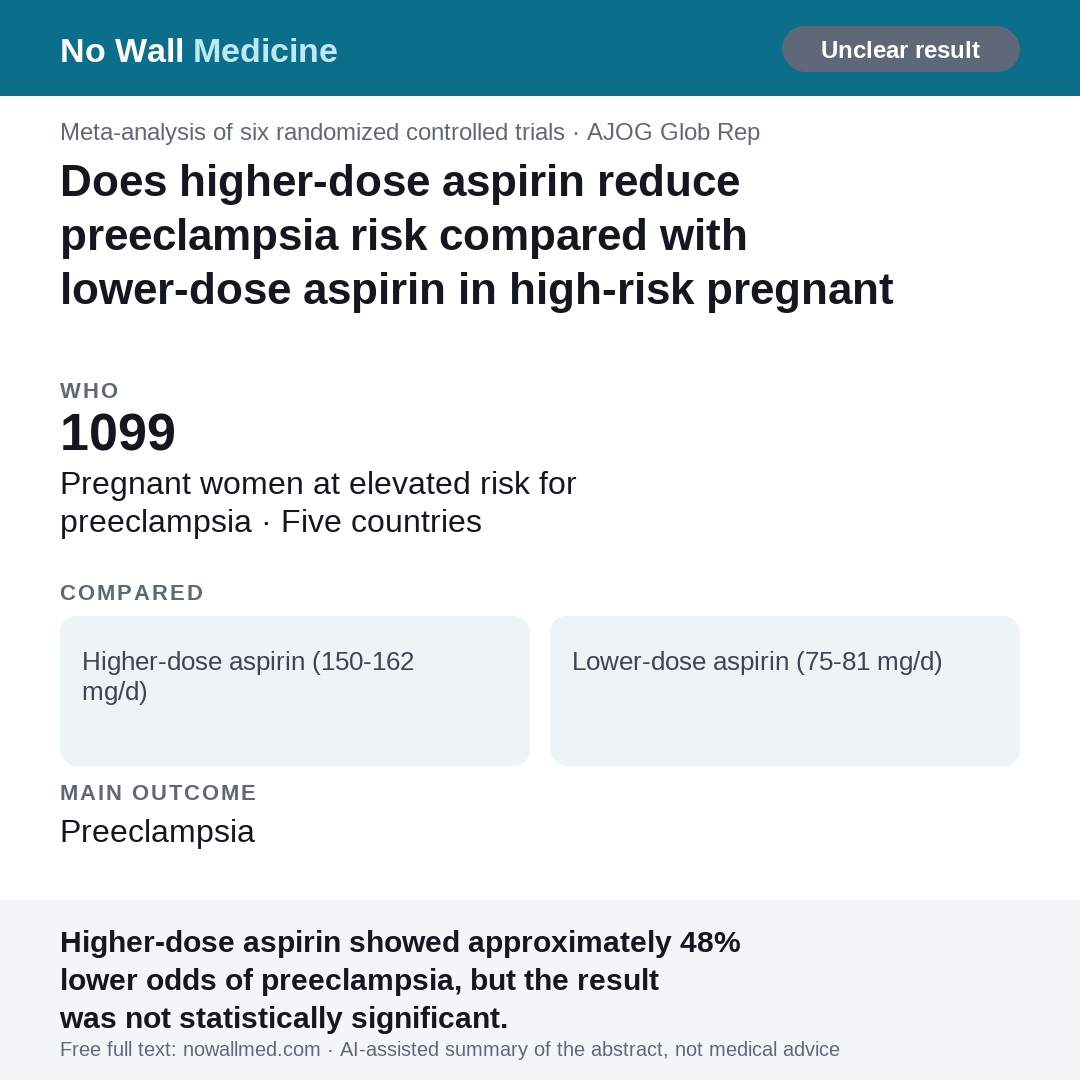
Clinical question: Does higher-dose aspirin reduce preeclampsia risk compared with lower-dose aspirin in high-risk pregnant women?
Why it matters: Doctors have had limited evidence on aspirin dose for preeclampsia prevention in pregnant women
Key points
- Six trials with 1099 pregnant women at elevated preeclampsia risk were studied.
- Higher dose aspirin was associated with 48 percent lower odds of preeclampsia, but not statistically significant.
- A safety signal for placental abruption was identified with higher dose aspirin in one large trial.
Limitation the authors note: The evidence certainty was graded as Very Low due to limited sample size and substantial between-study heterogeneity
Headline and key points written with AI from the paper’s abstract, with every number checked against it. Read the paper before relying on them.
Cite this article
Ahmed AM, Goyal R. Comparative effectiveness of lower-dose vs higher-dose aspirin for preeclampsia prevention: a systematic review and meta-analysis of randomized controlled trials. AJOG Glob Rep. 2026. doi:10.1016/j.xagr.2026.100673
Spotted a mistake? Suggest a correction