Dye-based chromoendoscopy may detect more precancerous lesions than white light endoscopy in inflammatory bowel disease
Comparative Efficacy and Safety of Endoscopic Modalities for Colorectal Cancer Screening in Inflammatory Bowel Disease: A Systematic Review and Network Meta-analysis
Network meta-analysis of 26 randomized controlled trialsBenefit found
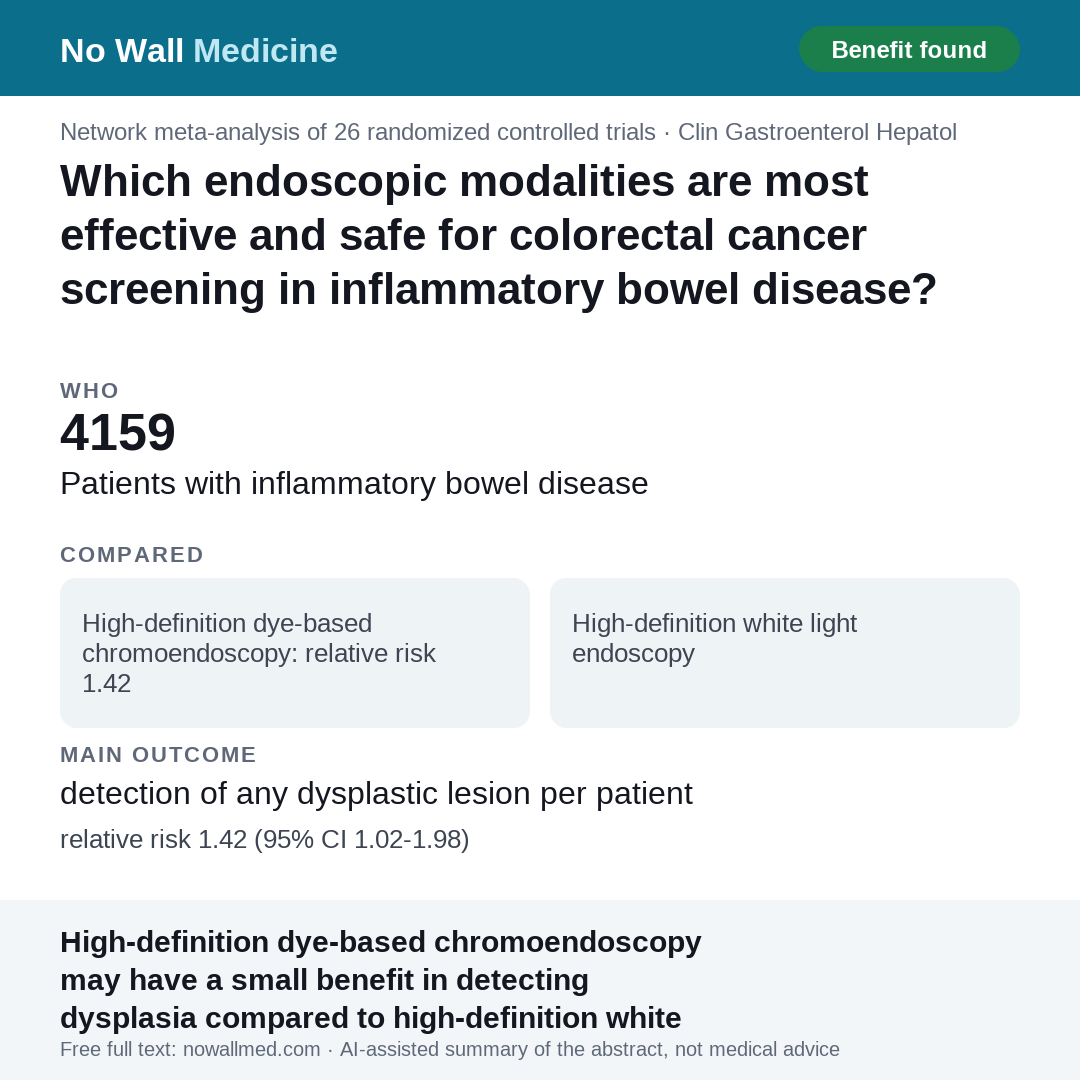
Which endoscopic modalities are most effective and safe for colorectal cancer screening in inflammatory bowel disease?
Who
4159
Patients with inflammatory bowel disease
Compared
High-definition dye-based chromoendoscopy: relative risk 1.42
High-definition white light endoscopy
Main outcome
detection of any dysplastic lesion per patient
Result: relative risk 1.42 (95% CI 1.02-1.98)
Bottom line: High-definition dye-based chromoendoscopy may have a small benefit in detecting dysplasia compared to high-definition white light endoscopy.
Limitation: Limited data on serious adverse events precluded meta-analysis.
Clin Gastroenterol Hepatol · 2024-12-13Download image
Clinical question: Which endoscopic modalities are most effective and safe for colorectal cancer screening in inflammatory bowel disease?
Why it matters: It is unknown which endoscopic method is most effective for detecting precancerous lesions during surveillance in patients with inflammatory bowel disease.
Key points
- Researchers analyzed 26 randomized controlled trials involving 4159 participants to compare different endoscopic methods for screening patients with inflammatory bowel disease.
- High-definition dye-based chromoendoscopy was associated with a higher risk of detecting dysplastic lesions compared to high-definition white light endoscopy (RR, 1.42; 95% CI, 1.02-1.98).
- Two serious adverse events were reported among 2164 patients, though limited data prevented a full meta-analysis of safety.
Limitation the authors note: The certainty of evidence for most modalities was low or very low, and limited data on serious adverse events precluded meta-analysis.
Headline and key points written with AI from the paper’s abstract, with every number checked against it. Read the paper before relying on them.
Was this summary helpful?
Subject terms
Cite this article
Sinopoulou V, Nigam GB, Gordon M, Ganeshan M, Tokonyai MR, Dolwani S. Comparative Efficacy and Safety of Endoscopic Modalities for Colorectal Cancer Screening in Inflammatory Bowel Disease: A Systematic Review and Network Meta-analysis. Clin Gastroenterol Hepatol. 2024. doi:10.1016/j.cgh.2024.11.008
Spotted a mistake? Suggest a correction
Top studies every Monday
The week’s key trials and guidelines in your specialties, plus any topics you follow. By email, free.
Get the weekly digest