Imaging techniques are unsuitable for colorectal cancer surveillance in individuals with Lynch syndrome
Systematic review: non-endoscopic surveillance for colorectal neoplasia in individuals with Lynch syndrome
Systematic reviewUnclear result
What is the performance of non-endoscopic screening for Lynch syndrome colorectal neoplasia?
Who
Individuals with Lynch syndrome · MEDLINE and EMBASE
Compared
Imaging techniques: unable to detect colorectal cancer and adenomas <10 mm
Biomarkers: sensitivity for colorectal cancer varied from 33% to 91%
Main outcome
Detection of colorectal cancer and adenomas
Bottom line: Imaging techniques are unsuitable, while biomarkers show potential but remain understudied in Lynch syndrome.
Limitation: Small populations, high or unclear risk of bias, and low prevalence of adenomas.
Aliment Pharmacol Ther · 2022-02-18Download image
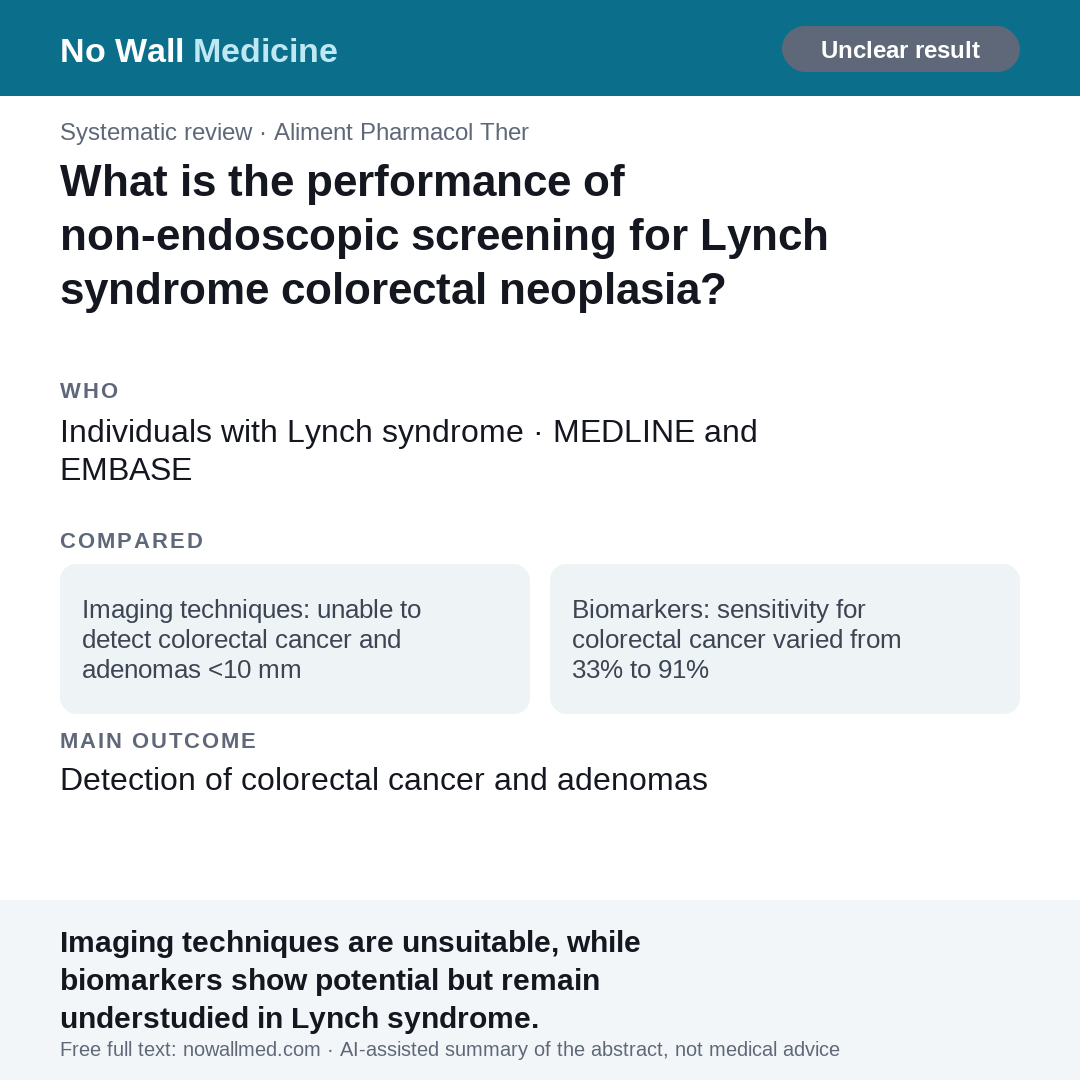
Clinical question: What is the performance of non-endoscopic screening for Lynch syndrome colorectal neoplasia?
Why it matters: It is unknown whether non-invasive screening methods can accurately guide the timing of colonoscopies to reduce the burden of regular endoscopic procedures.
Key points
- Researchers reviewed seven studies to evaluate the performance of non-endoscopic screening methods for colorectal cancer and adenomas in people with Lynch syndrome.
- Imaging techniques like computed tomography colonography or magnetic resonance colonography were unable to detect colorectal cancer or adenomas smaller than 10 mm.
- Biomarker sensitivity for colorectal cancer varied from 33% for BAT-26 to 70% for methylated-SEPTIN9 and 91% for hMLH1.
Limitation the authors note: The included studies were characterized by small populations, high or unclear risk of bias, and low prevalence of adenomas.
Headline and key points written with AI from the paper’s abstract, with every number checked against it. Read the paper before relying on them.
Was this summary helpful?
Subject terms
Cite this article
van Liere ELSA, de Boer NKH, Dekker E, van Leerdam ME, de Meij TGJ, Ramsoekh D. Systematic review: non-endoscopic surveillance for colorectal neoplasia in individuals with Lynch syndrome. Aliment Pharmacol Ther. 2022. doi:10.1111/apt.16824
Spotted a mistake? Suggest a correction
Top studies every Monday
The week’s key trials and guidelines in your specialties, plus any topics you follow. By email, free.
Get the weekly digest