Comparative efficacy of non-pharmacological interventions on executive function and attentional control in children and adolescents with ADHD: a Bayesian network meta-analysis based on task-based cognitive outcomes
Bayesian random-effects network meta-analysisBenefit found
How do non-pharmacological interventions compare for executive function and attentional control in ADHD?
Who
4628
Children and adolescents with ADHD aged 6-18 years
Compared
Multicomponent interventions: inhibitory control Hedges' g = 0.63
Cognitive Training: inhibitory control Hedges' g = 0.61
Control
Main outcome
task-based executive function and attentional control performance
Bottom line: Multicomponent interventions and Cognitive Training show consistent improvements in objective executive and attentional tasks for pediatric ADHD.
Transl Psychiatry · 2026-08-21Download image
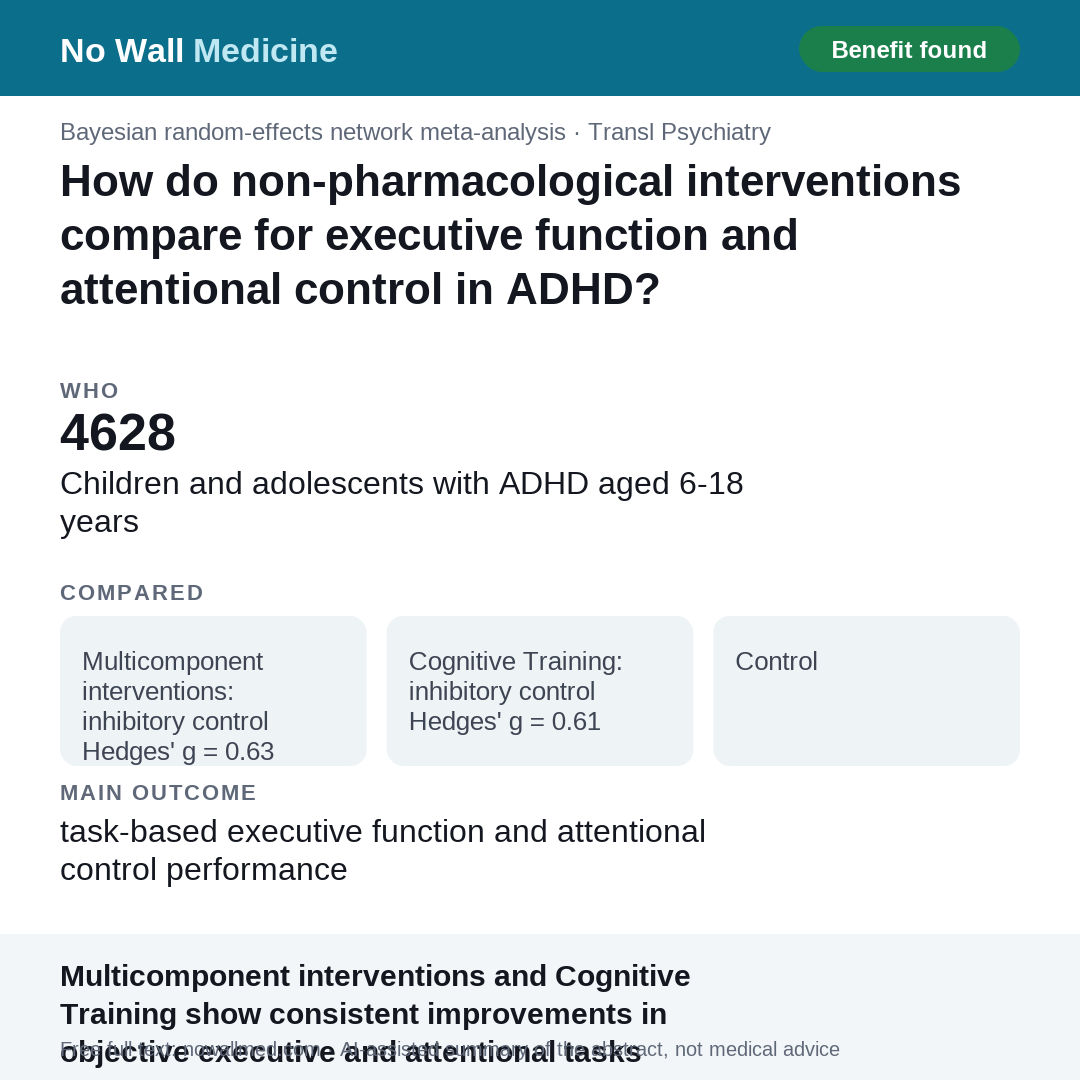
Clinical question: How do non-pharmacological interventions compare for executive function and attentional control in ADHD?
Abstract
Background
Attention-deficit/hyperactivity disorder (ADHD) involves measurable impairments in executive functioning and attentional control, yet the relative efficacy of non-pharmacological treatments on objective, task-based performance in pediatric samples remains uncertain. Methods
We conducted a Bayesian random-effects network meta-analysis of randomized controlled trials enrolling children and adolescents with ADHD aged 6-18 years, identified from PubMed, Embase, Web of Science, and CENTRAL between 2000 and 2025. Interventions were aggregated into eight active categories plus Control, and task outcomes were prospectively assigned to seven executive/attentional task-family domains. Effect directions were harmonized, and the primary endpoint was defined as 0-2 weeks after treatment completion; models were fitted separately by domain. Additional exploratory post-intervention analyses examined study-level mean age and sex composition, indexed by male proportion, as aggregate-level moderators and complementary subgroup variables. Results
Eighty-six eligible randomized study reports involving 4628 participants met the inclusion criteria. For inhibitory control, Multicomponent interventions (Hedges' g = 0.63, 95% credible interval [CrI] 0.21-1.06), Cognitive Training (g = 0.61, 0.30-0.93), and Physical Activity/Motor Training (g = 0.46, 0.13-0.80) outperformed Control. Cognitive Training also improved working memory (g = 0.32, 0.01-0.63). For sustained attention, Multicomponent interventions showed the largest effects (g = 0.95, 0.36-1.55), with additional benefits for Cognitive Training (g = 0.50, 0.13-0.89) and Neurofeedback (g = 0.43, 0.02-0.85). Evidence for cognitive flexibility was attenuated, and planning/higher-order executive function and processing speed/reaction-time variability remained mixed or uncertain. Sensitivity analyses did not materially change the main ranking patterns. Exploratory aggregate-level analyses did not indicate clear systematic moderation of the better-powered domain-level effects by study-level mean age or male proportion. Conclusions
Multicomponent interventions and Cognitive Training showed the most consistent task-family-level improvements on objective executive and attentional tasks in pediatric ADHD, whereas evidence for higher-order executive function and processing speed/reaction-time variability remained uncertain. The exploratory age and sex-composition findings should be interpreted at the study level and do not establish individual-level developmental or sex-specific treatment effects. Prospero
CRD420251129986.
Topics
Cite this article
You Z, Han R, Du Y, Cao A. Comparative efficacy of non-pharmacological interventions on executive function and attentional control in children and adolescents with ADHD: a Bayesian network meta-analysis based on task-based cognitive outcomes. Transl Psychiatry. 2026. doi:10.1038/s41398-026-04331-9
Spotted a mistake? Suggest a correction