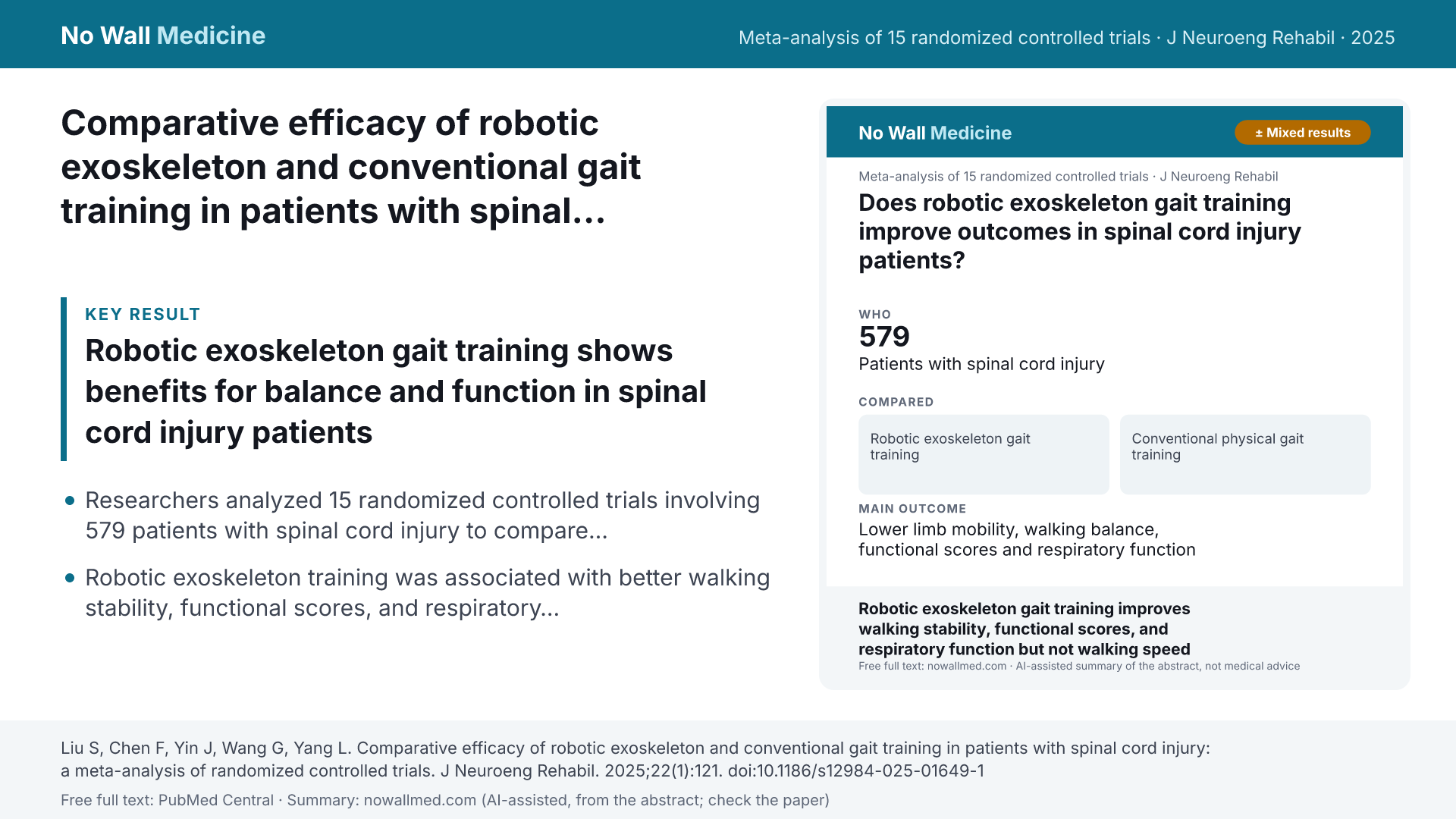
Comparative efficacy of robotic exoskeleton and conventional gait training in patients with spinal cord injury: a meta-analysis of randomized controlled trials
Key result: Robotic exoskeleton gait training shows benefits for balance and function in spinal cord injury patients
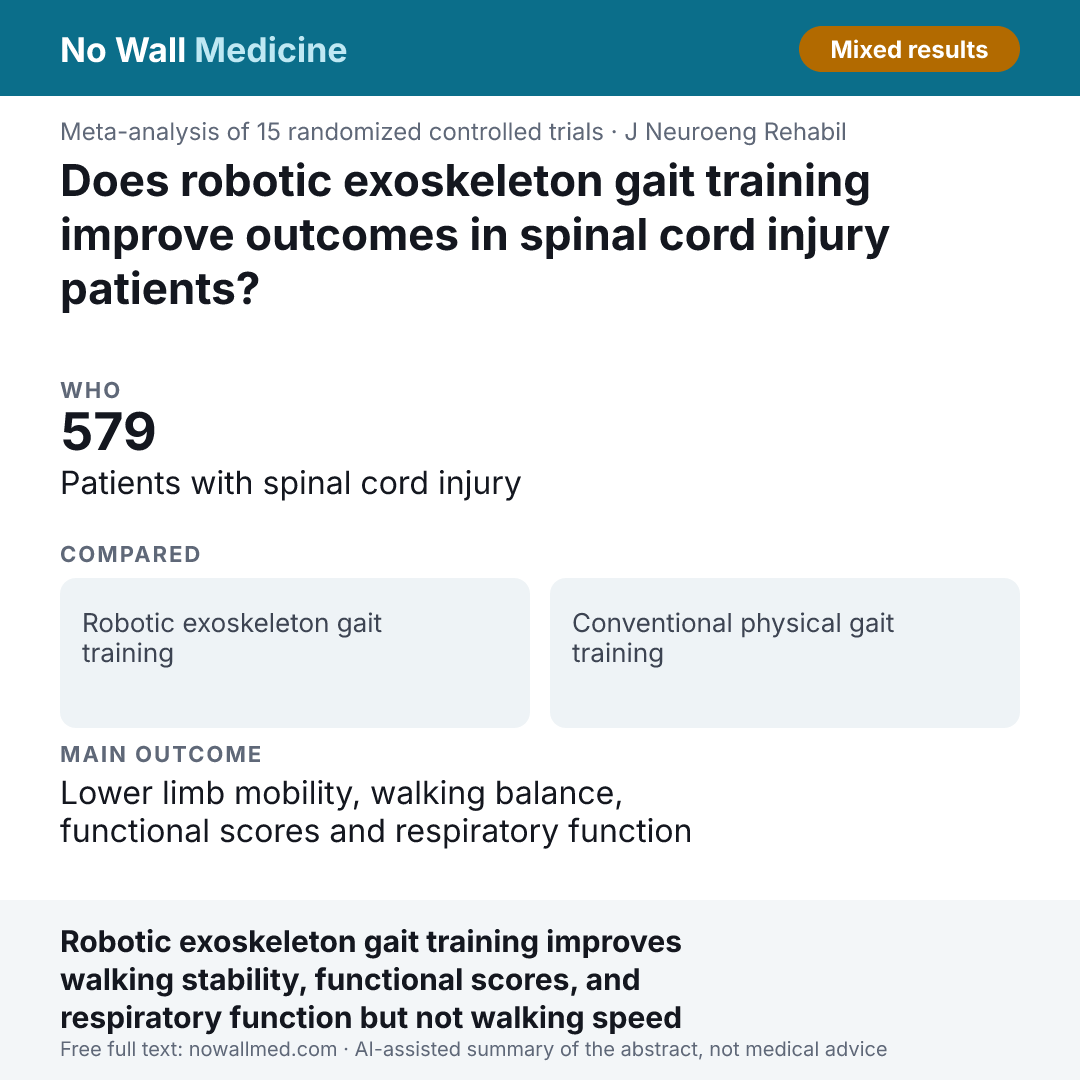
Meta-analysis of 15 randomized controlled trialsMixed results
Does robotic exoskeleton gait training improve outcomes in spinal cord injury patients?
Who
579
Patients with spinal cord injury
Compared
Robotic exoskeleton gait training
Conventional physical gait training
Main outcome
Lower limb mobility, walking balance, functional scores and respiratory function
Bottom line: Robotic exoskeleton gait training improves walking stability, functional scores, and respiratory function but not walking speed or distance.
J Neuroeng Rehabil · 2025-05-29 · Save PNG
Key points
- Researchers analyzed 15 randomized controlled trials involving 579 patients with spinal cord injury to compare robotic exoskeleton gait training with conventional physical gait training.
- Robotic exoskeleton training was associated with better walking stability, functional scores, and respiratory function, including a forced expiratory volume in one second increase of 0.60 (95%CI 0.05, 1.16) L.
- The robotic training showed no significant difference in walking speed or walking distance compared to conventional physical gait training.
Discussion prompts
- Would these patients look like yours? Who was left out?
- Is the main outcome one that matters to patients?
- Is the difference large enough to change what you do?
Cite: Liu S, Chen F, Yin J, Wang G, Yang L. Comparative efficacy of robotic exoskeleton and conventional gait training in patients with spinal cord injury: a meta-analysis of randomized controlled trials. J Neuroeng Rehabil. 2025;22(1):121. doi:10.1186/s12984-025-01649-1
Free full text: PubMed Central · Summary and visual abstract: nowallmed.com/a/comparative-efficacy-of-robotic-exoskeleton-and-conventional-gait-14sjtf9/ (AI-assisted from the abstract; check the paper before relying on it).