Comparative performance of fully-automated and semi-automated artificial intelligence methods for the detection of clinically significant prostate cancer on MRI: a systematic review
Systematic reviewNo clear difference
Do fully-automated and semi-automated artificial intelligence methods perform differently for prostate cancer detection?
Who
Studies evaluating artificial intelligence for prostate cancer detection on MRI
Compared
Fully-automated deep learning: AUC 0.80-0.89
Semi-automated traditional machine learning: AUC 0.75-0.88
Main outcome
Area under the receiver operating characteristic curve for discrimination
Bottom line: Fully-automated deep learning and semi-automated traditional machine learning show comparable performance for detecting clinically significant prostate cancer.
Limitation: Substantial study heterogeneity precluded quantitative analysis.
Insights Imaging · 2022-03-28Download image
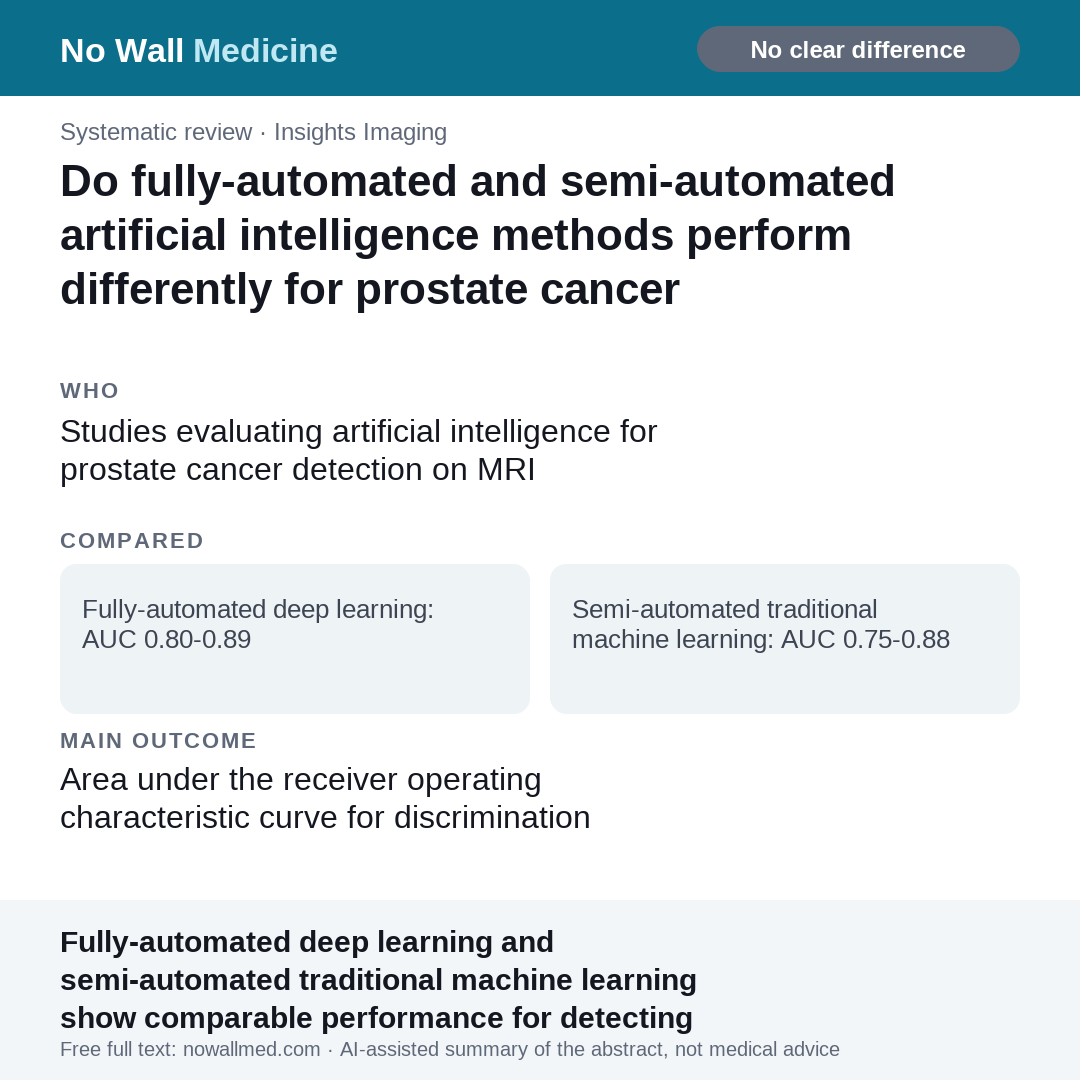
Clinical question: Do fully-automated and semi-automated artificial intelligence methods perform differently for prostate cancer detection?
Abstract
Objectives
We systematically reviewed the current literature evaluating the ability of fully-automated deep learning (DL) and semi-automated traditional machine learning (TML) MRI-based artificial intelligence (AI) methods to differentiate clinically significant prostate cancer (csPCa) from indolent PCa (iPCa) and benign conditions. Methods
We performed a computerised bibliographic search of studies indexed in MEDLINE/PubMed, arXiv, medRxiv, and bioRxiv between 1 January 2016 and 31 July 2021. Two reviewers performed the title/abstract and full-text screening. The remaining papers were screened by four reviewers using the Checklist for Artificial Intelligence in Medical Imaging (CLAIM) for DL studies and Radiomics Quality Score (RQS) for TML studies. Papers that fulfilled the pre-defined screening requirements underwent full CLAIM/RQS evaluation alongside the risk of bias assessment using QUADAS-2, both conducted by the same four reviewers. Standard measures of discrimination were extracted for the developed predictive models. Results
17/28 papers (five DL and twelve TML) passed the quality screening and were subject to a full CLAIM/RQS/QUADAS-2 assessment, which revealed a substantial study heterogeneity that precluded us from performing quantitative analysis as part of this review. The mean RQS of TML papers was 11/36, and a total of five papers had a high risk of bias. AUCs of DL and TML papers with low risk of bias ranged between 0.80-0.89 and 0.75-0.88, respectively. Conclusion
We observed comparable performance of the two classes of AI methods and identified a number of common methodological limitations and biases that future studies will need to address to ensure the generalisability of the developed models.
Cite this article
Sushentsev N, Moreira Da Silva N, Yeung M, Barrett T, Sala E, Roberts M. Comparative performance of fully-automated and semi-automated artificial intelligence methods for the detection of clinically significant prostate cancer on MRI: a systematic review. Insights Imaging. 2022. doi:10.1186/s13244-022-01199-3
Spotted a mistake? Suggest a correction
Top studies every Monday
The week’s key trials and guidelines in your specialties, plus any topics you follow. By email, free.
Get the weekly digest