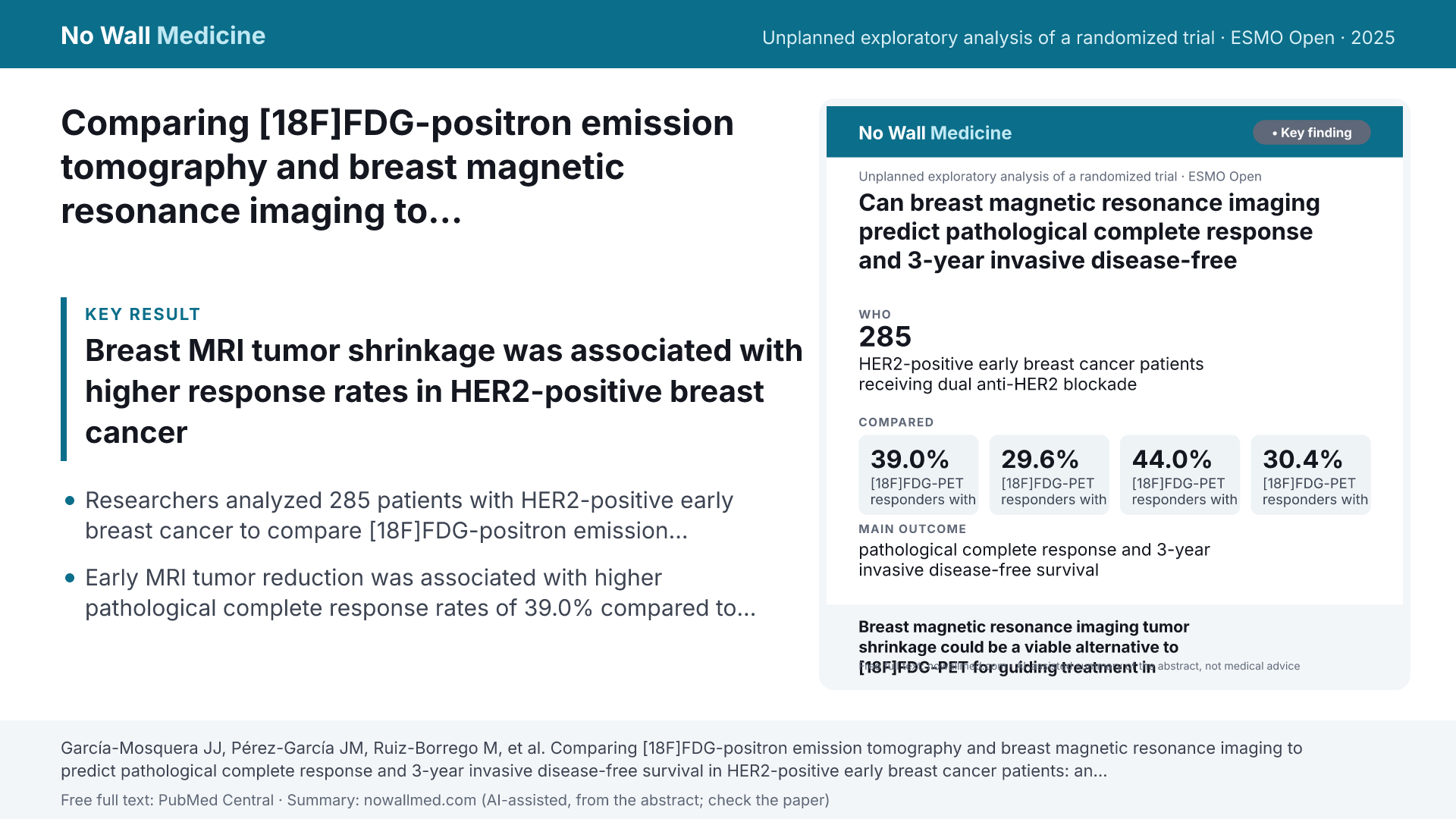
Breast MRI tumor shrinkage was associated with higher response rates in HER2-positive breast cancer
Comparing [18F]FDG-positron emission tomography and breast magnetic resonance imaging to predict pathological complete response and 3-year invasive disease-free survival in HER2-positive early breast cancer patients: an unplanned exploratory analysis of the PHERGain trial
Unplanned exploratory analysis of a randomized trialBenefit found
Can breast magnetic resonance imaging predict pathological complete response and 3-year invasive disease-free survival?
Who
285
HER2-positive early breast cancer patients receiving dual anti-HER2 blockade
Compared
39.0%[18F]FDG-PET responders with early MRI reduction
29.6%[18F]FDG-PET responders with no early MRI reduction
44.0%[18F]FDG-PET responders with early MRI response
30.4%[18F]FDG-PET responders with no early MRI response
Main outcome
pathological complete response and 3-year invasive disease-free survival
Bottom line: Breast magnetic resonance imaging tumor shrinkage could be a viable alternative to [18F]FDG-PET for guiding treatment in HER2-positive early breast cancer.
Limitation: This was an unplanned exploratory analysis
ESMO Open · 2025-11-06Download image
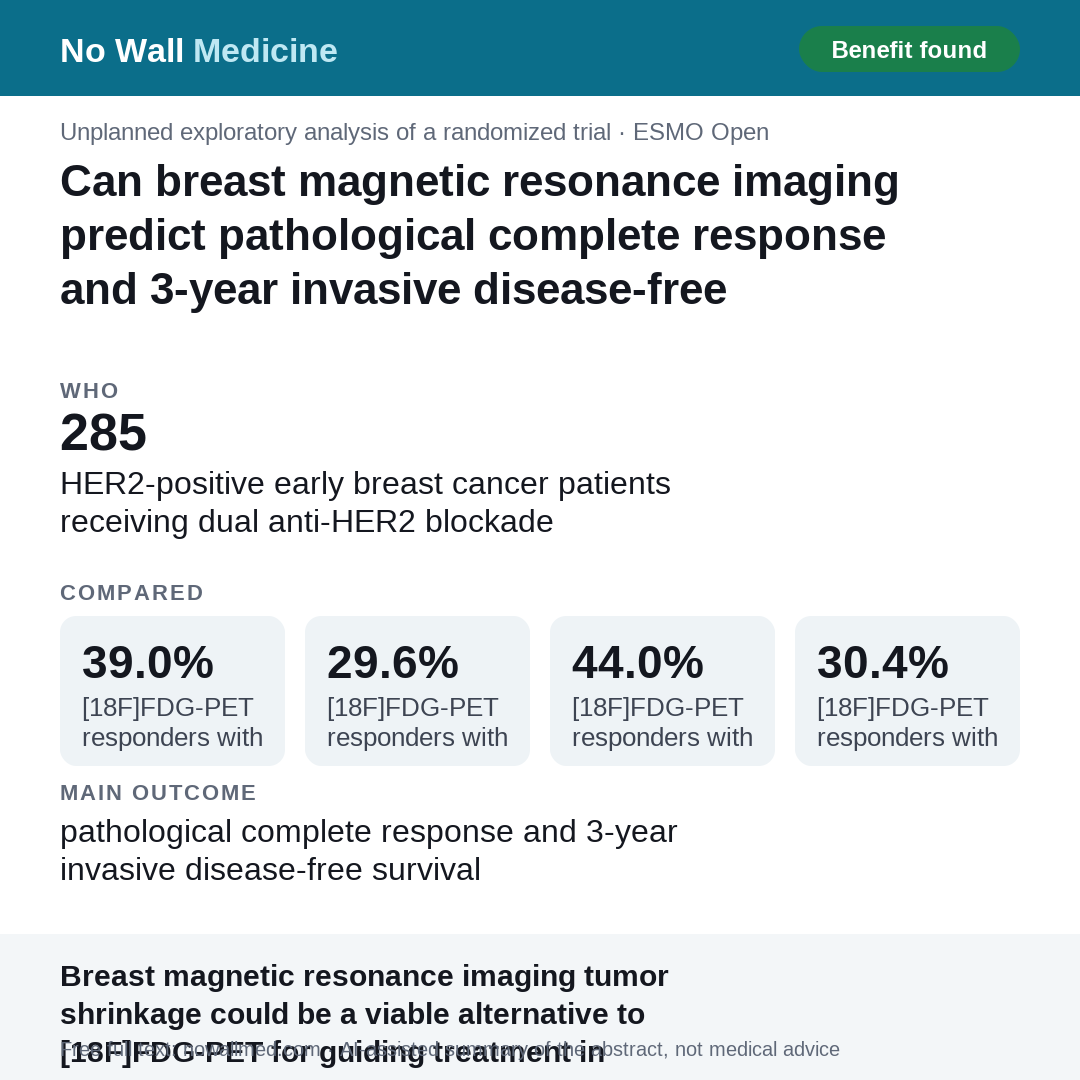
Clinical question: Can breast magnetic resonance imaging predict pathological complete response and 3-year invasive disease-free survival?
Why it matters: The availability of [18F]FDG-PET is limited, so researchers evaluated if breast MRI could serve as an alternative for assessing early treatment response.
Key points
- Researchers analyzed 285 patients with HER2-positive early breast cancer to compare [18F]FDG-positron emission tomography (PET) and breast magnetic resonance imaging (MRI) for predicting treatment response.
- Early MRI tumor reduction was associated with higher pathological complete response rates of 39.0% compared to 29.6% when no reduction occurred.
- Late MRI complete response predicted pathological complete response better in hormone receptor-negative tumors with a positive predictive value of 85.5% compared to 61.5% for hormone receptor-positive tumors.
Headline and key points written with AI from the paper’s abstract, with every number checked against it. Read the paper before relying on them.
Was this summary helpful?
Subject terms
Cite this article
García-Mosquera JJ, Pérez-García JM, Ruiz-Borrego M, Stradella A, Bermejo B, Escrivá-de-Romaní S. Comparing [18F]FDG-positron emission tomography and breast magnetic resonance imaging to predict pathological complete response and 3-year invasive disease-free survival in HER2-positive early breast cancer patients: an unplanned exploratory analysis of the PHERGain trial. ESMO Open. 2025. doi:10.1016/j.esmoop.2025.105875
Spotted a mistake? Suggest a correction