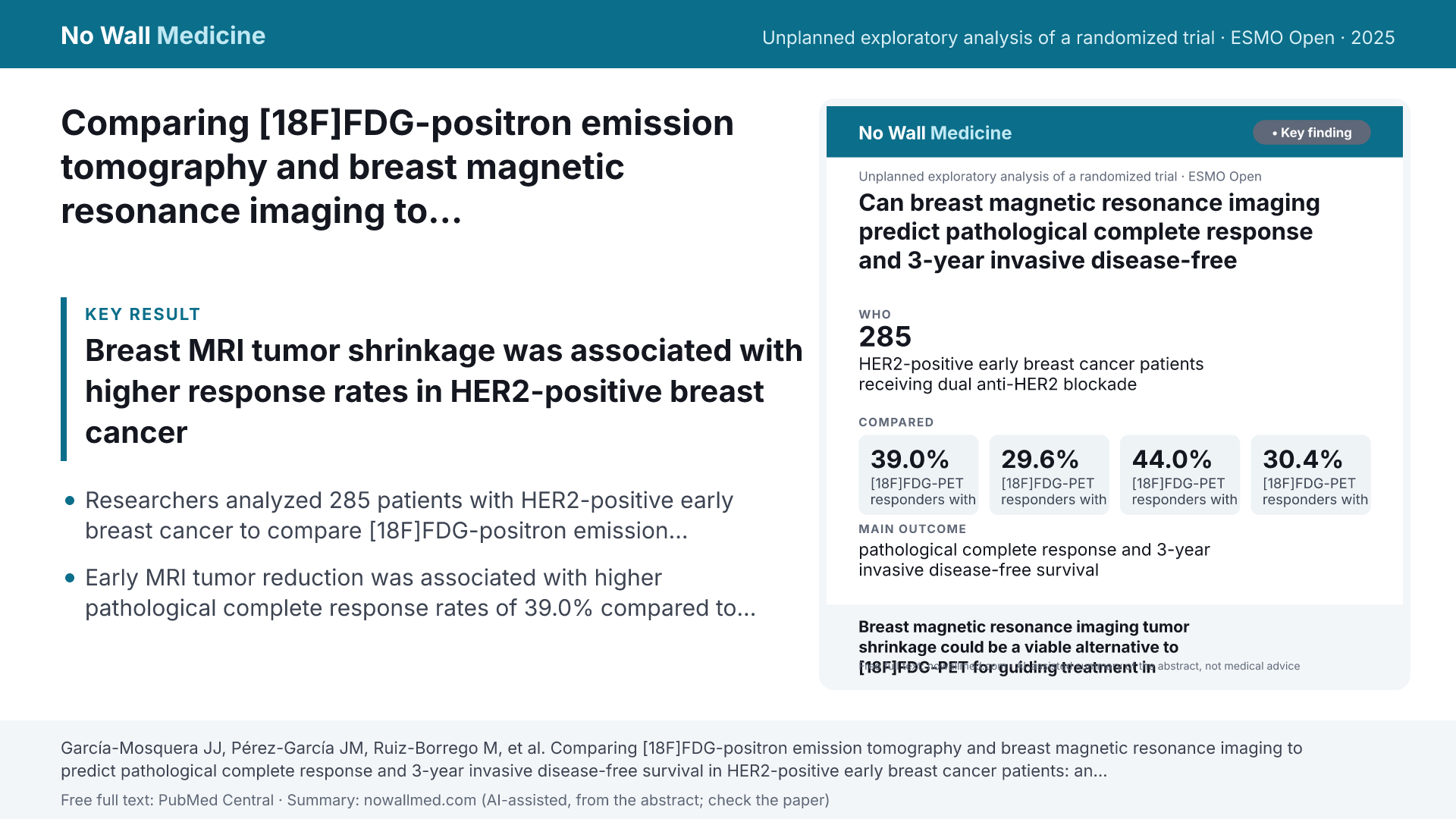
Comparing [18F]FDG-positron emission tomography and breast magnetic resonance imaging to predict pathological complete response and 3-year invasive disease-free survival in HER2-positive early breast cancer patients: an unplanned exploratory analysis of the PHERGain trial
Key result: Breast MRI tumor shrinkage was associated with higher response rates in HER2-positive breast cancer
Key points
- Researchers analyzed 285 patients with HER2-positive early breast cancer to compare [18F]FDG-positron emission tomography (PET) and breast magnetic resonance imaging (MRI) for predicting treatment response.
- Early MRI tumor reduction was associated with higher pathological complete response rates of 39.0% compared to 29.6% when no reduction occurred.
- Late MRI complete response predicted pathological complete response better in hormone receptor-negative tumors with a positive predictive value of 85.5% compared to 61.5% for hormone receptor-positive tumors.
Why it matters: The availability of [18F]FDG-PET is limited, so researchers evaluated if breast MRI could serve as an alternative for assessing early treatment response.
Discussion prompts
- Would these patients look like yours? Who was left out?
- Is the main outcome one that matters to patients?
- Is the difference large enough to change what you do?
Cite: García-Mosquera JJ, Pérez-García JM, Ruiz-Borrego M, et al. Comparing [18F]FDG-positron emission tomography and breast magnetic resonance imaging to predict pathological complete response and 3-year invasive disease-free survival in HER2-positive early breast cancer patients: an unplanned exploratory analysis of the PHERGain trial. ESMO Open. 2025;10(11):105875. doi:10.1016/j.esmoop.2025.105875
Free full text: PubMed Central · Summary and visual abstract: nowallmed.com/a/comparing-18f-fdg-positron-emission-tomography-and-breast-magnetic-1arhuzr/ (AI-assisted from the abstract; check the paper before relying on it).