Intermittent preventive treatment and screening-based treatment both reduced malaria infection in Malawian students
Comparing approaches for chemoprevention for school-based malaria control in Malawi: an open label, randomized, controlled clinical trial
Open-label, randomized, controlled trialBenefit found
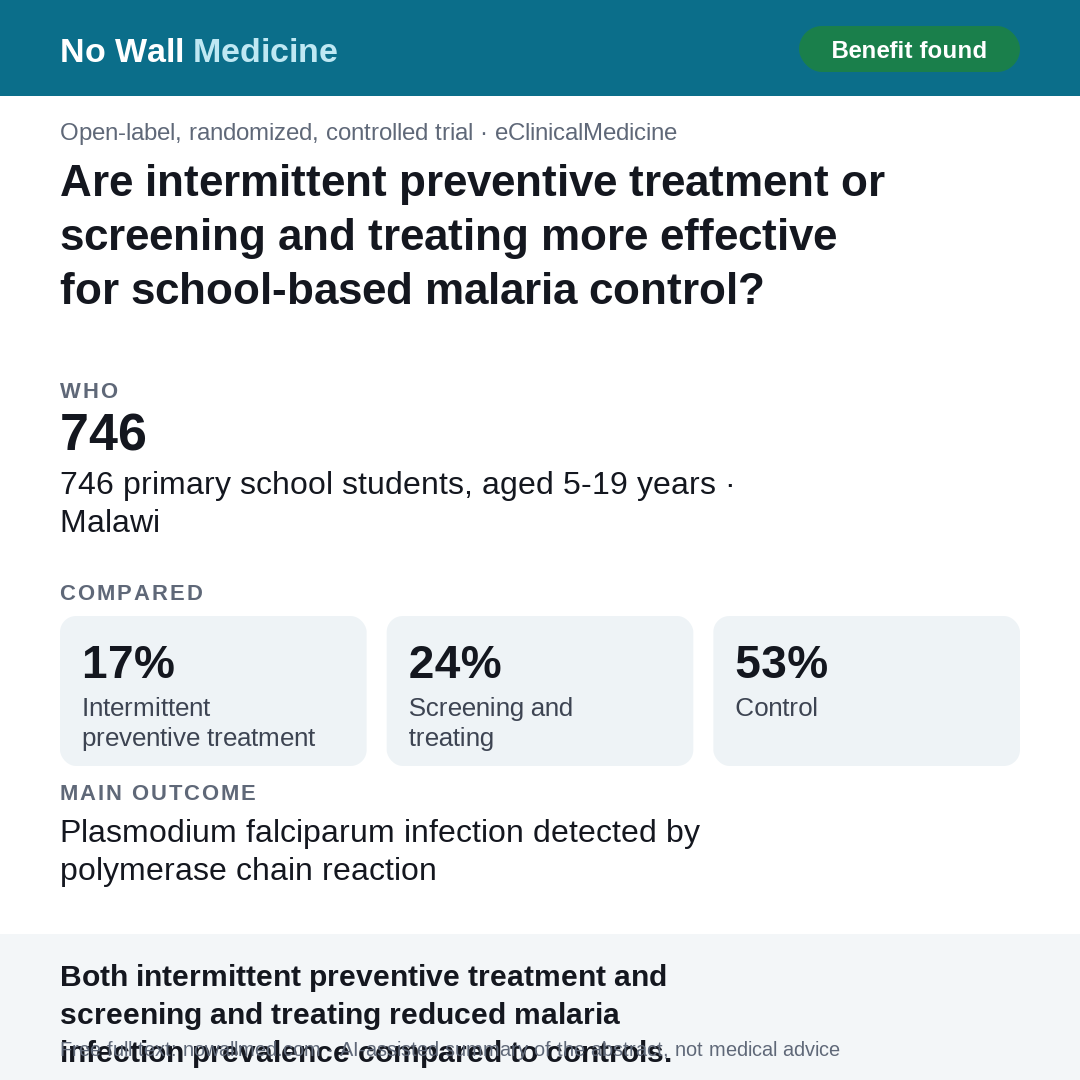
Are intermittent preventive treatment or screening and treating more effective for school-based malaria control?
Who
746
746 primary school students, aged 5-19 years · Malawi
Compared
17%Intermittent preventive treatment (41/243)
24%Screening and treating (58/244)
53%Control (127/240)
Main outcome
Plasmodium falciparum infection detected by polymerase chain reaction
Result: IPT adjusted odds ratio 0.18 (95% CI: 0.11, 0.27)
Bottom line: Both intermittent preventive treatment and screening and treating reduced malaria infection prevalence compared to controls.
Funded by: Doris Duke Charitable Foundation and U.S. NIH
eClinicalMedicine · 2024-09-16Download image
Clinical question: Are intermittent preventive treatment or screening and treating more effective for school-based malaria control?
Why it matters: It is unknown whether giving malaria medication to all students or only screening and treating those with detected infections is more effective for school-based control.
Key points
- Researchers randomized 746 primary school students in Malawi to intermittent preventive treatment, screening and treating only those with detected infections, or a control group.
- At the end of the study, malaria infection prevalence was 17% in the intermittent preventive treatment group, 24% in the screening group, and 53% in the control group.
- Only the intermittent preventive treatment group showed a lower incidence of clinical malaria and lower prevalence of anaemia compared to the control group.
Headline and key points written with AI from the paper’s abstract, with every number checked against it. Read the paper before relying on them.
Cite this article
Sixpence A, Vokhiwa M, Kumalakwaanthu W, Pitchford NJ, Seydel KB, Magder LS. Comparing approaches for chemoprevention for school-based malaria control in Malawi: an open label, randomized, controlled clinical trial. eClinicalMedicine. 2024. doi:10.1016/j.eclinm.2024.102832
Spotted a mistake? Suggest a correction
Top studies every Monday
The week’s key trials and guidelines in your specialties, by email. Free.
Get the weekly digest