Behavioral science electronic health record tools did not significantly increase medication tapering in older adults
Comparing Fourteen Behavioral Science Electronic Health Record Deprescribing Tools in Older Adults: NUDGE-EHR Adaptive Trial
Randomized adaptive trialNo clear difference
Do behavioral science electronic health record tools improve deprescribing in older adults?
Who
3063
Patients 65 years or older using long-term benzodiazepines and sedative hypnotics · Large healthcare system
Compared
33.6%Usual care
Intervention group: 25.9% to 45.1%
Main outcome
Deprescribing (discontinuation or tapering)
Bottom line: Most behavioral science principles in electronic health record alerts did not significantly improve deprescribing in older adults.
J Am Geriatr Soc · 2025-07-04Download image
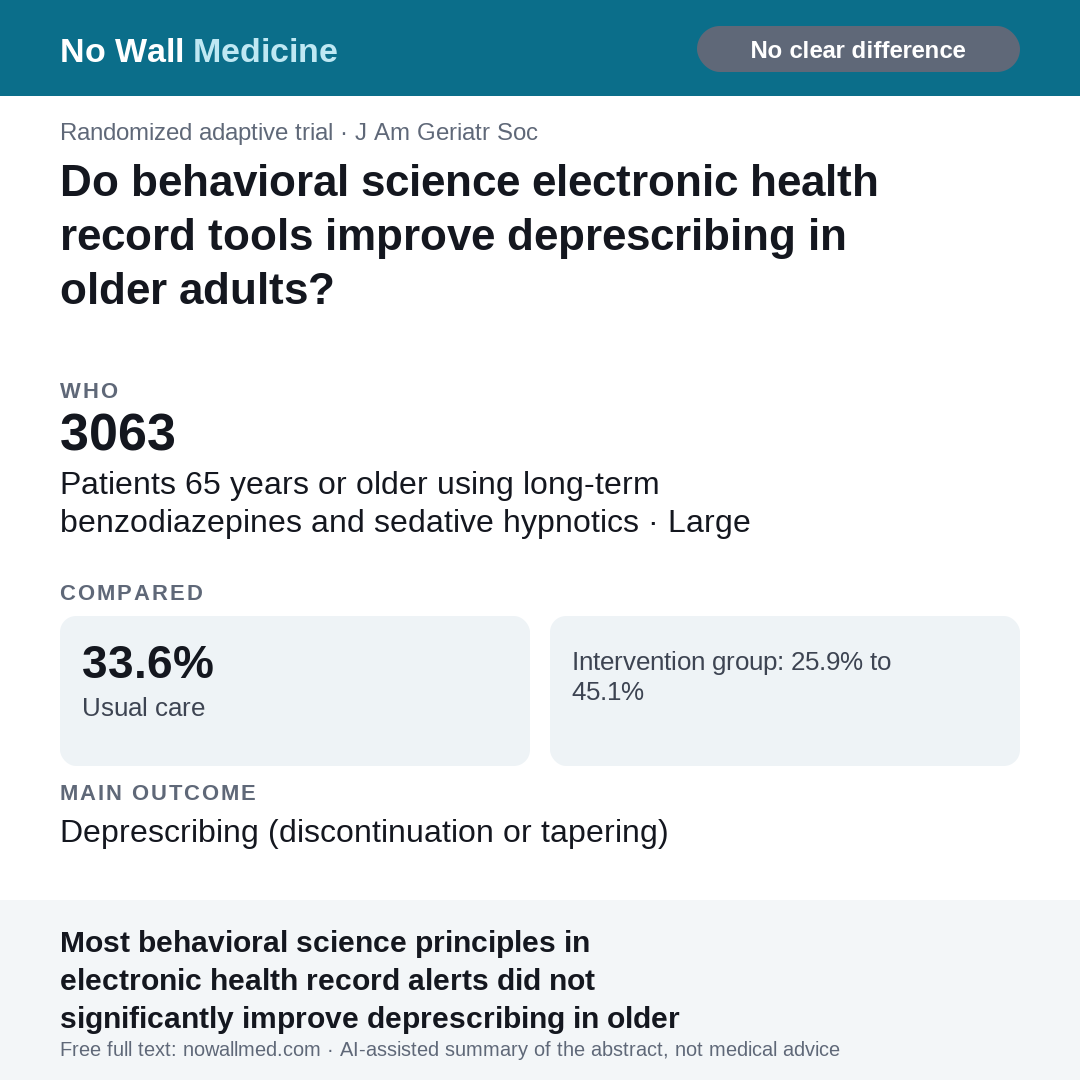
Clinical question: Do behavioral science electronic health record tools improve deprescribing in older adults?
Why it matters: Electronic health record alerts using behavioral science are under-evaluated for the purpose of deprescribing, which is the process of reducing or stopping medications.
Key points
- Researchers randomized 216 primary care providers to receive either usual care or one of 14 electronic health record tools designed to help taper benzodiazepines and sedative hypnotics in 3063 patients.
- While 33.6% of usual care patients experienced deprescribing, none of the behavioral science factors significantly increased the odds of deprescribing compared to arms without those factors.
- In secondary comparisons, alerts triggered when opening a patient encounter were more effective than those triggered during medication order entry (OR: 1.25, 95% CI: 1.01-1.56).
Headline and key points written with AI from the paper’s abstract, with every number checked against it. Read the paper before relying on them.
Was this summary helpful?
Subject terms
Cite this article
Lauffenburger JC, Isaac T, Trippa L, Glynn RJ, Russo M, Keller P. Comparing Fourteen Behavioral Science Electronic Health Record Deprescribing Tools in Older Adults: NUDGE-EHR Adaptive Trial. J Am Geriatr Soc. 2025. doi:10.1111/jgs.19609
Spotted a mistake? Suggest a correction
Top studies every Monday
The week’s key trials and guidelines in your specialties, plus any topics you follow. By email, free.
Get the weekly digest