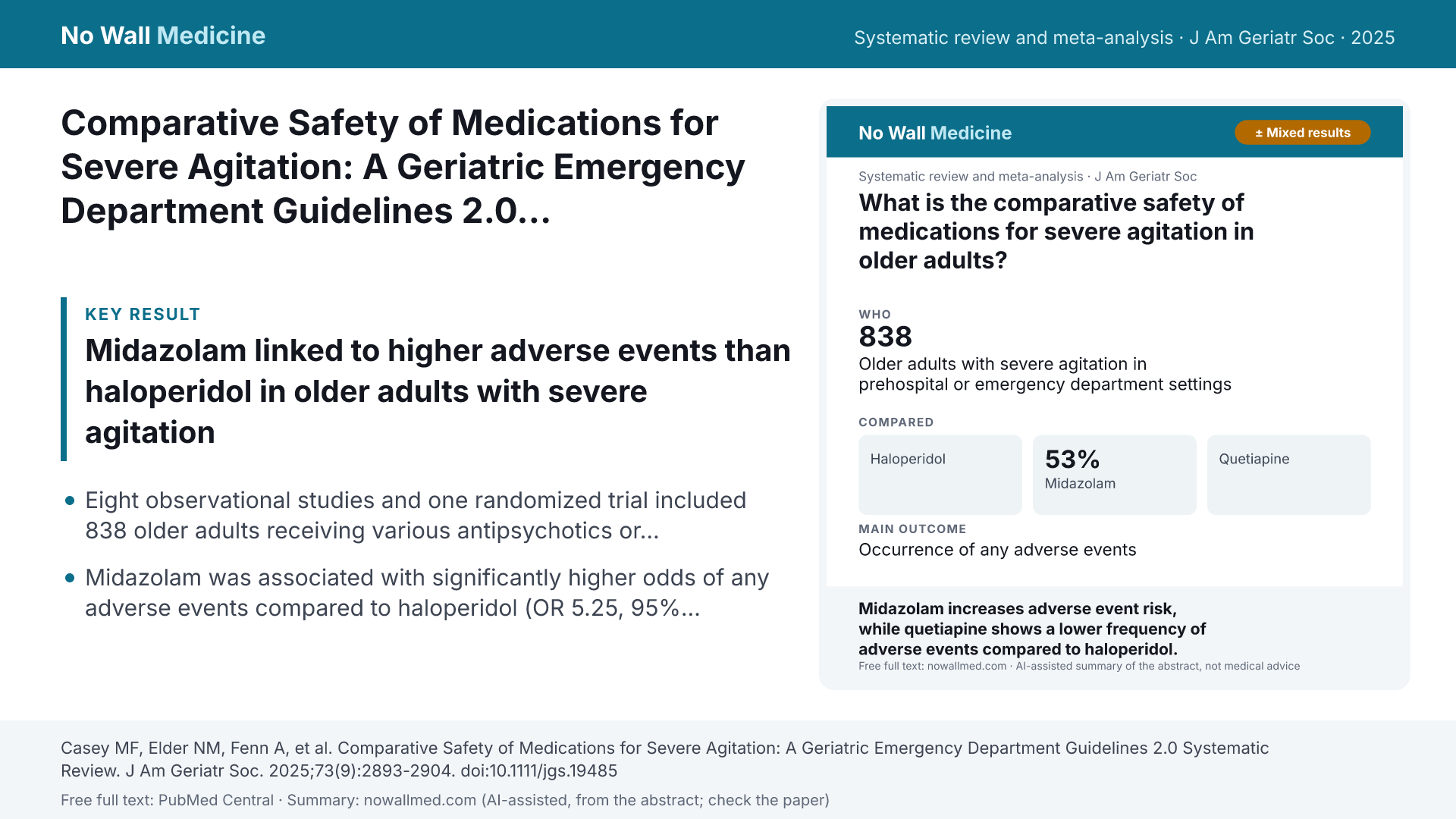
Midazolam linked to higher adverse events than haloperidol in older adults with severe agitation
Comparative Safety of Medications for Severe Agitation: A Geriatric Emergency Department Guidelines 2.0 Systematic Review
Systematic review and meta-analysisMixed results
What is the comparative safety of medications for severe agitation in older adults?
Who
838
Older adults with severe agitation in prehospital or emergency department settings
Compared
Haloperidol
53%Midazolam (36/68)
Quetiapine
Main outcome
Occurrence of any adverse events
Result: midazolam odds ratio 5.25 (95% CI 2.64-10.45); quetiapine odds ratio 0.27 (95% CI 0.08, 0.97)
Bottom line: Midazolam increases adverse event risk, while quetiapine shows a lower frequency of adverse events compared to haloperidol.
J Am Geriatr Soc · 2025-04-24 · Save PNG
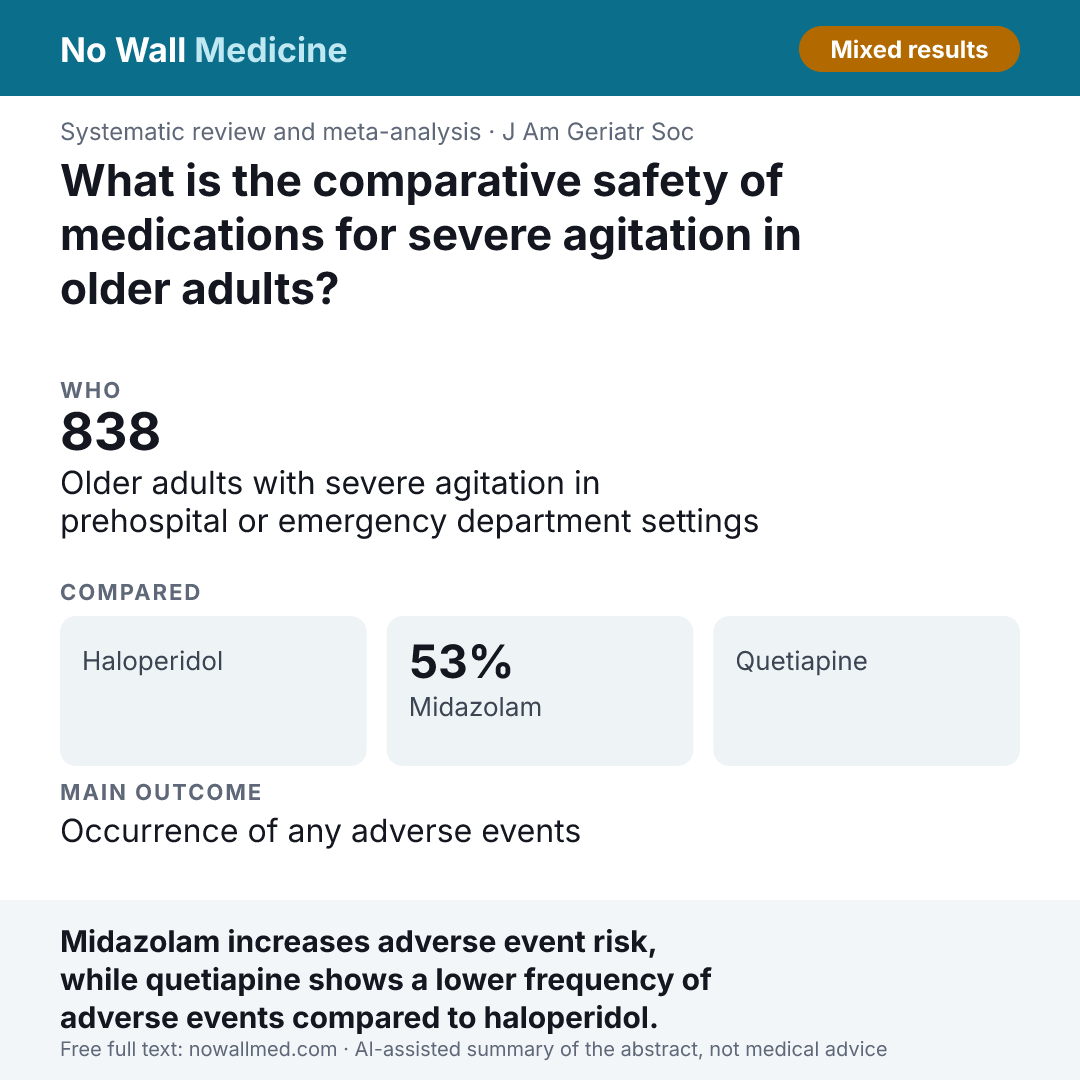
Clinical question: What is the comparative safety of medications for severe agitation in older adults?
Why it matters: Applies to older adults in emergency settings; suggests midazolam carries excessive risk while quetiapine may have a safer profile.
Key points
- Eight observational studies and one randomized trial included 838 older adults receiving various antipsychotics or sedatives for severe agitation.
- Midazolam was associated with significantly higher odds of any adverse events compared to haloperidol (OR 5.25, 95% CI 2.64-10.45).
- Quetiapine was the only drug associated with lower odds of adverse events than haloperidol (OR 0.27, 95% CI 0.08-0.97).
Limitation the authors note: The analysis primarily relied on observational studies, which can only show links rather than cause.
Headline and key points written with AI from the paper’s abstract, with every number checked against it. Read the paper before relying on them.
Was this summary helpful?
Subject terms
Headline, design, result, key points, caveat and citation as plain text.
Cite this article
Casey MF, Elder NM, Fenn A, et al. Comparative Safety of Medications for Severe Agitation: A Geriatric Emergency Department Guidelines 2.0 Systematic Review. J Am Geriatr Soc. 2025;73(9):2893-2904. doi:10.1111/jgs.19485
Spotted a mistake? Suggest a correction