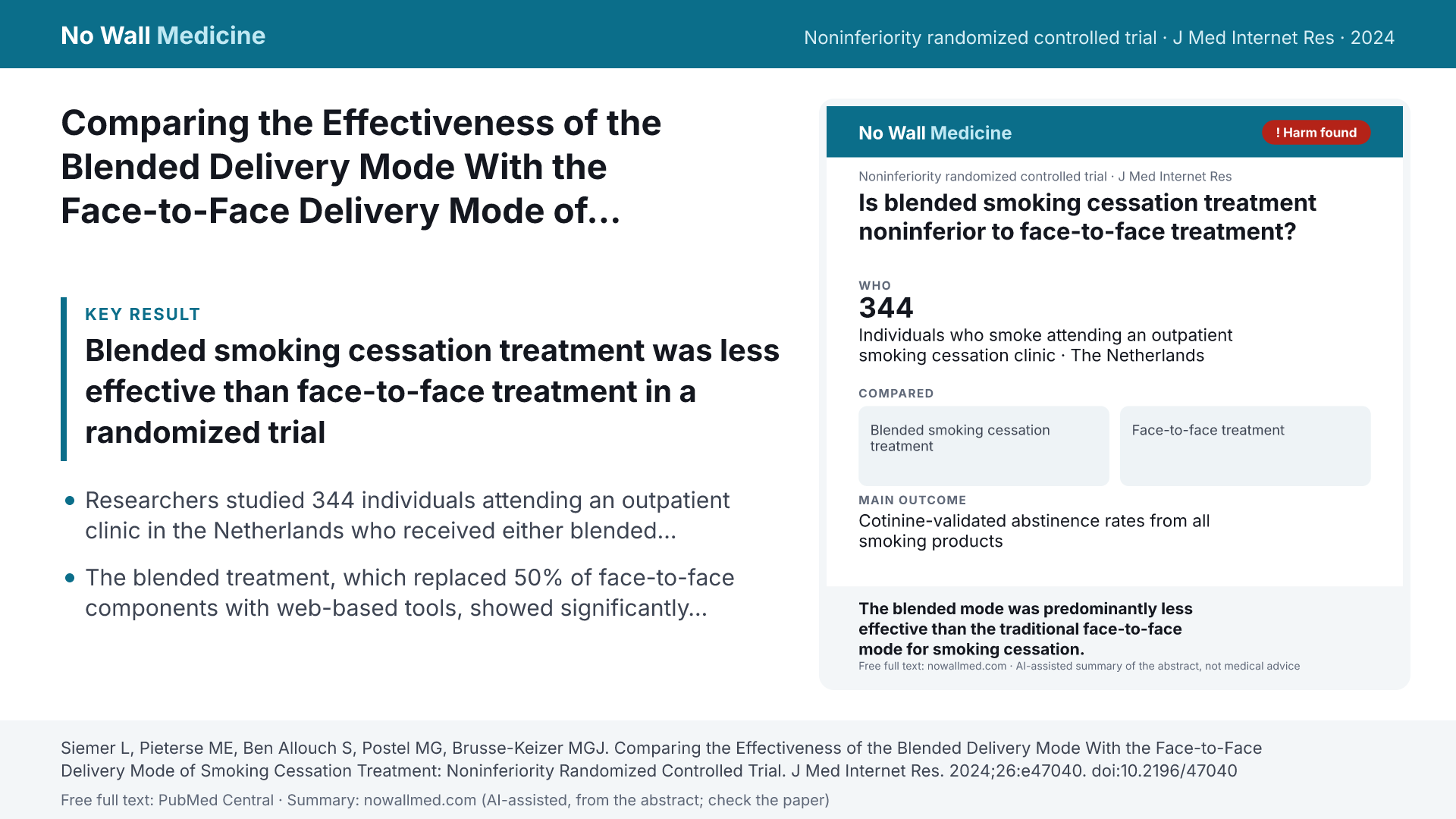
Comparing the Effectiveness of the Blended Delivery Mode With the Face-to-Face Delivery Mode of Smoking Cessation Treatment: Noninferiority Randomized Controlled Trial
Key result: Blended smoking cessation treatment was less effective than face-to-face treatment in a randomized trial
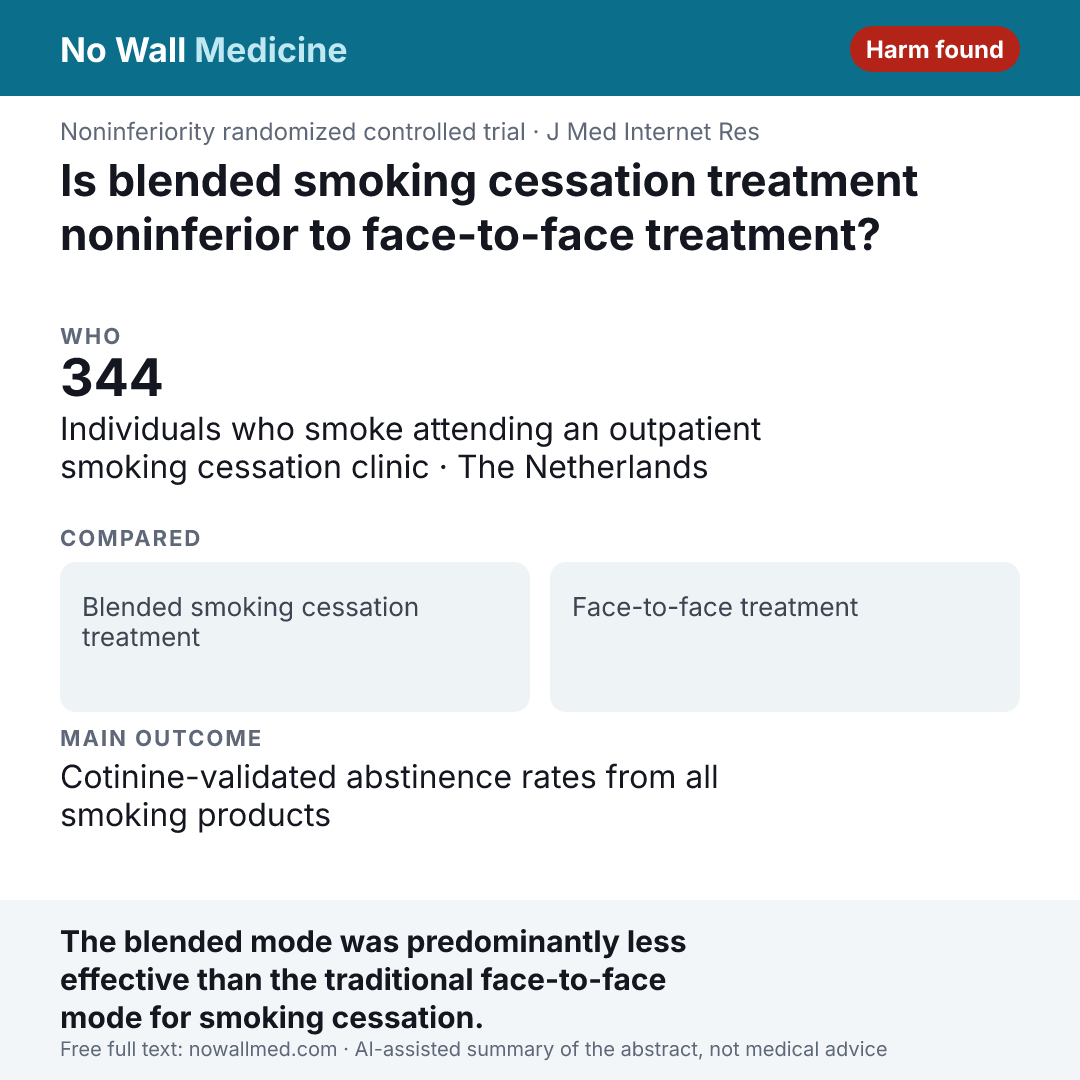
Noninferiority randomized controlled trialHarm found
Is blended smoking cessation treatment noninferior to face-to-face treatment?
Who
344
Individuals who smoke attending an outpatient smoking cessation clinic · The Netherlands
Compared
Blended smoking cessation treatment
Face-to-face treatment
Main outcome
Cotinine-validated abstinence rates from all smoking products
Bottom line: The blended mode was predominantly less effective than the traditional face-to-face mode for smoking cessation.
J Med Internet Res · 2024-02-20 · Save PNG
Key points
- Researchers studied 344 individuals attending an outpatient clinic in the Netherlands who received either blended treatment or face-to-face treatment.
- The blended treatment, which replaced 50% of face-to-face components with web-based tools, showed significantly inferior abstinence rates in 4 out of 13 measured outcomes.
- Specific inferior outcomes for the blended group included cotinine-validated point prevalence abstinence at 3 months with a difference of 12.7 (95% CI 6.2-19.4).
Discussion prompts
- Would these patients look like yours? Who was left out?
- Is the main outcome one that matters to patients?
- Is the difference large enough to change what you do?
Cite: Siemer L, Pieterse ME, Ben Allouch S, Postel MG, Brusse-Keizer MGJ. Comparing the Effectiveness of the Blended Delivery Mode With the Face-to-Face Delivery Mode of Smoking Cessation Treatment: Noninferiority Randomized Controlled Trial. J Med Internet Res. 2024;26:e47040. doi:10.2196/47040
Free full text: PubMed Central · Summary and visual abstract: nowallmed.com/a/comparing-the-effectiveness-of-the-blended-delivery-mode-with-the-1f94q84/ (AI-assisted from the abstract; check the paper before relying on it).