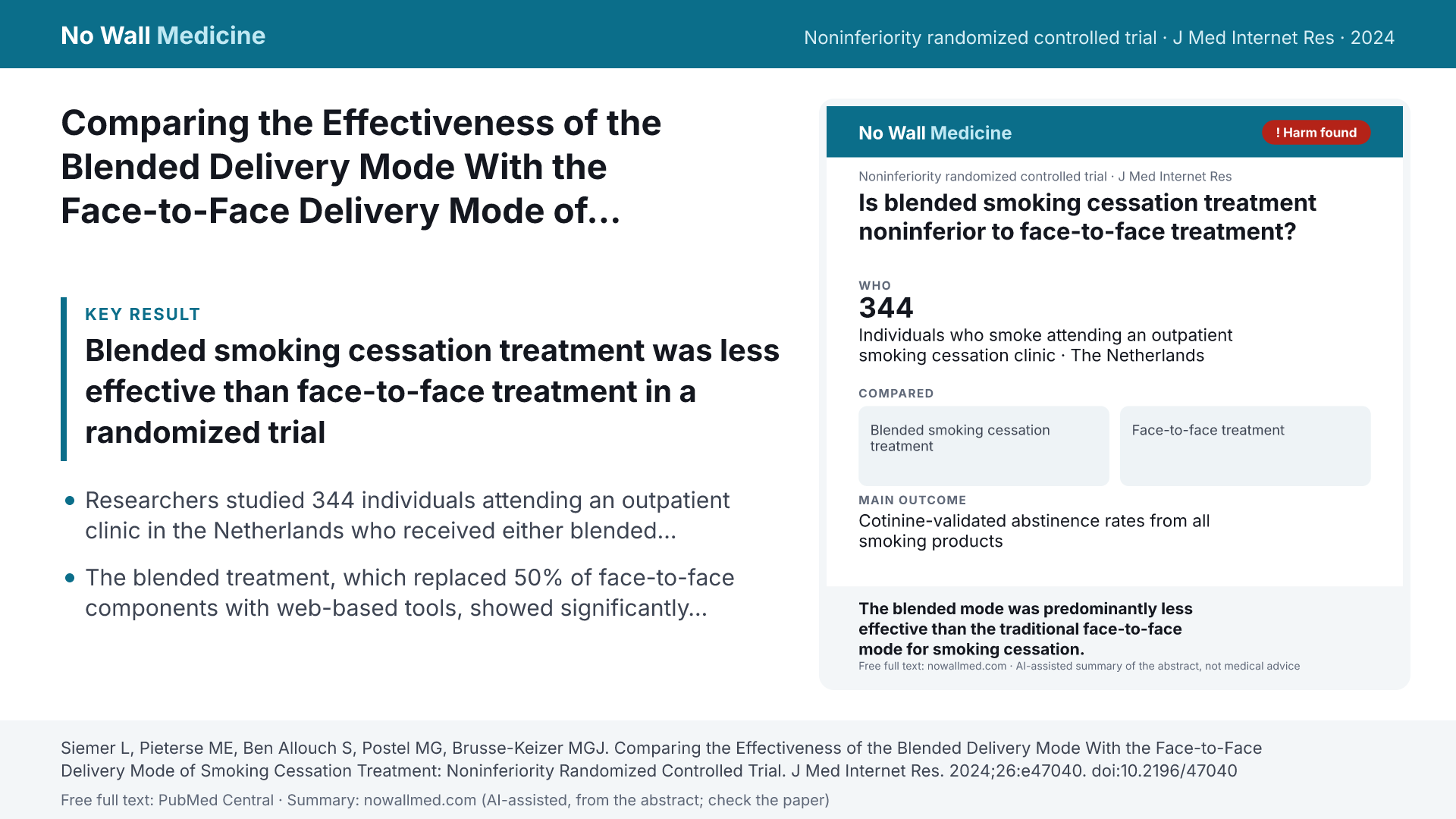
Blended smoking cessation treatment was less effective than face-to-face treatment in a randomized trial
Comparing the Effectiveness of the Blended Delivery Mode With the Face-to-Face Delivery Mode of Smoking Cessation Treatment: Noninferiority Randomized Controlled Trial
Noninferiority randomized controlled trialHarm found
Is blended smoking cessation treatment noninferior to face-to-face treatment?
Who
344
Individuals who smoke attending an outpatient smoking cessation clinic · The Netherlands
Compared
Blended smoking cessation treatment
Face-to-face treatment
Main outcome
Cotinine-validated abstinence rates from all smoking products
Bottom line: The blended mode was predominantly less effective than the traditional face-to-face mode for smoking cessation.
J Med Internet Res · 2024-02-20Download image
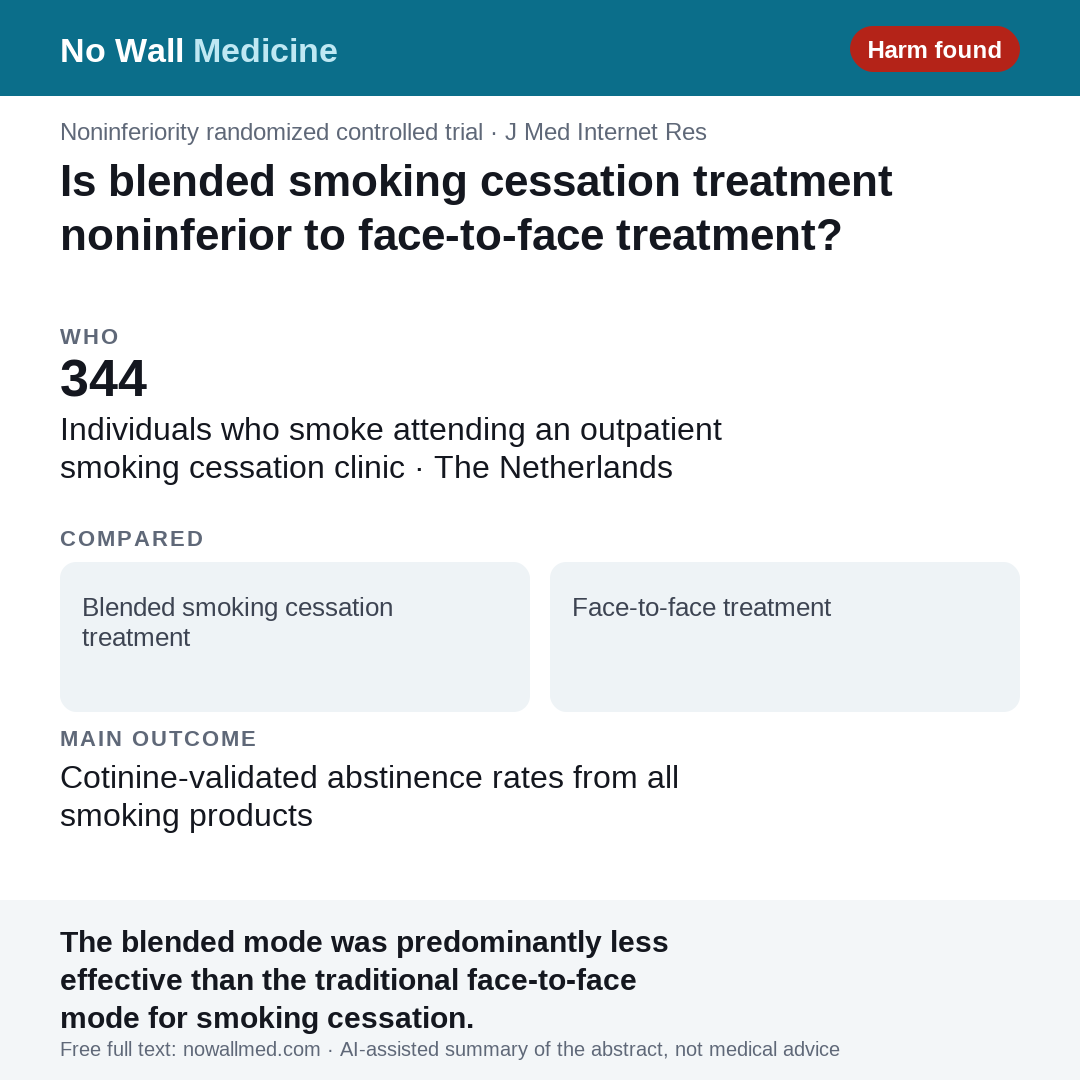
Clinical question: Is blended smoking cessation treatment noninferior to face-to-face treatment?
Why it matters: It was unknown if replacing 50% of face-to-face smoking cessation components with web-based tools would be as effective as traditional face-to-face treatment.
Key points
- Researchers studied 344 individuals attending an outpatient clinic in the Netherlands who received either blended treatment or face-to-face treatment.
- The blended treatment, which replaced 50% of face-to-face components with web-based tools, showed significantly inferior abstinence rates in 4 out of 13 measured outcomes.
- Specific inferior outcomes for the blended group included cotinine-validated point prevalence abstinence at 3 months with a difference of 12.7 (95% CI 6.2-19.4).
Headline and key points written with AI from the paper’s abstract, with every number checked against it. Read the paper before relying on them.
Was this summary helpful?
Subject terms
Cite this article
Siemer L, Pieterse ME, Ben Allouch S, Postel MG, Brusse-Keizer MGJ. Comparing the Effectiveness of the Blended Delivery Mode With the Face-to-Face Delivery Mode of Smoking Cessation Treatment: Noninferiority Randomized Controlled Trial. J Med Internet Res. 2024. doi:10.2196/47040
Spotted a mistake? Suggest a correction