Nicotine replacement and behavioral support helped reduce cigarette use in opioid agonist therapy patients
Integrated Nicotine Replacement and Behavioral Support to Reduce Smoking in Opioid Agonist Therapy: A Randomized Clinical Trial
Multicenter randomized clinical trialBenefit found
Does integrated nicotine replacement and behavioral support reduce smoking in opioid agonist therapy?
Who
259
Individuals with opioid dependency receiving opioid agonist therapy who smoke tobacco · 7 specialized opioid agonist therapy clinics in Norway
Compared
Intervention group: not specified
Control group: not specified
Main outcome
At least 50% reduction in cigarettes smoked at week 16
Result: odds ratio 2.07 (95% CI, 1.14-3.75)
Bottom line: Integrated nicotine replacement and behavioral support effectively helped opioid-dependent participants reduce cigarette smoking.
Limitation: Assessors were not fully blinded to participant allocation.
JAMA Psychiatry · 2025-02-12Download image
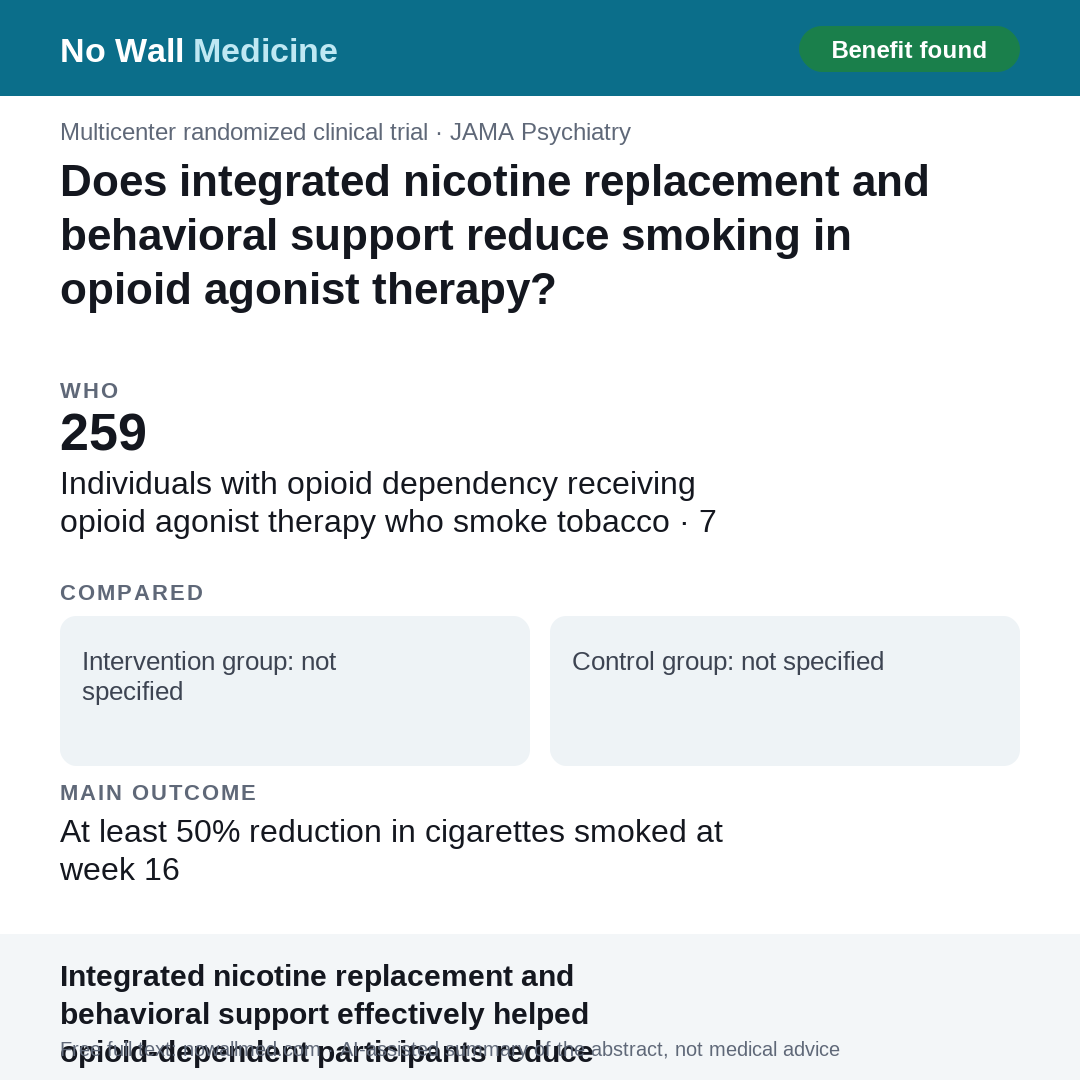
Clinical question: Does integrated nicotine replacement and behavioral support reduce smoking in opioid agonist therapy?
Why it matters: It is unknown if interventions combining nicotine replacement with behavioral support are effective for people receiving opioid agonist therapy for opioid dependence.
Key points
- Researchers studied 259 individuals receiving opioid agonist therapy for opioid dependence at 7 specialized clinics in Norway.
- The group receiving 16 weeks of nicotine replacement and behavioral support had 2.07 times the odds of reducing cigarette smoking by at least 50% compared to the control group.
- The study included 135 participants in the intervention group and 124 participants in the control group.
Limitation the authors note: Assessors, specifically the study nurses, were not fully blinded to participant allocation.
Headline and key points written with AI from the paper’s abstract, with every number checked against it. Read the paper before relying on them.
Topics
Cite this article
Druckrey-Fiskaaen KT, Madebo T, Daltveit JT, Vold JH, Furulund E, Chalabianloo F. Integrated Nicotine Replacement and Behavioral Support to Reduce Smoking in Opioid Agonist Therapy: A Randomized Clinical Trial. JAMA Psychiatry. 2025. doi:10.1001/jamapsychiatry.2024.4801
Spotted a mistake? Suggest a correction