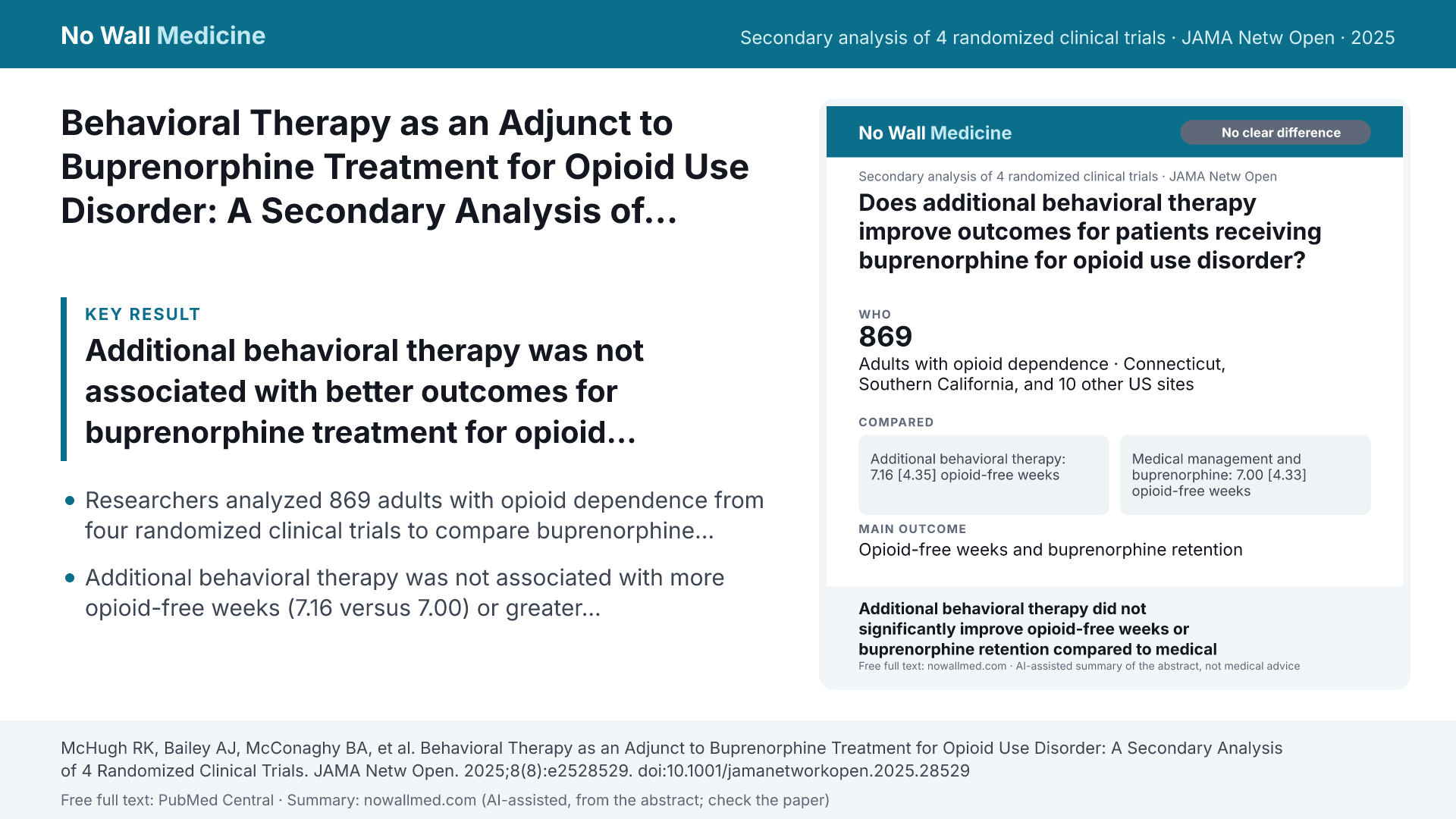
Additional behavioral therapy was not associated with better outcomes for buprenorphine treatment for opioid use disorder
Behavioral Therapy as an Adjunct to Buprenorphine Treatment for Opioid Use Disorder: A Secondary Analysis of 4 Randomized Clinical Trials
Secondary analysis of 4 randomized clinical trialsNo clear difference
Does additional behavioral therapy improve outcomes for patients receiving buprenorphine for opioid use disorder?
Who
869
Adults with opioid dependence · Connecticut, Southern California, and 10 other US sites
Compared
Additional behavioral therapy: 7.16 [4.35] opioid-free weeks
Medical management and buprenorphine: 7.00 [4.33] opioid-free weeks
Main outcome
Opioid-free weeks and buprenorphine retention
Result: B = 0.28; 95% CI, -0.33 to 0.89
Bottom line: Additional behavioral therapy did not significantly improve opioid-free weeks or buprenorphine retention compared to medical management and buprenorphine.
JAMA Netw Open · 2025-08-01 · Save PNG
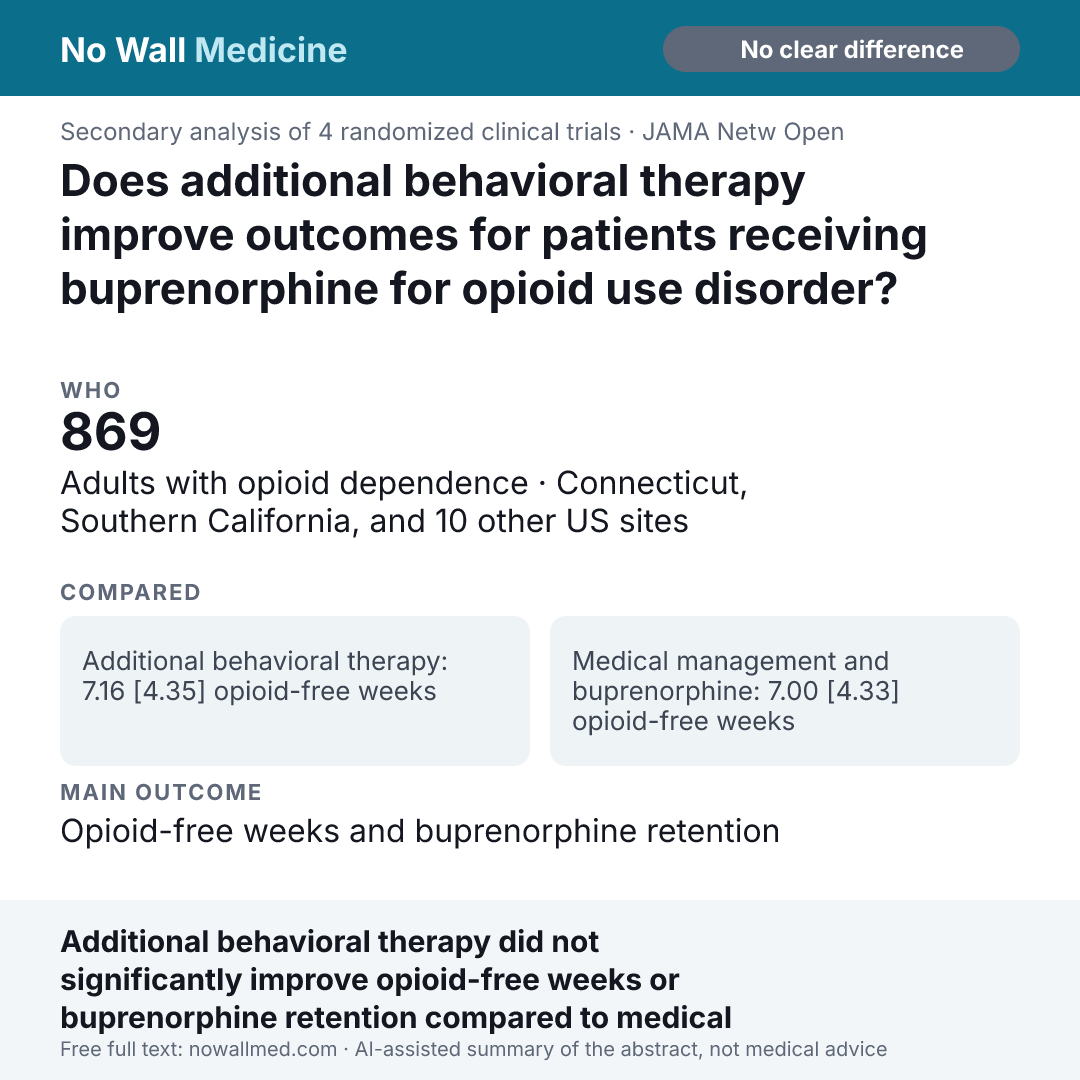
Clinical question: Does additional behavioral therapy improve outcomes for patients receiving buprenorphine for opioid use disorder?
Key points
- Researchers analyzed 869 adults with opioid dependence from four randomized clinical trials to compare buprenorphine with medical management against buprenorphine plus additional behavioral therapy.
- Additional behavioral therapy was not associated with more opioid-free weeks (7.16 versus 7.00) or greater buprenorphine retention (10.29 versus 10.21 weeks out of 12).
- There were no significant differences between groups regarding functioning across seven domains or any significant subgroup moderation effects.
Headline and key points written with AI from the paper’s abstract, with every number checked against it. Read the paper before relying on them.
Was this summary helpful?
Subject terms
Headline, design, result, key points, caveat and citation as plain text.
Cite this article
McHugh RK, Bailey AJ, McConaghy BA, et al. Behavioral Therapy as an Adjunct to Buprenorphine Treatment for Opioid Use Disorder: A Secondary Analysis of 4 Randomized Clinical Trials. JAMA Netw Open. 2025;8(8):e2528529. doi:10.1001/jamanetworkopen.2025.28529
Spotted a mistake? Suggest a correction