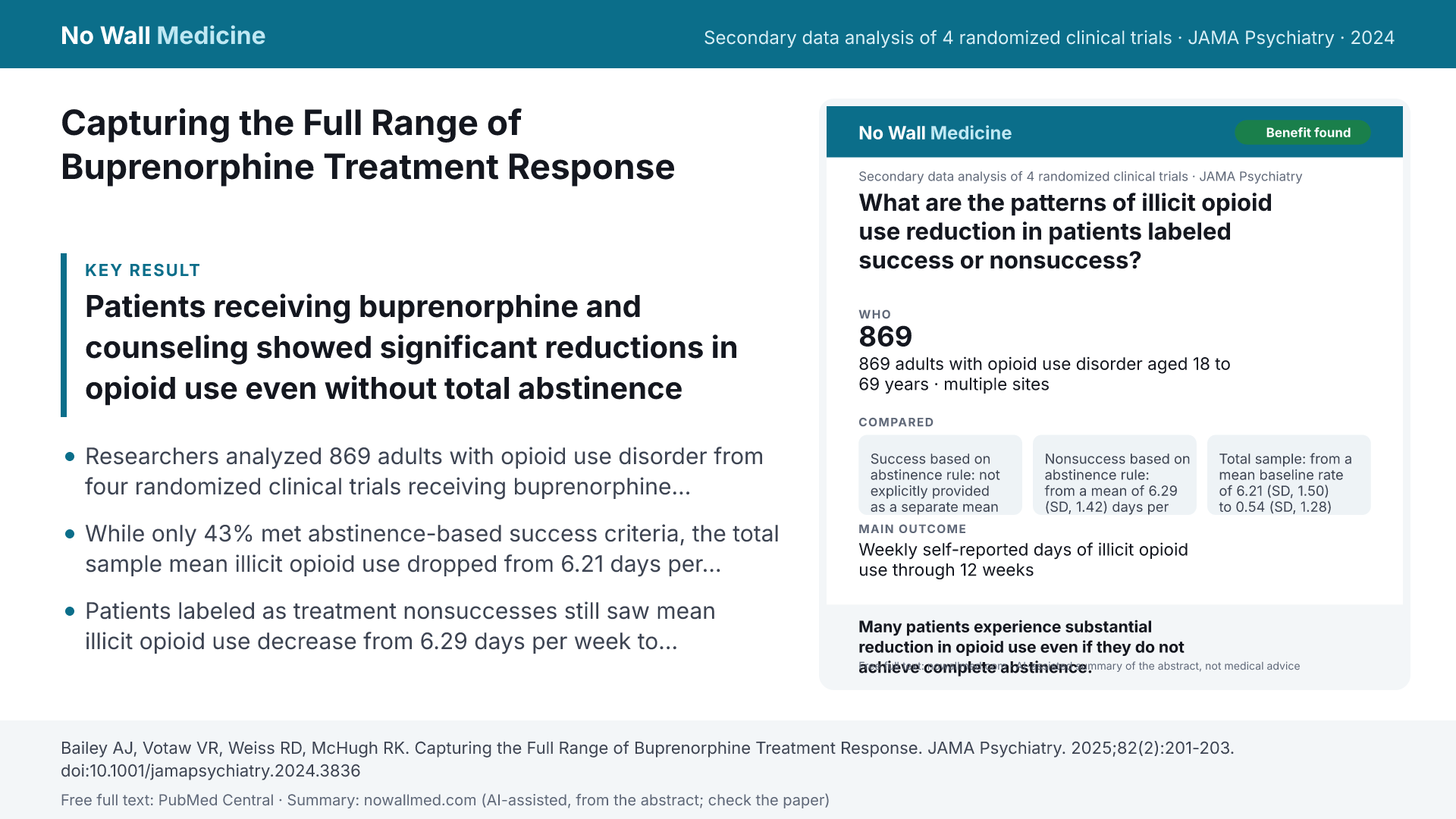
Patients receiving buprenorphine and counseling showed significant reductions in opioid use even without total abstinence
Capturing the Full Range of Buprenorphine Treatment Response
Secondary data analysis of 4 randomized clinical trialsBenefit found
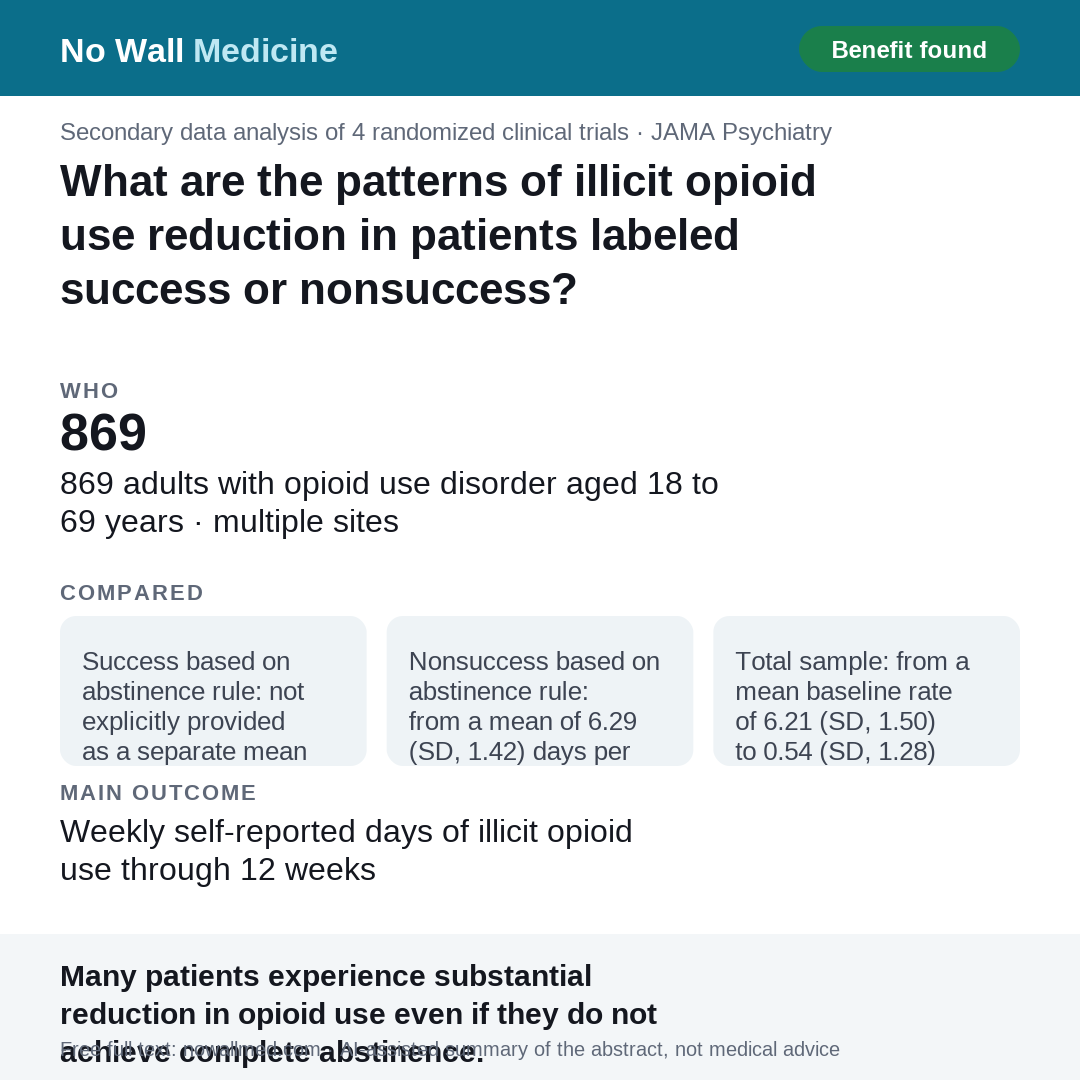
What are the patterns of illicit opioid use reduction in patients labeled success or nonsuccess?
Who
869
869 adults with opioid use disorder aged 18 to 69 years · multiple sites
Compared
Success based on abstinence rule: not explicitly provided as a separate mean
Nonsuccess based on abstinence rule: from a mean of 6.29 (SD, 1.42) days per week to 1.51 (SD, 1.76) days per week
Total sample: from a mean baseline rate of 6.21 (SD, 1.50) to 0.54 (SD, 1.28)
Main outcome
Weekly self-reported days of illicit opioid use through 12 weeks
Bottom line: Many patients experience substantial reduction in opioid use even if they do not achieve complete abstinence.
Limitation: Future studies are needed to characterize how these reductions are associated with functional and long-term outcomes.
JAMA Psychiatry · 2024-12-04Download image
Clinical question: What are the patterns of illicit opioid use reduction in patients labeled success or nonsuccess?
Why it matters: Reliance on abstinence-based success rules may fail to capture the full range of how patients respond to buprenorphine and medical counseling.
Key points
- Researchers analyzed 869 adults with opioid use disorder from four randomized clinical trials receiving buprenorphine plus medical counseling or enhanced counseling.
- While only 43% met abstinence-based success criteria, the total sample mean illicit opioid use dropped from 6.21 days per week to 0.54 days per week by week 12.
- Patients labeled as treatment nonsuccesses still saw mean illicit opioid use decrease from 6.29 days per week to 1.51 days per week.
Headline and key points written with AI from the paper’s abstract, with every number checked against it. Read the paper before relying on them.
Was this summary helpful?
Subject terms
Cite this article
Bailey AJ, Votaw VR, Weiss RD, McHugh RK. Capturing the Full Range of Buprenorphine Treatment Response. JAMA Psychiatry. 2024. doi:10.1001/jamapsychiatry.2024.3836
Spotted a mistake? Suggest a correction