Rapid induction to buprenorphine injection showed higher retention than standard induction in opioid users
Rapid vs Standard Induction to Injectable Extended-Release Buprenorphine: A Randomized Clinical Trial
Multicenter, open-label randomized clinical trialBenefit found
Is rapid induction more effective than standard induction for injectable buprenorphine?
Who
729
Participants with moderate or severe opioid use disorder · 28 outpatient treatment centers in the US and Canada
Compared
66.2%Rapid induction
54.1%Standard induction
Main outcome
Retention rate difference at injection 2
Result: difference, 11.8%; 95% credible interval [CrI], 4.3%-19.0%
Bottom line: Rapid induction resulted in higher retention than standard induction for injectable buprenorphine treatment.
JAMA Netw Open · 2025-10-01Download image
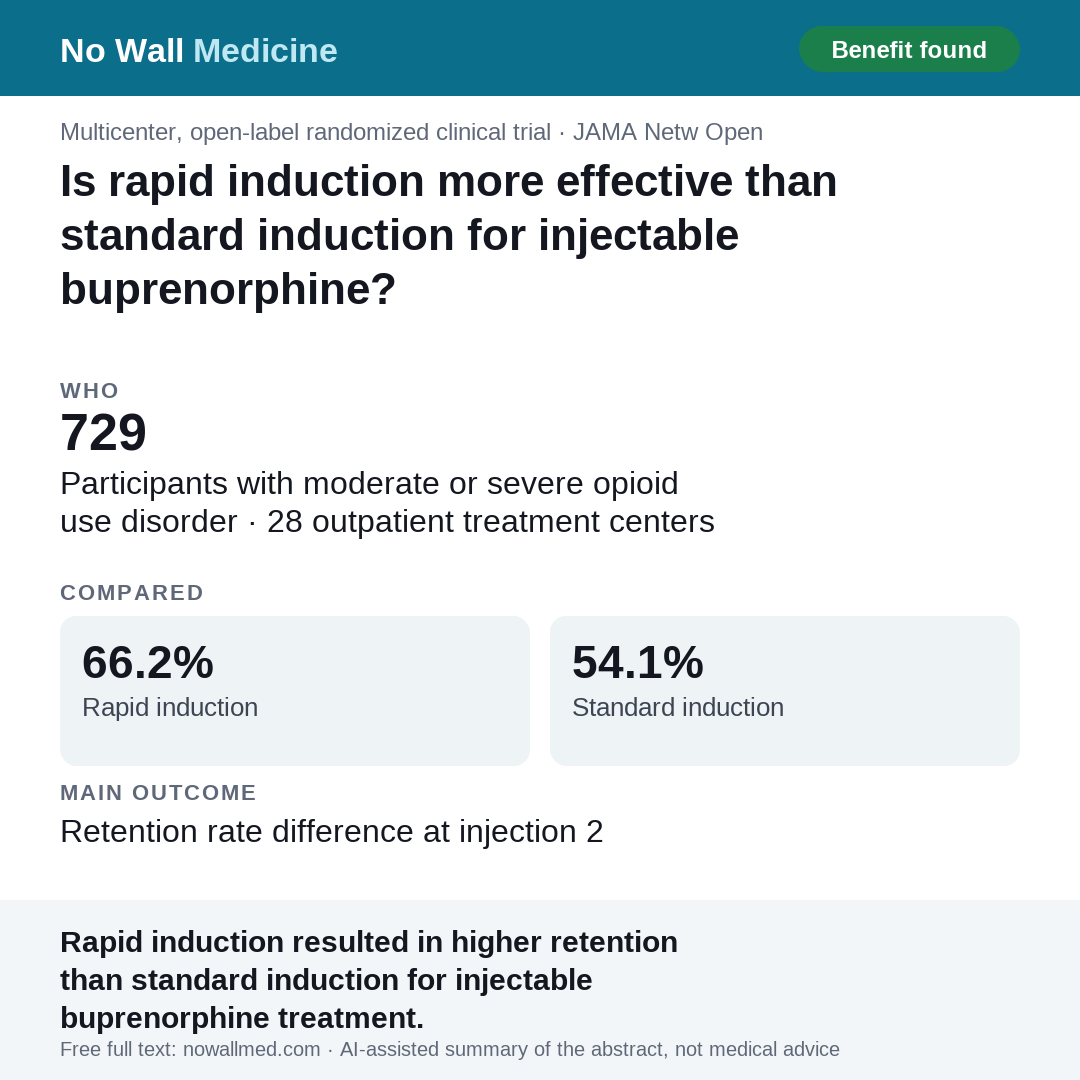
Clinical question: Is rapid induction more effective than standard induction for injectable buprenorphine?
Why it matters: Standard induction using transmucosal buprenorphine-naloxone is challenging for individuals who inject opioids, use high doses, or use synthetic opioids like fentanyl.
Key points
- Researchers studied 729 participants with opioid use disorder who were randomized to receive either rapid induction or standard induction before extended-release buprenorphine injection.
- Rapid induction was associated with a higher retention rate at the second injection compared to standard induction, with a difference of 11.8% (95% credible interval, 4.3%-19.0%).
- Among participants who tested positive for fentanyl, the retention rate difference in favor of rapid induction was 14.8% (95% credible interval, 6.5%-23.7%).
Headline and key points written with AI from the paper’s abstract, with every number checked against it. Read the paper before relying on them.
Topics
Cite this article
Shiwach R, Le Foll B, Alho H, Dunn KE, Strafford S, Zhao Y. Rapid vs Standard Induction to Injectable Extended-Release Buprenorphine: A Randomized Clinical Trial. JAMA Netw Open. 2025. doi:10.1001/jamanetworkopen.2025.37319
Spotted a mistake? Suggest a correction
Top studies every Monday
The week’s key trials and guidelines in your specialties, by email. Free.
Get the weekly digest