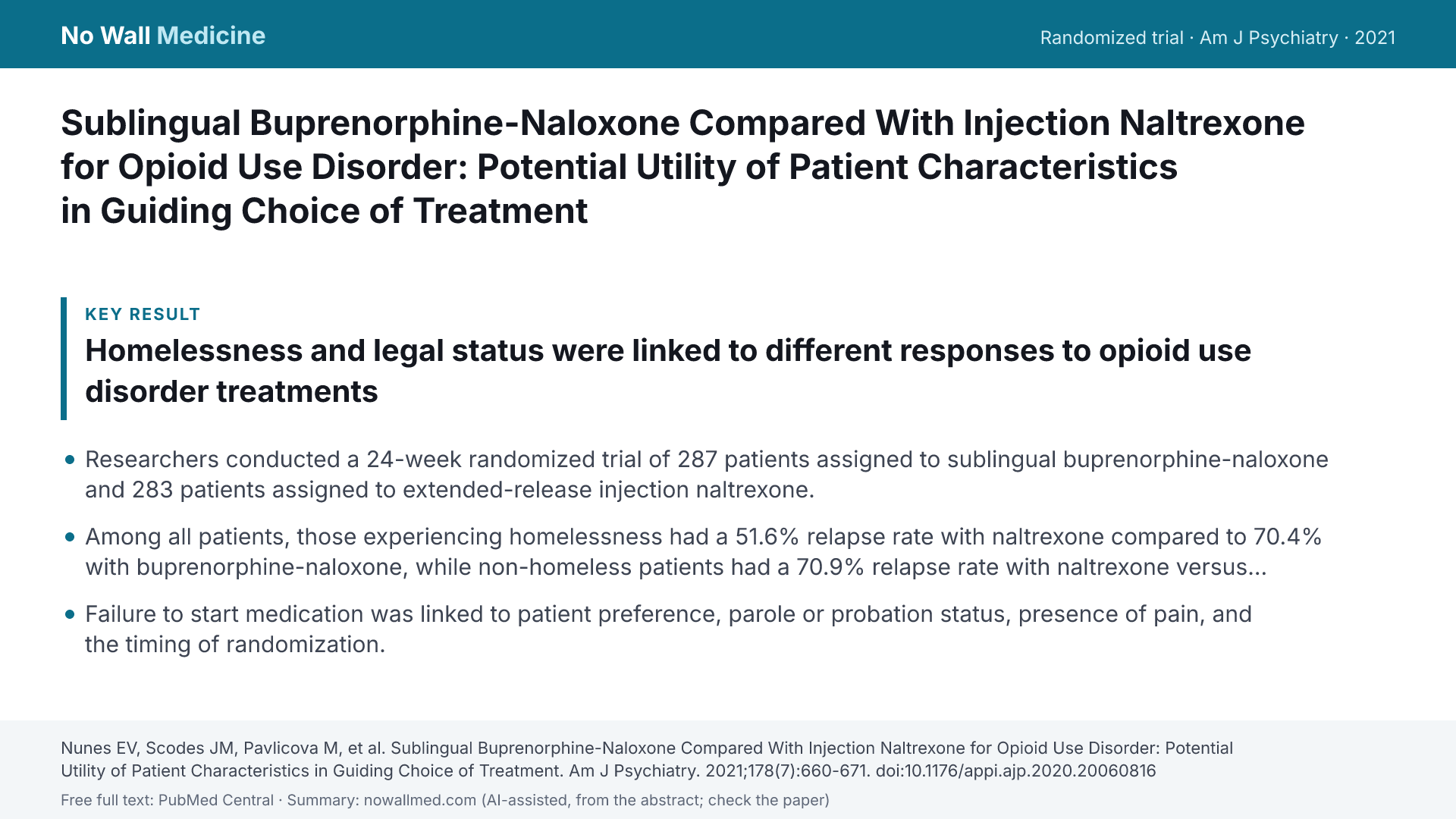
Homelessness and legal status were linked to different responses to opioid use disorder treatments
Sublingual Buprenorphine-Naloxone Compared With Injection Naltrexone for Opioid Use Disorder: Potential Utility of Patient Characteristics in Guiding Choice of Treatment
Why it matters: It is unknown if specific demographic or clinical characteristics can help guide the choice between buprenorphine-naloxone and extended-release injection naltrexone for treating opioid use disorder.
Key points
- Researchers conducted a 24-week randomized trial of 287 patients assigned to sublingual buprenorphine-naloxone and 283 patients assigned to extended-release injection naltrexone.
- Among all patients, those experiencing homelessness had a 51.6% relapse rate with naltrexone compared to 70.4% with buprenorphine-naloxone, while non-homeless patients had a 70.9% relapse rate with naltrexone versus 53.1% with buprenorphine-naloxone.
- Failure to start medication was linked to patient preference, parole or probation status, presence of pain, and the timing of randomization.
Headline and key points written with AI from the paper’s abstract, with every number checked against it. Read the paper before relying on them.
Was this summary helpful?
Subject terms
Cite this article
Nunes EV, Scodes JM, Pavlicova M, Lee JD, Novo P, Campbell ANC. Sublingual Buprenorphine-Naloxone Compared With Injection Naltrexone for Opioid Use Disorder: Potential Utility of Patient Characteristics in Guiding Choice of Treatment. Am J Psychiatry. 2021. doi:10.1176/appi.ajp.2020.20060816
Spotted a mistake? Suggest a correction
Top studies every Monday
The week’s key trials and guidelines in your specialties, plus any topics you follow. By email, free.
Get the weekly digest