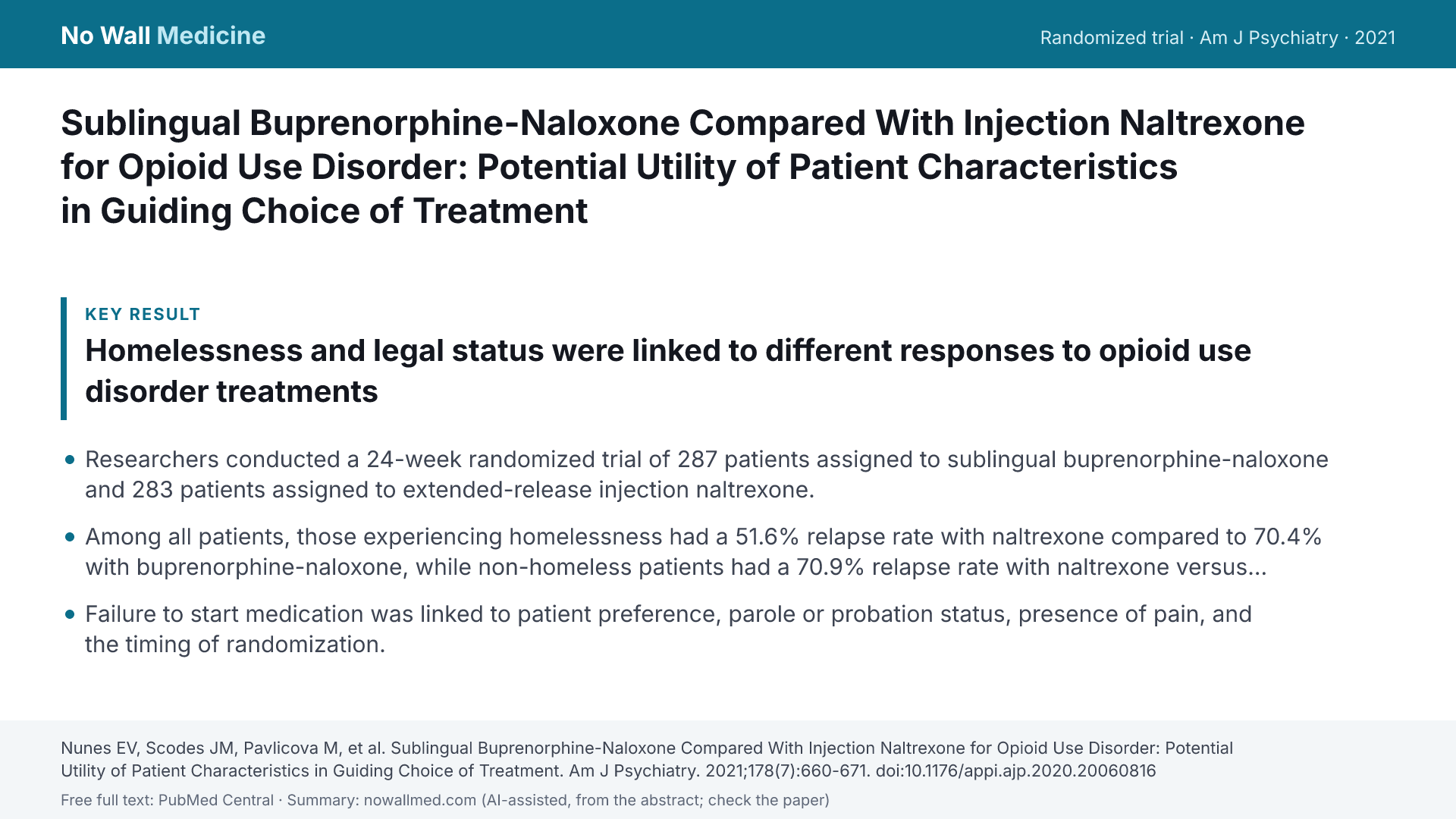
Sublingual Buprenorphine-Naloxone Compared With Injection Naltrexone for Opioid Use Disorder: Potential Utility of Patient Characteristics in Guiding Choice of Treatment
Key result: Homelessness and legal status were linked to different responses to opioid use disorder treatments
Key points
- Researchers conducted a 24-week randomized trial of 287 patients assigned to sublingual buprenorphine-naloxone and 283 patients assigned to extended-release injection naltrexone.
- Among all patients, those experiencing homelessness had a 51.6% relapse rate with naltrexone compared to 70.4% with buprenorphine-naloxone, while non-homeless patients had a 70.9% relapse rate with naltrexone versus 53.1% with buprenorphine-naloxone.
- Failure to start medication was linked to patient preference, parole or probation status, presence of pain, and the timing of randomization.
Discussion prompts
- Would these patients look like yours? Who was left out?
- Is the main outcome one that matters to patients?
- Is the difference large enough to change what you do?
Cite: Nunes EV, Scodes JM, Pavlicova M, et al. Sublingual Buprenorphine-Naloxone Compared With Injection Naltrexone for Opioid Use Disorder: Potential Utility of Patient Characteristics in Guiding Choice of Treatment. Am J Psychiatry. 2021;178(7):660-671. doi:10.1176/appi.ajp.2020.20060816
Free full text: PubMed Central · Summary and visual abstract: nowallmed.com/a/sublingual-buprenorphine-naloxone-compared-with-injection-naltrexone-1i7xk60/ (AI-assisted from the abstract; check the paper before relying on it).