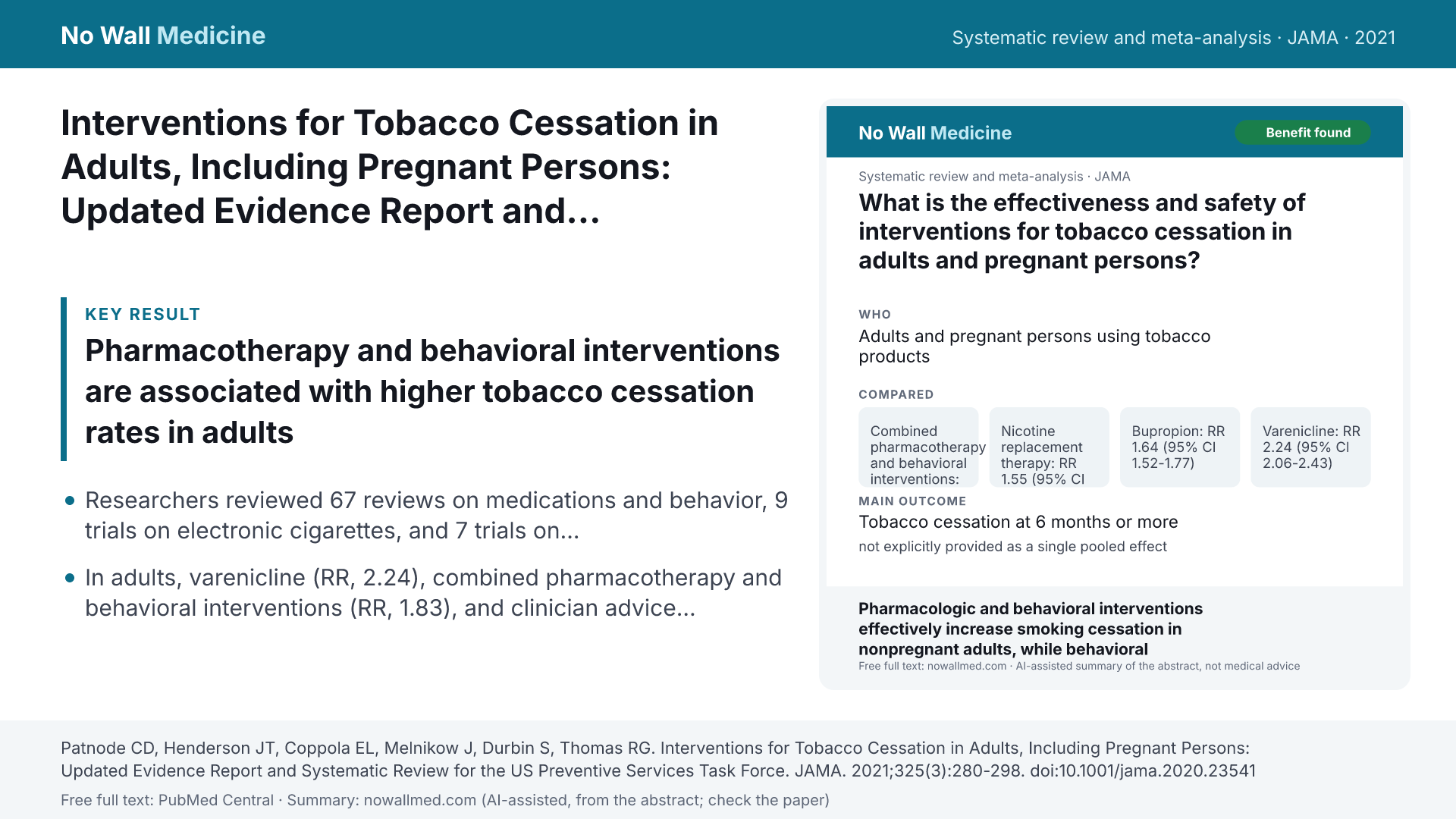
Pharmacotherapy and behavioral interventions are associated with higher tobacco cessation rates in adults
Interventions for Tobacco Cessation in Adults, Including Pregnant Persons: Updated Evidence Report and Systematic Review for the US Preventive Services Task Force
Systematic review and meta-analysisBenefit found
What is the effectiveness and safety of interventions for tobacco cessation in adults and pregnant persons?
Who
Adults and pregnant persons using tobacco products
Compared
Combined pharmacotherapy and behavioral interventions: RR 1.83 (95% CI 1.68-1.98)
Nicotine replacement therapy: RR 1.55 (95% CI 1.49-1.61)
Bupropion: RR 1.64 (95% CI 1.52-1.77)
Varenicline: RR 2.24 (95% CI 2.06-2.43)
Main outcome
Tobacco cessation at 6 months or more
Result: not explicitly provided as a single pooled effect
Bottom line: Pharmacologic and behavioral interventions effectively increase smoking cessation in nonpregnant adults, while behavioral interventions work for pregnant persons.
Limitation: Data are limited on pharmacotherapy for smoking cessation in pregnancy and electronic cigarette effectiveness is inconsistent.
JAMA · 2021-01-19Download image
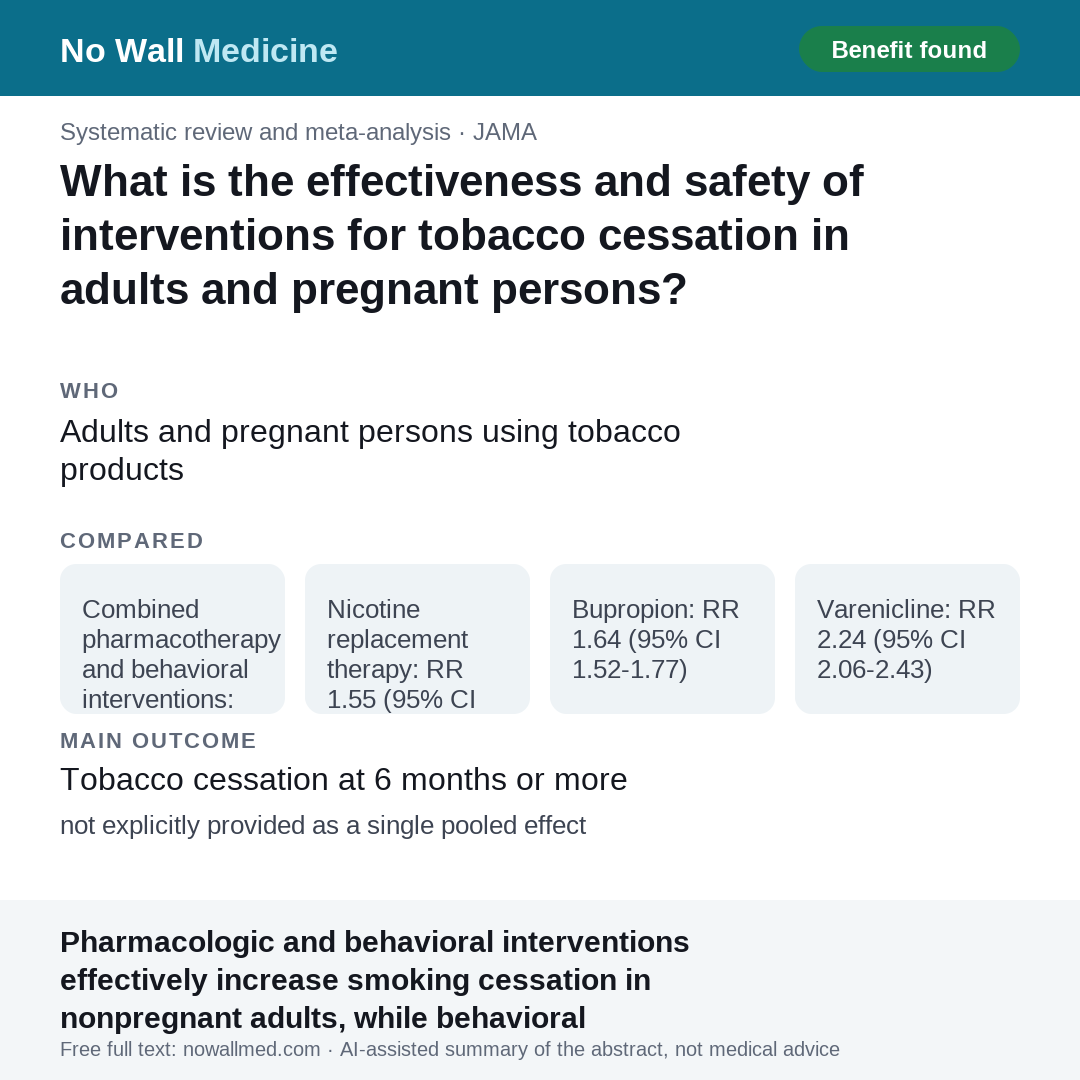
Clinical question: What is the effectiveness and safety of interventions for tobacco cessation in adults and pregnant persons?
Why it matters: The effectiveness and safety of medications, behavioral support, and electronic cigarettes for tobacco cessation in adults and pregnant persons needed updating.
Key points
- Researchers reviewed 67 reviews on medications and behavior, 9 trials on electronic cigarettes, and 7 trials on nicotine replacement therapy in pregnancy.
- In adults, varenicline (RR, 2.24), combined pharmacotherapy and behavioral interventions (RR, 1.83), and clinician advice (RR, 1.76) were associated with increased quit rates at 6 months or longer.
- Among pregnant persons, behavioral interventions were associated with greater smoking cessation during late pregnancy (RR, 1.35), but nicotine replacement therapy showed no significant difference compared to placebo (RR, 1.11).
Limitation the authors note: Data on the effectiveness and safety of electronic cigarettes for smoking cessation are limited and results are inconsistent.
Headline and key points written with AI from the paper’s abstract, with every number checked against it. Read the paper before relying on them.
Was this summary helpful?
Subject terms
Headline, design, result, key points, caveat and citation as plain text.
Cite this article
Patnode CD, Henderson JT, Coppola EL, Melnikow J, Durbin S, Thomas RG. Interventions for Tobacco Cessation in Adults, Including Pregnant Persons: Updated Evidence Report and Systematic Review for the US Preventive Services Task Force. JAMA. 2021. doi:10.1001/jama.2020.23541
Spotted a mistake? Suggest a correction