HIV self-testing increased testing uptake and frequency among key populations in randomized controlled trials
Comparing the effects of HIV self-testing to standard HIV testing for key populations: a systematic review and meta-analysis
Meta-analysis of 10 randomized controlled trialsMixed results
Does HIV self-testing compare effectively to standard HIV testing for key populations?
Who
9679
Key populations including men who have sex with men, trans people, and female sex workers
Compared
HIV self-testing
Standard HIV testing
Main outcome
HIV testing uptake
Result: relative risk 1.45 (95% CI 1.20, 1.75)
Bottom line: HIV self-testing increases testing uptake and frequency but reduces linkage to care overall.
BMC Med · 2020-12-03Download image
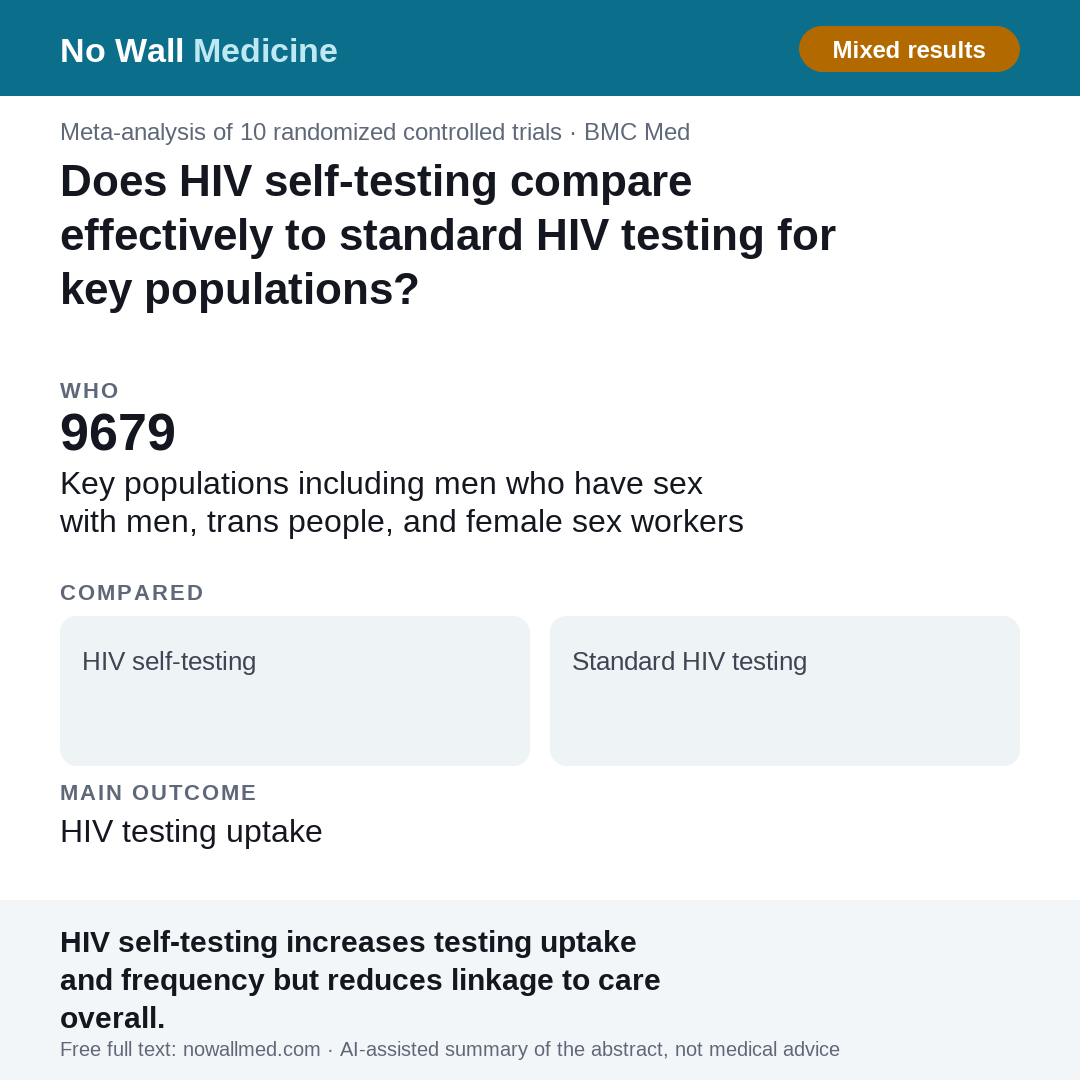
Clinical question: Does HIV self-testing compare effectively to standard HIV testing for key populations?
Why it matters: It was unknown which service delivery models for HIV self-testing are effective for key populations to inform new World Health Organization recommendations.
Key points
- Researchers analyzed 10 randomized controlled trials involving 9679 participants, including 5486 men who have sex with men and 4121 female sex workers.
- HIV self-testing increased testing uptake by 1.45 times and increased the mean number of tests by 2.56 for men who have sex with men and trans people.
- HIV self-testing was associated with a 17% reduction in linkage to care, which is the process of connecting a person with a positive test to medical treatment.
Headline and key points written with AI from the paper’s abstract, with every number checked against it. Read the paper before relying on them.
Was this summary helpful?
Subject terms
Cite this article
Witzel TC, Eshun-Wilson I, Jamil MS, Tilouche N, Figueroa C, Johnson CC. Comparing the effects of HIV self-testing to standard HIV testing for key populations: a systematic review and meta-analysis. BMC Med. 2020. doi:10.1186/s12916-020-01835-z
Spotted a mistake? Suggest a correction
Top studies every Monday
The week’s key trials and guidelines in your specialties, plus any topics you follow. By email, free.
Get the weekly digest