Liquid glucagon autoinjector was non-inferior to emergency kits for treating severe low blood sugar
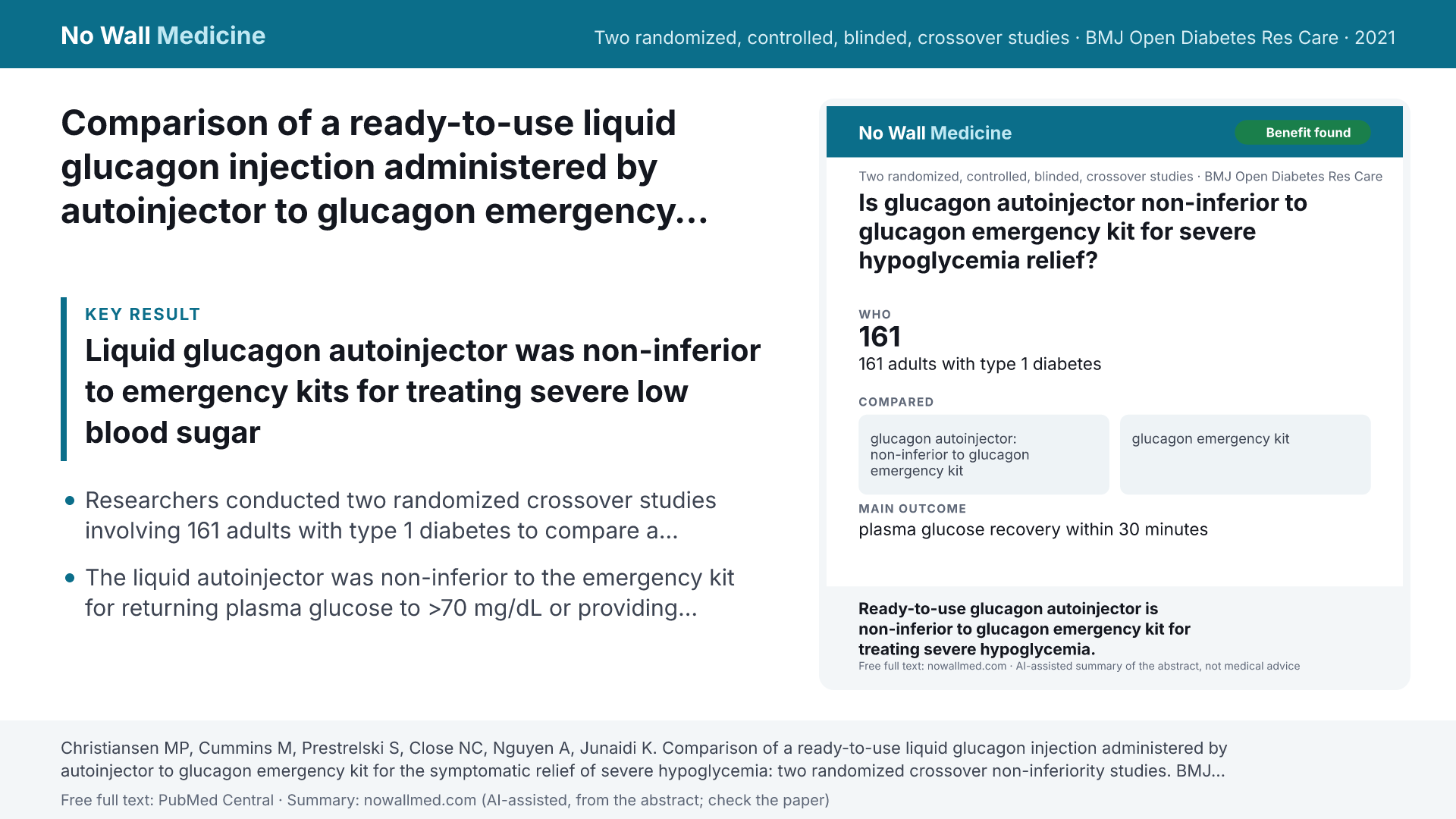
Comparison of a ready-to-use liquid glucagon injection administered by autoinjector to glucagon emergency kit for the symptomatic relief of severe hypoglycemia: two randomized crossover non-inferiority studies
Two randomized, controlled, blinded, crossover studiesBenefit found
Is glucagon autoinjector non-inferior to glucagon emergency kit for severe hypoglycemia relief?
Who
161
161 adults with type 1 diabetes
Compared
glucagon autoinjector: non-inferior to glucagon emergency kit
glucagon emergency kit
Main outcome
plasma glucose recovery within 30 minutes
Bottom line: Ready-to-use glucagon autoinjector is non-inferior to glucagon emergency kit for treating severe hypoglycemia.
BMJ Open Diabetes Res Care · 2021-10-08Download image
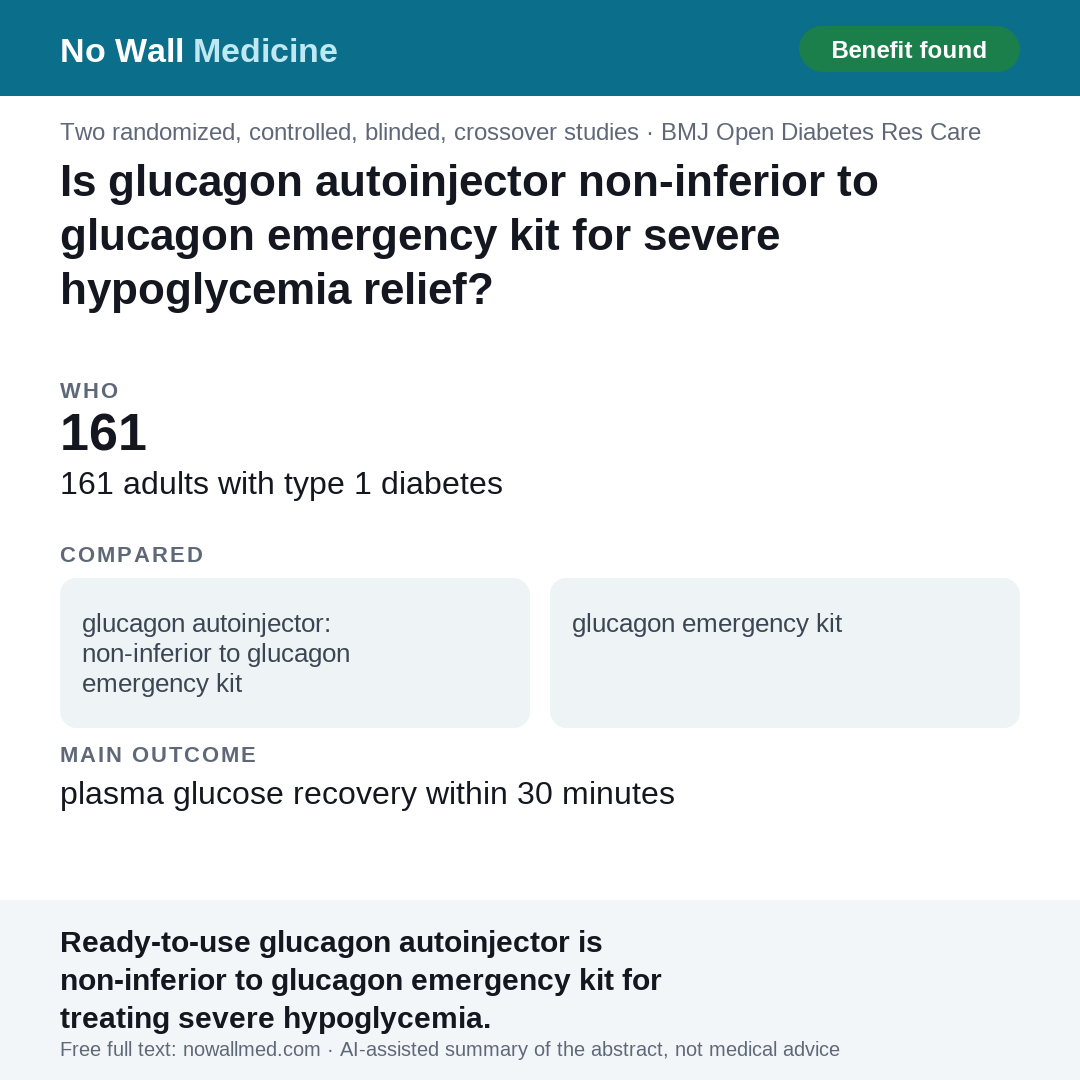
Clinical question: Is glucagon autoinjector non-inferior to glucagon emergency kit for severe hypoglycemia relief?
Key points
- Researchers conducted two randomized crossover studies involving 161 adults with type 1 diabetes to compare a liquid glucagon autoinjector to a glucagon emergency kit.
- The liquid autoinjector was non-inferior to the emergency kit for returning plasma glucose to >70 mg/dL or providing symptom relief within 30 min.
- The mean time to achieve target glucose levels was 13.8±5.6 min for the autoinjector and 10.0±3.6 min for the emergency kit.
Headline and key points written with AI from the paper’s abstract, with every number checked against it. Read the paper before relying on them.
Was this summary helpful?
Abstract
Introduction
To prevent medical sequelae of severe hypoglycemic emergencies, prompt and reliable rescue intervention is critically important. A ready-to-use, liquid stable glucagon, administered subcutaneously by glucagon autoinjector (GAI), Gvoke HypoPen (glucagon injection; Xeris Pharmaceuticals), was evaluated for rescue treatment of severe hypoglycemia. Research design and methods
Two phase III, randomized, controlled, blinded, non-inferiority crossover studies were conducted in 161 adults with type 1 diabetes to compare 1 mg doses of GAI versus glucagon emergency kit (GEK) for treating insulin-induced severe hypoglycemia. Efficacy was evaluated as either a return of plasma glucose to >70 mg/dL (3.9 mmol/L) or increase ≥20 mg/dL (1.1 mmol/L) from a baseline glucose of <50 mg/dL (2.9 mmol/L), within 30 min of dosing. Results
For successful plasma glucose recovery within 30 min, treatment with GAI was non-inferior to GEK. Treatment with GAI was non-inferior to GEK for a plasma glucose >70 mg/dL (3.9 mmol/L) or neuroglycopenic symptom relief within 30 min. From administration of glucagon, the mean time to achieve plasma glucose >70 mg/dL (3.9 mmol/L) or increase ≥20 mg/dL (1.1 mmol/L) was 13.8±5.6 min for GAI and 10.0±3.6 min for GEK. This mean time does not account for the significantly shorter (p<0.0001) drug preparation and administration time for GAI (27.3±19.7 s) versus GEK (97.2±45.1 s). The incidence of treatment emergent adverse events was comparable in both groups. Conclusions
A ready-to-use GAI was non-inferior to GEK, with a similar tolerability profile. GAI is an effective, safe, and well-tolerated rescue treatment for severe hypoglycemia and is a viable alternative to GEK. Trial registration numbers
NCT02656069 and NCT03439072.
Abstract reproduced under the article’s CC BY NC licence.
Subject terms
Headline, design, result, key points, caveat and citation as plain text.
Cite this article
Christiansen MP, Cummins M, Prestrelski S, Close NC, Nguyen A, Junaidi K. Comparison of a ready-to-use liquid glucagon injection administered by autoinjector to glucagon emergency kit for the symptomatic relief of severe hypoglycemia: two randomized crossover non-inferiority studies. BMJ Open Diabetes Res Care. 2021. doi:10.1136/bmjdrc-2021-002137
Spotted a mistake? Suggest a correction