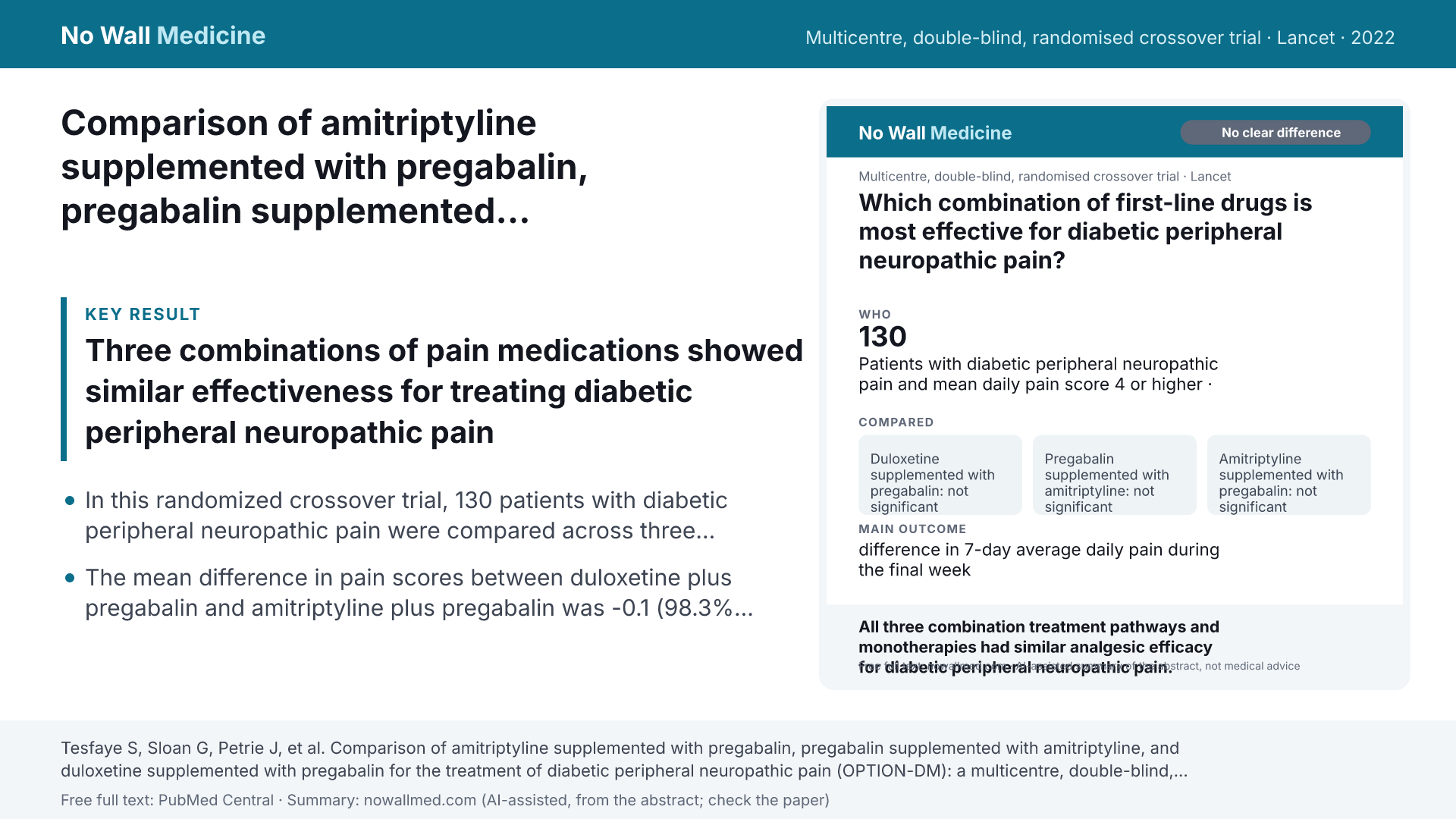
Three combinations of pain medications showed similar effectiveness for treating diabetic peripheral neuropathic pain
Comparison of amitriptyline supplemented with pregabalin, pregabalin supplemented with amitriptyline, and duloxetine supplemented with pregabalin for the treatment of diabetic peripheral neuropathic pain (OPTION-DM): a multicentre, double-blind, randomised crossover trial
Multicentre, double-blind, randomised crossover trialNo clear difference
Which combination of first-line drugs is most effective for diabetic peripheral neuropathic pain?
Who
130
Patients with diabetic peripheral neuropathic pain and mean daily pain score 4 or higher · 13 United Kingdom centres
Compared
Duloxetine supplemented with pregabalin: not significant
Pregabalin supplemented with amitriptyline: not significant
Amitriptyline supplemented with pregabalin: not significant
Main outcome
difference in 7-day average daily pain during the final week
Result: -0·1 (98·3% CI -0·5 to 0·3) for D-P versus A-P
Bottom line: All three combination treatment pathways and monotherapies had similar analgesic efficacy for diabetic peripheral neuropathic pain.
Funded by: National Institute for Health Research Health Technology Assessment programme
Lancet · 2022-08-22Download image
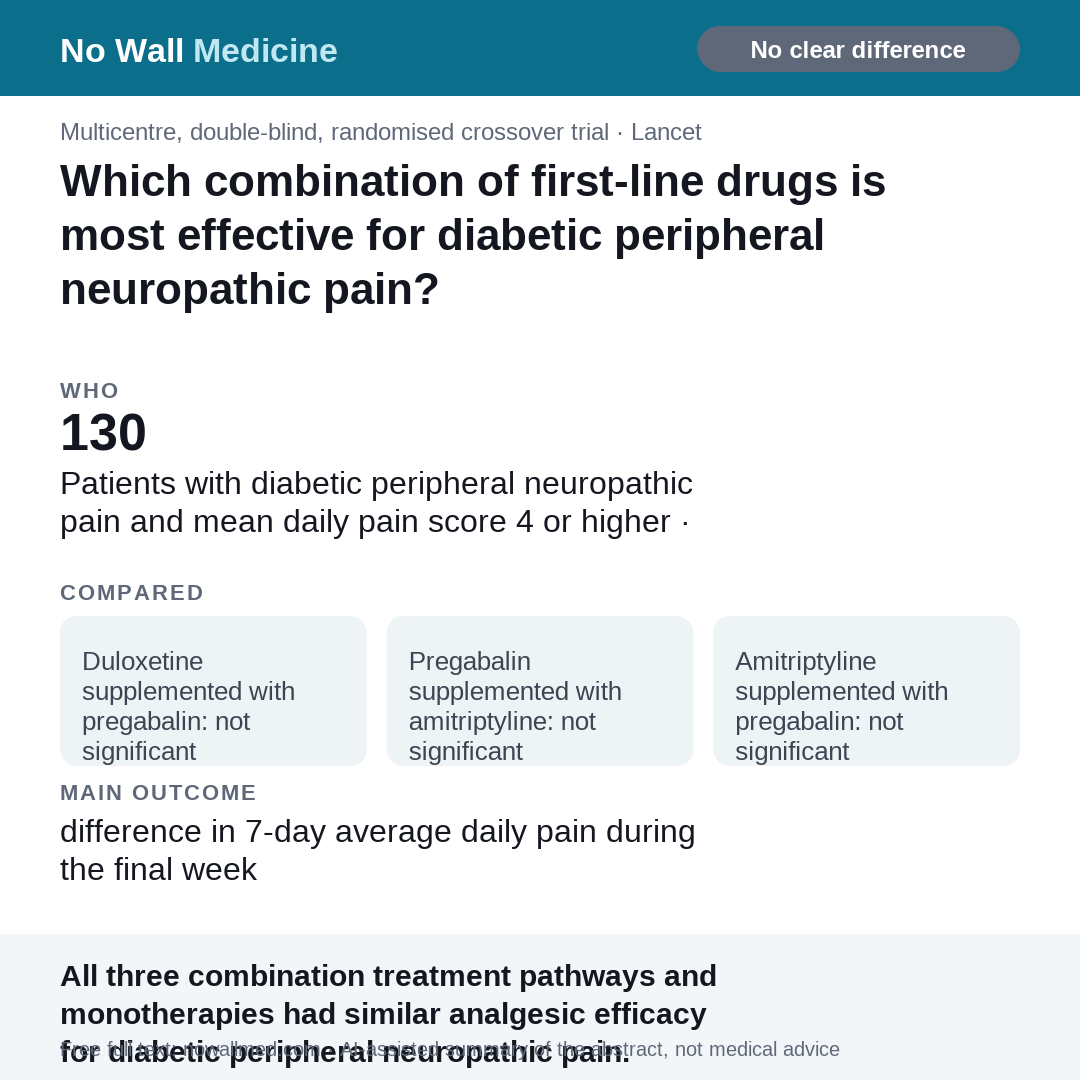
Clinical question: Which combination of first-line drugs is most effective for diabetic peripheral neuropathic pain?
Key points
- In this randomized crossover trial, 130 patients with diabetic peripheral neuropathic pain were compared across three drug combination pathways over 16 weeks.
- The mean difference in pain scores between duloxetine plus pregabalin and amitriptyline plus pregabalin was -0.1 (98.3% CI -0.5 to 0.3), which was not significant.
- Mean pain scores decreased from 6.6 (SD 1.5) at baseline to 3.3 (1.8) at week 16 for all three treatment pathways.
Headline and key points written with AI from the paper’s abstract, with every number checked against it. Read the paper before relying on them.
Was this summary helpful?
Abstract
Background
Diabetic peripheral neuropathic pain (DPNP) is common and often distressing. Most guidelines recommend amitriptyline, duloxetine, pregabalin, or gabapentin as initial analgesic treatment for DPNP, but there is little comparative evidence on which one is best or whether they should be combined. We aimed to assess the efficacy and tolerability of different combinations of first-line drugs for treatment of DPNP. Methods
OPTION-DM was a multicentre, randomised, double-blind, crossover trial in patients with DPNP with mean daily pain numerical rating scale (NRS) of 4 or higher (scale is 0-10) from 13 UK centres. Participants were randomly assigned (1:1:1:1:1:1), with a predetermined randomisation schedule stratified by site using permuted blocks of size six or 12, to receive one of six ordered sequences of the three treatment pathways: amitriptyline supplemented with pregabalin (A-P), pregabalin supplemented with amitriptyline (P-A), and duloxetine supplemented with pregabalin (D-P), each pathway lasting 16 weeks. Monotherapy was given for 6 weeks and was supplemented with the combination medication if there was suboptimal pain relief (NRS >3), reflecting current clinical practice. Both treatments were titrated towards maximum tolerated dose (75 mg per day for amitriptyline, 120 mg per day for duloxetine, and 600 mg per day for pregabalin). The primary outcome was the difference in 7-day average daily pain during the final week of each pathway. This trial is registered with ISRCTN, ISRCTN17545443. Findings
Between Nov 14, 2017, and July 29, 2019, 252 patients were screened, 140 patients were randomly assigned, and 130 started a treatment pathway (with 84 completing at least two pathways) and were analysed for the primary outcome. The 7-day average NRS scores at week 16 decreased from a mean 6·6 (SD 1·5) at baseline to 3·3 (1·8) at week 16 in all three pathways. The mean difference was -0·1 (98·3% CI -0·5 to 0·3) for D-P versus A-P, -0·1 (-0·5 to 0·3) for P-A versus A-P, and 0·0 (-0·4 to 0·4) for P-A versus D-P, and thus not significant. Mean NRS reduction in patients on combination therapy was greater than in those who remained on monotherapy (1·0 [SD 1·3] vs 0·2 [1·5]). Adverse events were predictable for the monotherapies: we observed a significant increase in dizziness in the P-A pathway, nausea in the D-P pathway, and dry mouth in the A-P pathway. Interpretation
To our knowledge, this was the largest and longest ever, head-to-head, crossover neuropathic pain trial. We showed that all three treatment pathways and monotherapies had similar analgesic efficacy. Combination treatment was well tolerated and led to improved pain relief in patients with suboptimal pain control with a monotherapy. Funding
National Institute for Health Research (NIHR) Health Technology Assessment programme.
Abstract reproduced under the article’s CC BY licence.
Subject terms
Cite this article
Tesfaye S, Sloan G, Petrie J, White D, Bradburn M, Julious S. Comparison of amitriptyline supplemented with pregabalin, pregabalin supplemented with amitriptyline, and duloxetine supplemented with pregabalin for the treatment of diabetic peripheral neuropathic pain (OPTION-DM): a multicentre, double-blind, randomised crossover trial. Lancet. 2022. doi:10.1016/S0140-6736(22)01472-6
Spotted a mistake? Suggest a correction