Comparison of Colonoscopy, Fecal Immunochemical Test, and Risk-Adapted Approach in a Colorectal Cancer Screening Trial (TARGET-C)
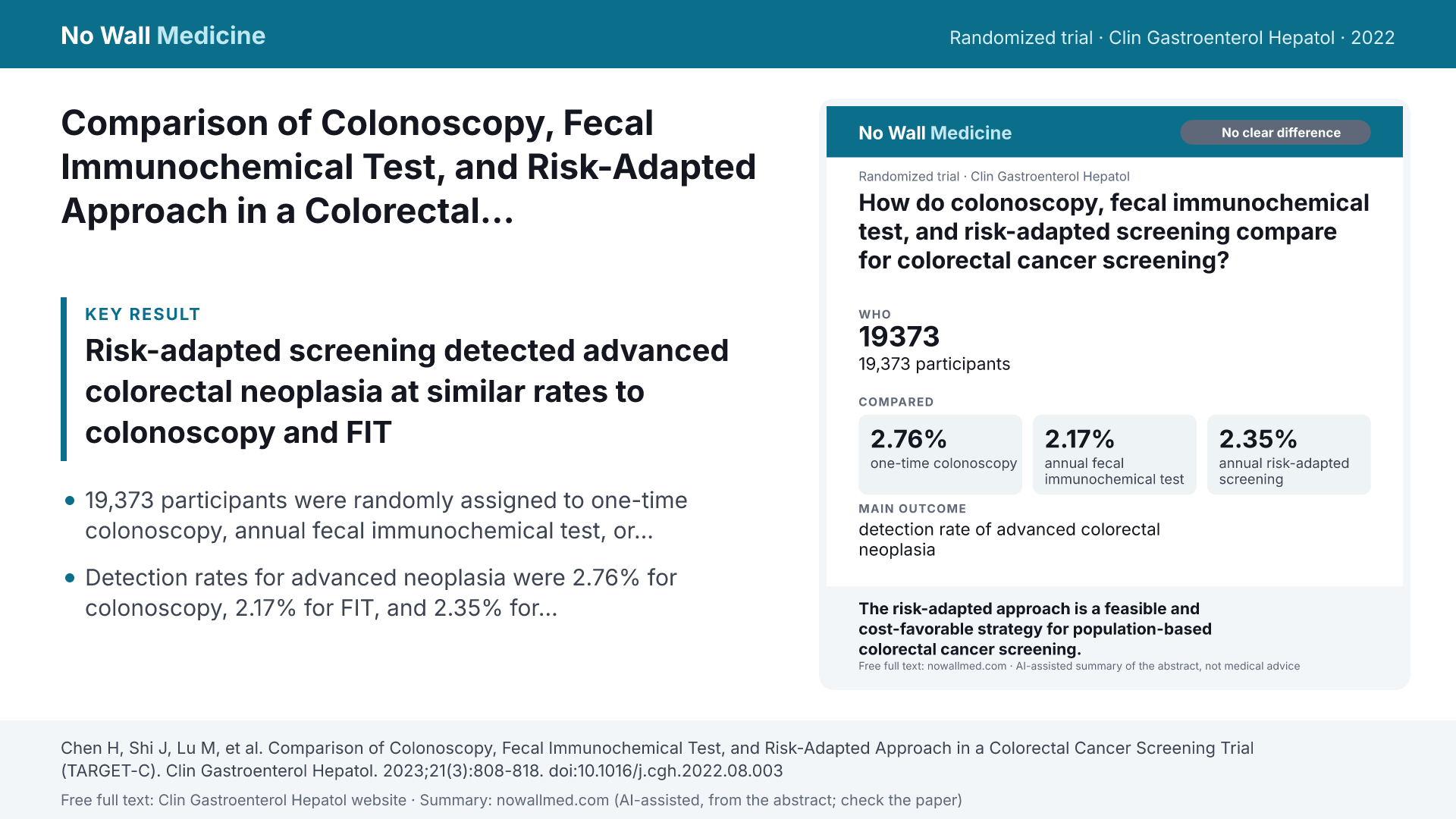
Key result: Risk-adapted screening detected advanced colorectal neoplasia at similar rates to colonoscopy and FIT
Randomized trialNo clear difference
How do colonoscopy, fecal immunochemical test, and risk-adapted screening compare for colorectal cancer screening?
Who
19373
19,373 participants
Compared
2.76%one-time colonoscopy
2.17%annual fecal immunochemical test
2.35%annual risk-adapted screening
Main outcome
detection rate of advanced colorectal neoplasia
Result: OR colonoscopy vs FIT 1.27 (95% CI 0.99-1.63)
Bottom line: The risk-adapted approach is a feasible and cost-favorable strategy for population-based colorectal cancer screening.
Clin Gastroenterol Hepatol · 2022-08-11
Key points
- 19,373 participants were randomly assigned to one-time colonoscopy, annual fecal immunochemical test, or annual risk-adapted screening over three rounds.
- Detection rates for advanced neoplasia were 2.76% for colonoscopy, 2.17% for FIT, and 2.35% for risk-adapted screening, with no significant differences between groups.
- The cost to detect one advanced neoplasm was 6928 CNY for colonoscopy, 5821 CNY for FIT, and 6694 CNY for risk-adapted screening.
Discussion prompts
- Would these patients look like yours? Who was left out?
- Is the main outcome one that matters to patients?
- Is the difference large enough to change what you do?
Cite: Chen H, Shi J, Lu M, et al. Comparison of Colonoscopy, Fecal Immunochemical Test, and Risk-Adapted Approach in a Colorectal Cancer Screening Trial (TARGET-C). Clin Gastroenterol Hepatol. 2023;21(3):808-818. doi:10.1016/j.cgh.2022.08.003
Free full text: Clin Gastroenterol Hepatol website · Summary and visual abstract: nowallmed.com/a/comparison-of-colonoscopy-fecal-immunochemical-test-and-risk-adapted-vhvmew/ (AI-assisted from the abstract; check the paper before relying on it).