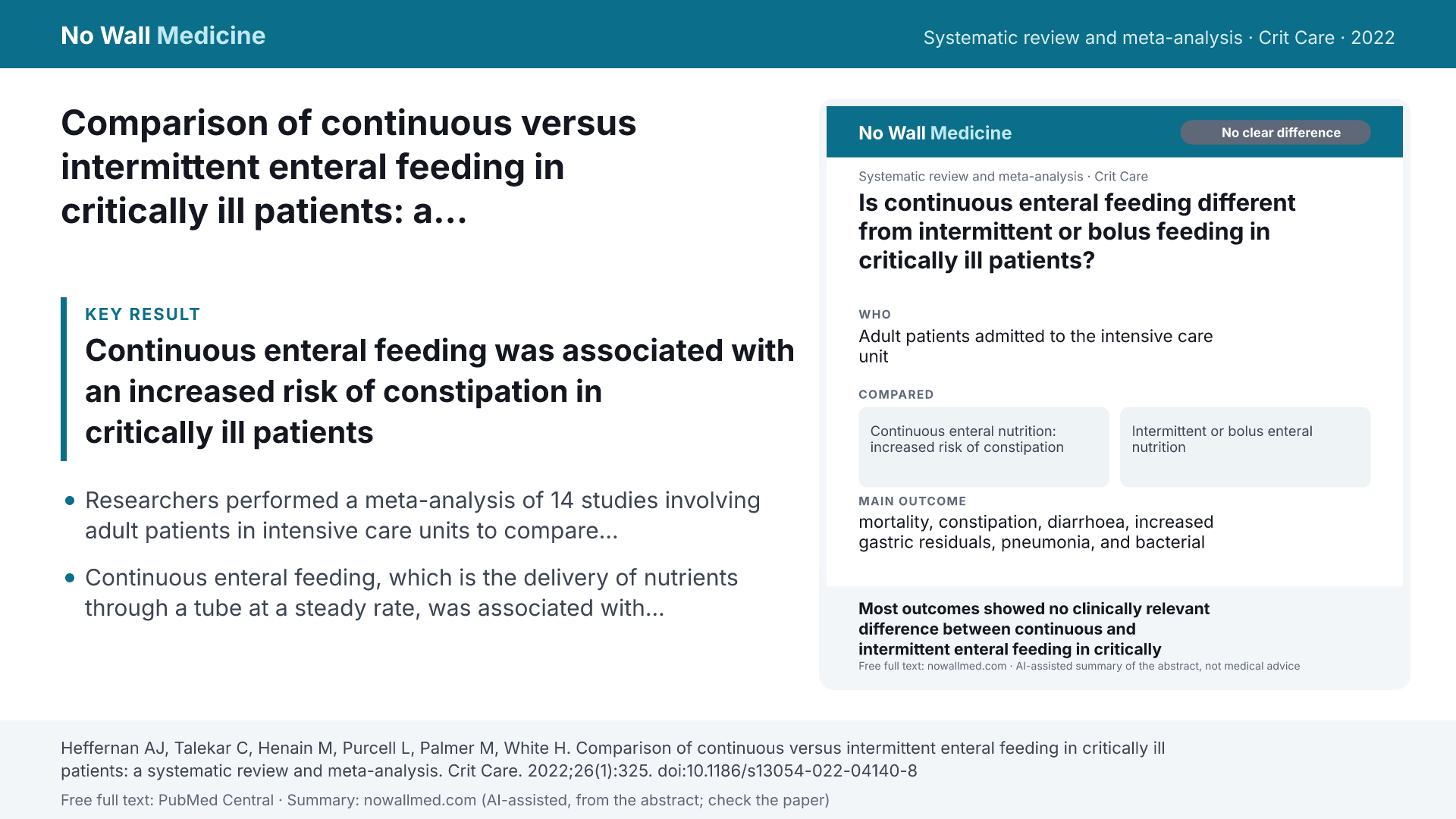
Continuous enteral feeding was associated with an increased risk of constipation in critically ill patients
Comparison of continuous versus intermittent enteral feeding in critically ill patients: a systematic review and meta-analysis
Systematic review and meta-analysisNo clear difference
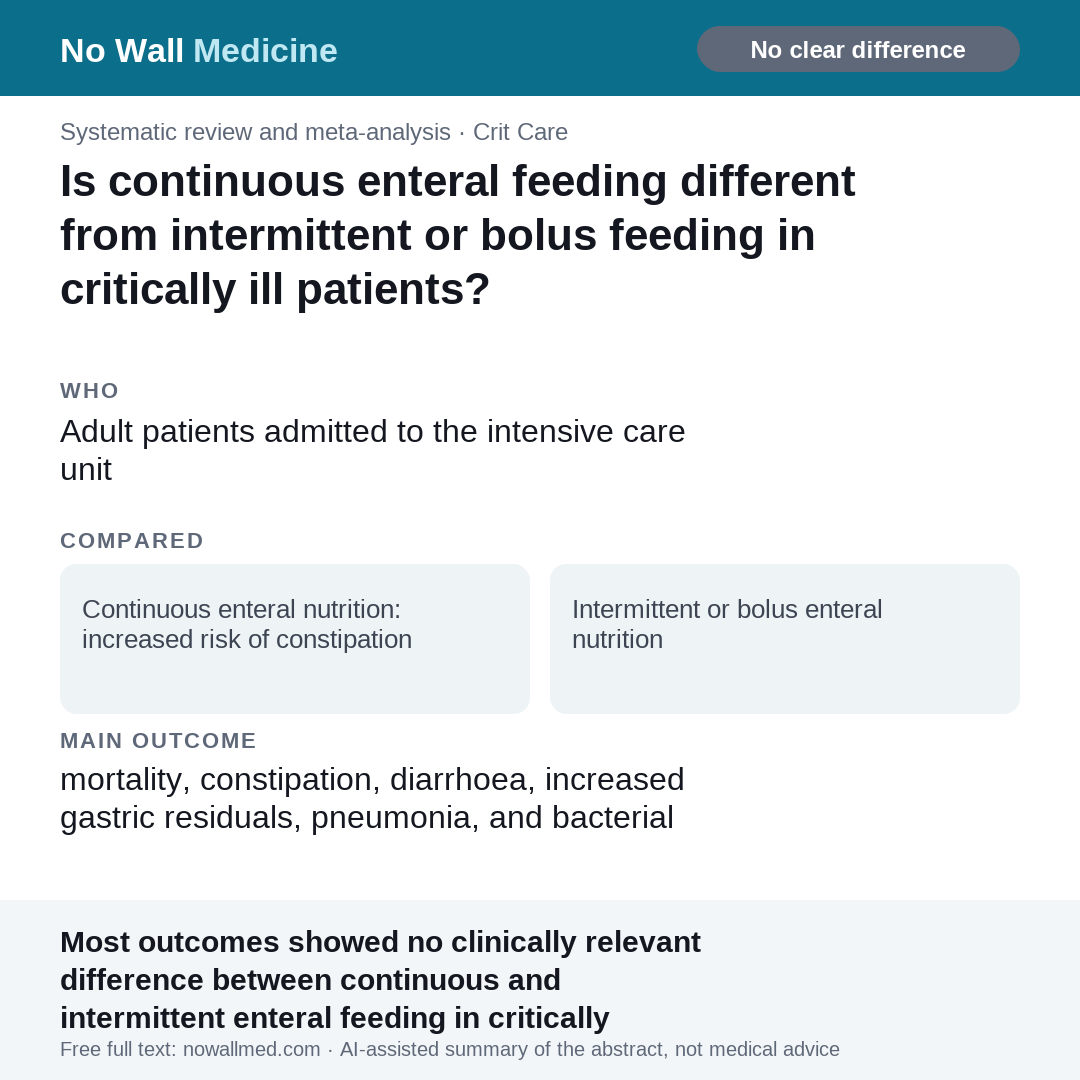
Is continuous enteral feeding different from intermittent or bolus feeding in critically ill patients?
Who
Adult patients admitted to the intensive care unit
Compared
Continuous enteral nutrition: increased risk of constipation
Intermittent or bolus enteral nutrition
Main outcome
mortality, constipation, diarrhoea, increased gastric residuals, pneumonia, and bacterial colonisation
Result: relative risk 2.24 (95% confidence interval 1.01-4.97)
Bottom line: Most outcomes showed no clinically relevant difference between continuous and intermittent enteral feeding in critically ill patients.
Limitation: paucity of high-quality randomised controlled clinical trials
Crit Care · 2022-10-25Download image
Clinical question: Is continuous enteral feeding different from intermittent or bolus feeding in critically ill patients?
Why it matters: It is unclear whether continuous or intermittent feeding methods are more appropriate for meeting the nutritional needs of critically ill patients.
Key points
- Researchers performed a meta-analysis of 14 studies involving adult patients in intensive care units to compare continuous feeding with intermittent or bolus feeding.
- Continuous enteral feeding, which is the delivery of nutrients through a tube at a steady rate, was associated with an increased risk of constipation (relative risk 2.24, 95% confidence interval 1.01-4.97, p = 0.05).
- No differences were identified between the two feeding methods regarding mortality, diarrhoea, increased gastric residuals, pneumonia, or bacterial colonisation.
Limitation the authors note: There is a paucity of high-quality randomised controlled clinical trials to guide this decision.
Headline and key points written with AI from the paper’s abstract, with every number checked against it. Read the paper before relying on them.
Was this summary helpful?
Subject terms
Cite this article
Heffernan AJ, Talekar C, Henain M, Purcell L, Palmer M, White H. Comparison of continuous versus intermittent enteral feeding in critically ill patients: a systematic review and meta-analysis. Crit Care. 2022. doi:10.1186/s13054-022-04140-8
Spotted a mistake? Suggest a correction