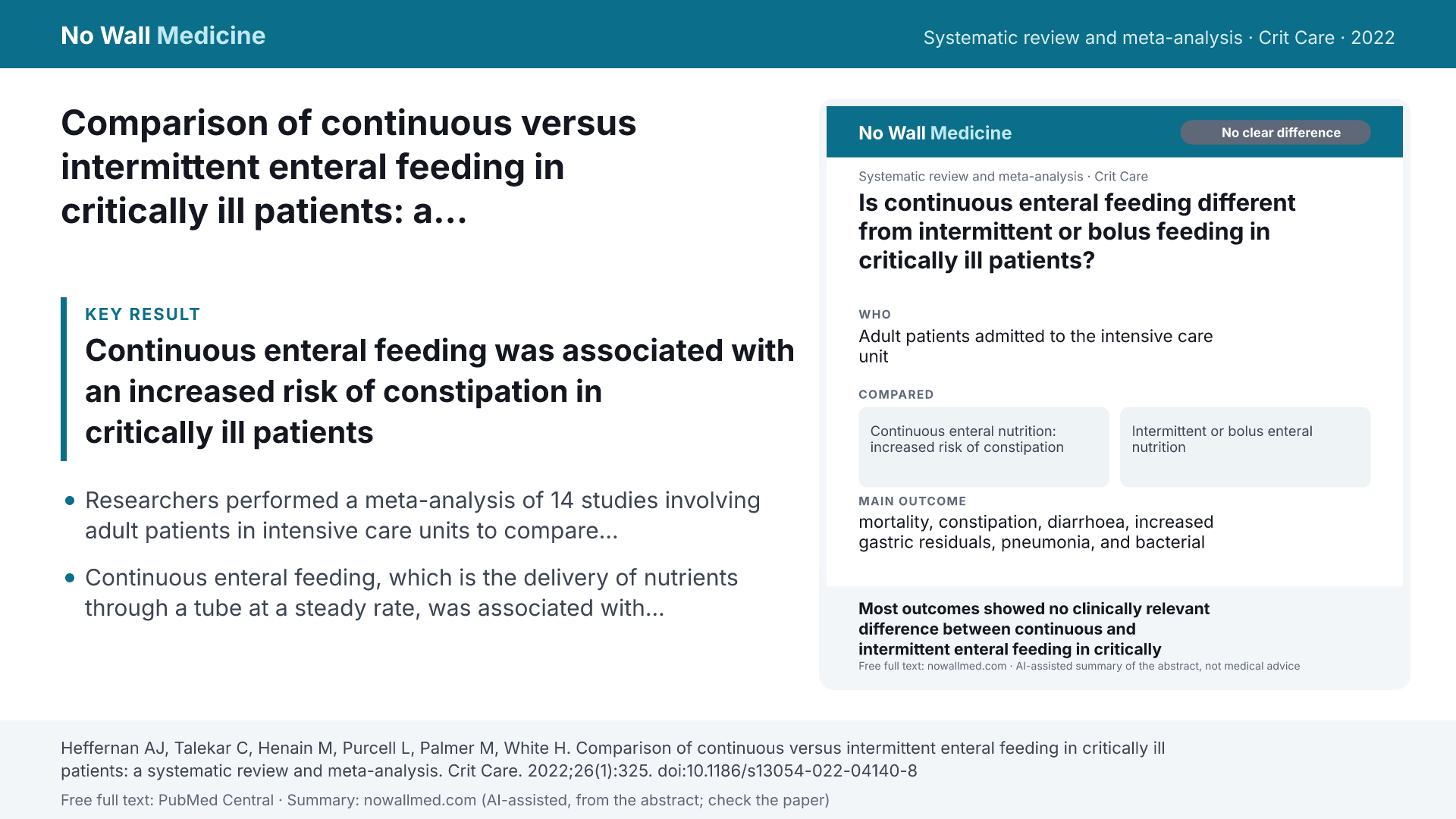
Comparison of continuous versus intermittent enteral feeding in critically ill patients: a systematic review and meta-analysis
Key result: Continuous enteral feeding was associated with an increased risk of constipation in critically ill patients
Systematic review and meta-analysisNo clear difference
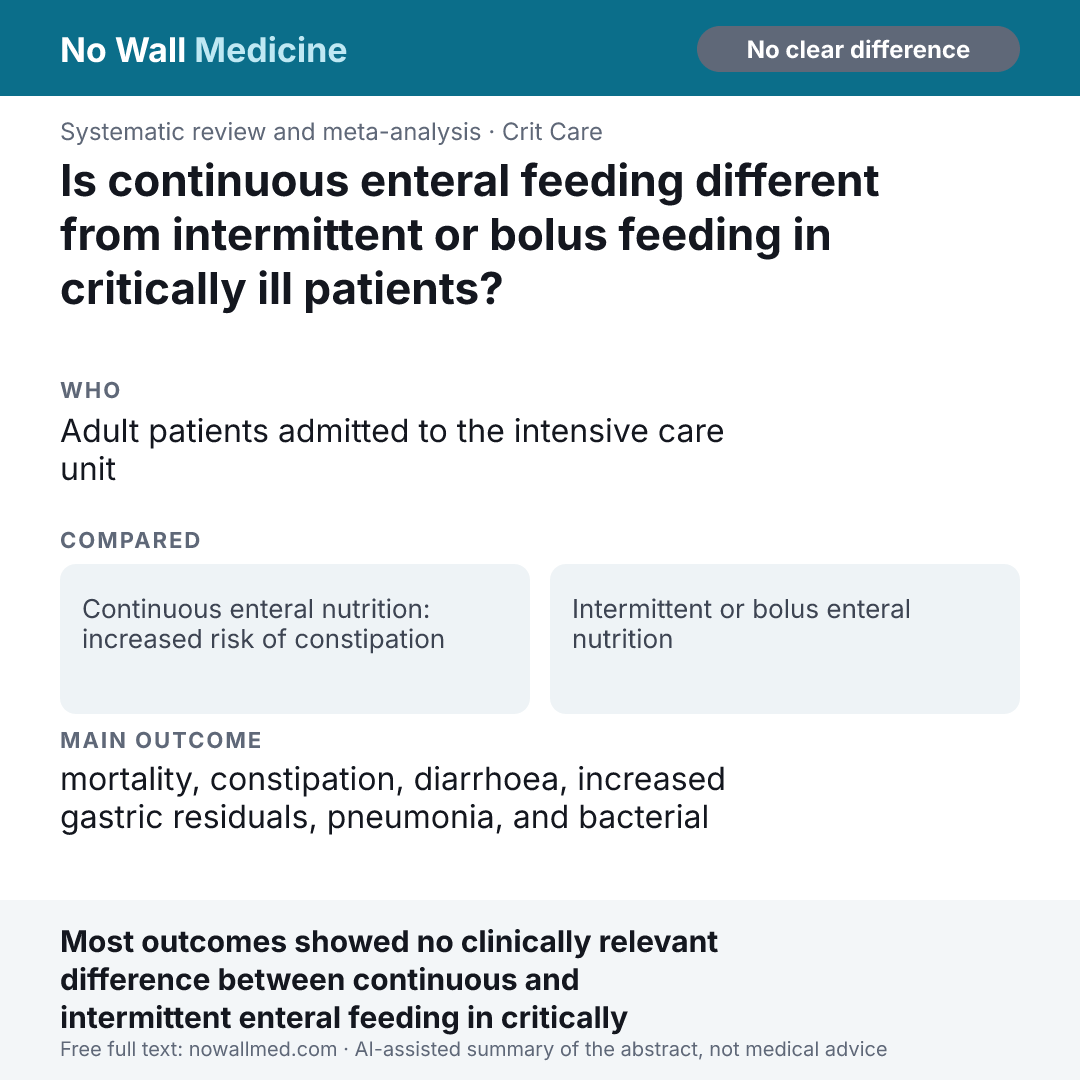
Is continuous enteral feeding different from intermittent or bolus feeding in critically ill patients?
Who
Adult patients admitted to the intensive care unit
Compared
Continuous enteral nutrition: increased risk of constipation
Intermittent or bolus enteral nutrition
Main outcome
mortality, constipation, diarrhoea, increased gastric residuals, pneumonia, and bacterial colonisation
Result: relative risk 2.24 (95% confidence interval 1.01-4.97)
Bottom line: Most outcomes showed no clinically relevant difference between continuous and intermittent enteral feeding in critically ill patients.
Limitation: paucity of high-quality randomised controlled clinical trials
Crit Care · 2022-10-25 · Save PNG
Key points
- Researchers performed a meta-analysis of 14 studies involving adult patients in intensive care units to compare continuous feeding with intermittent or bolus feeding.
- Continuous enteral feeding, which is the delivery of nutrients through a tube at a steady rate, was associated with an increased risk of constipation (relative risk 2.24, 95% confidence interval 1.01-4.97, p = 0.05).
- No differences were identified between the two feeding methods regarding mortality, diarrhoea, increased gastric residuals, pneumonia, or bacterial colonisation.
Limitation the authors note: There is a paucity of high-quality randomised controlled clinical trials to guide this decision.
Discussion prompts
- Would these patients look like yours? Who was left out?
- Is the main outcome one that matters to patients?
- Is the difference large enough to change what you do?
Cite: Heffernan AJ, Talekar C, Henain M, Purcell L, Palmer M, White H. Comparison of continuous versus intermittent enteral feeding in critically ill patients: a systematic review and meta-analysis. Crit Care. 2022;26(1):325. doi:10.1186/s13054-022-04140-8
Free full text: PubMed Central · Summary and visual abstract: nowallmed.com/a/comparison-of-continuous-versus-intermittent-enteral-feeding-in-rgpx8v/ (AI-assisted from the abstract; check the paper before relying on it).