Comparison of intravascular access methods applied by nurses wearing personal protective equipment in simulated COVID-19 resuscitation: A randomized crossover simulation trial
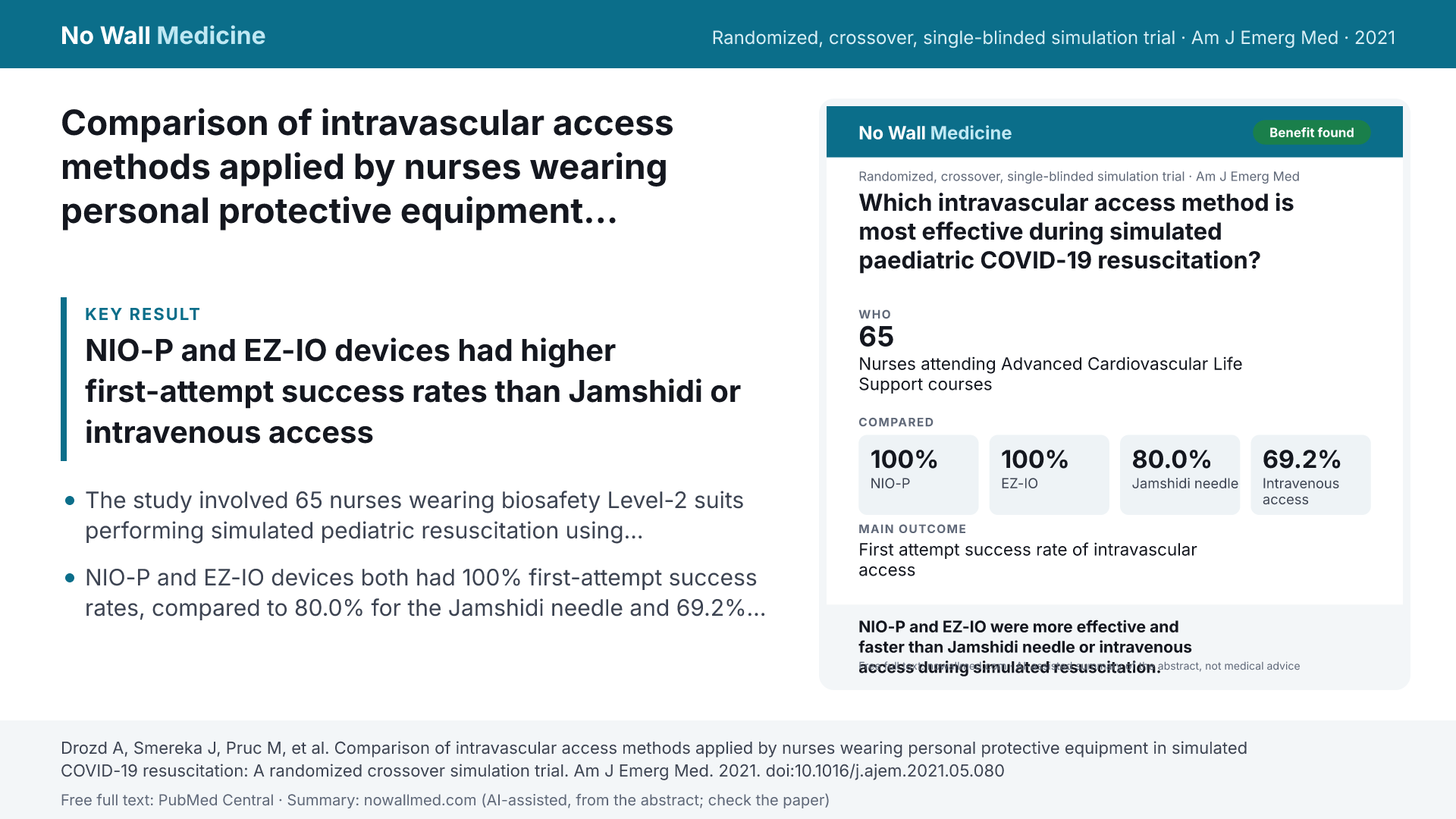
Key result: NIO-P and EZ-IO devices had higher first-attempt success rates than Jamshidi or intravenous access
Key points
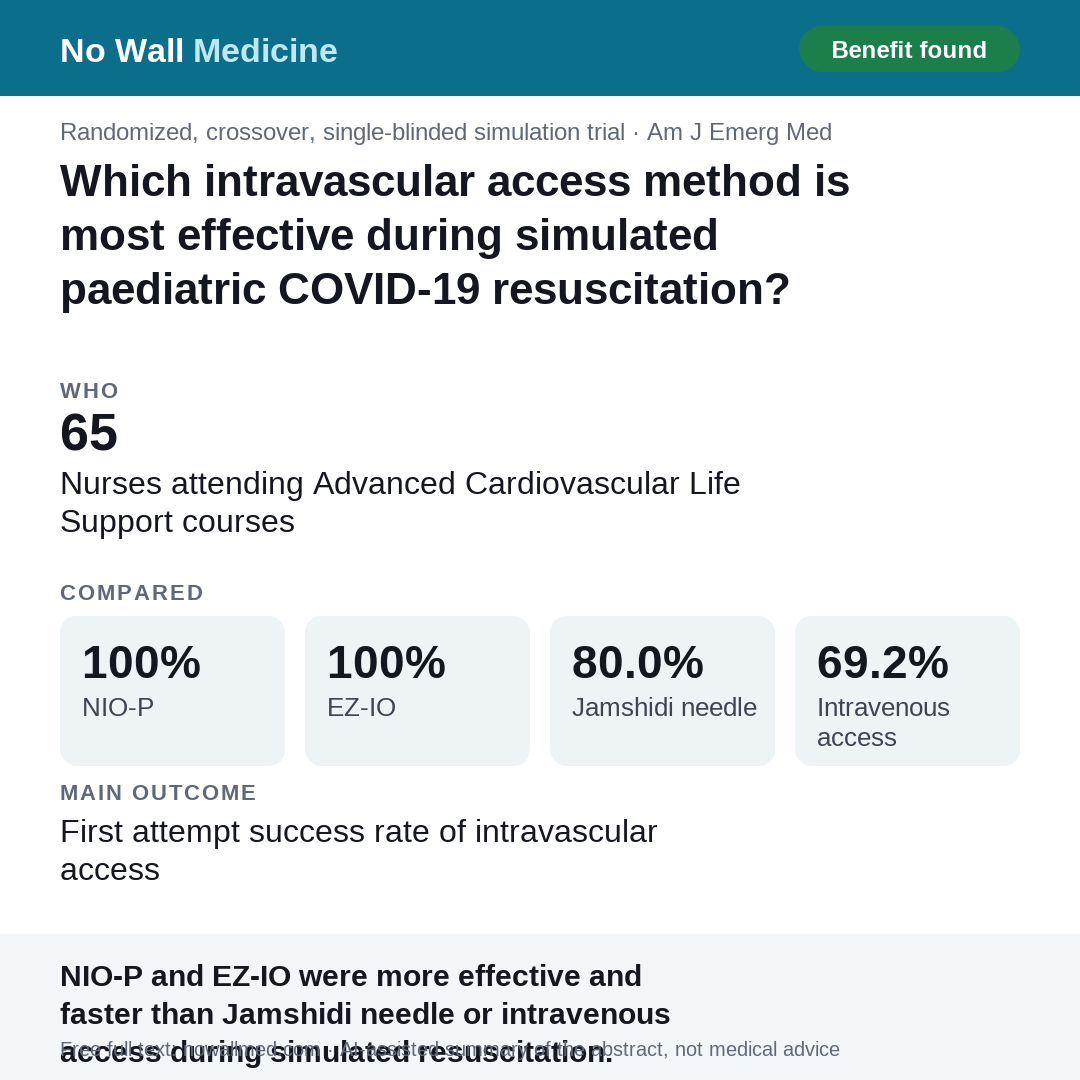
- The study involved 65 nurses wearing biosafety Level-2 suits performing simulated pediatric resuscitation using four different vascular access methods.
- NIO-P and EZ-IO devices both had 100% first-attempt success rates, compared to 80.0% for the Jamshidi needle and 69.2% for intravenous access.
- The time to connect infusion lines was 33 ± 4 s for NIO-P, 37 ± 6.7 s for EZ-IO, 43 ± 7 s for Jamshidi, and 98.5 ± 10 s for intravenous access.
Why it matters: It is unknown how wearing personal protective equipment affects the efficiency of different vascular access methods during pediatric resuscitation in a pandemic setting.
Discussion prompts
- Would these patients look like yours? Who was left out?
- Is the main outcome one that matters to patients?
- Is the difference large enough to change what you do?
Cite: Drozd A, Smereka J, Pruc M, Malysz M, Gasecka A, Sonmez LO. Comparison of intravascular access methods applied by nurses wearing personal protective equipment in simulated COVID-19 resuscitation: A randomized crossover simulation trial. Am J Emerg Med. 2021. doi:10.1016/j.ajem.2021.05.080
Free full text: PubMed Central · Summary and visual abstract: nowallmed.com/a/comparison-of-intravascular-access-methods-applied-by-nurses-wearing-916tlg/ (AI-assisted from the abstract; check the paper before relying on it).