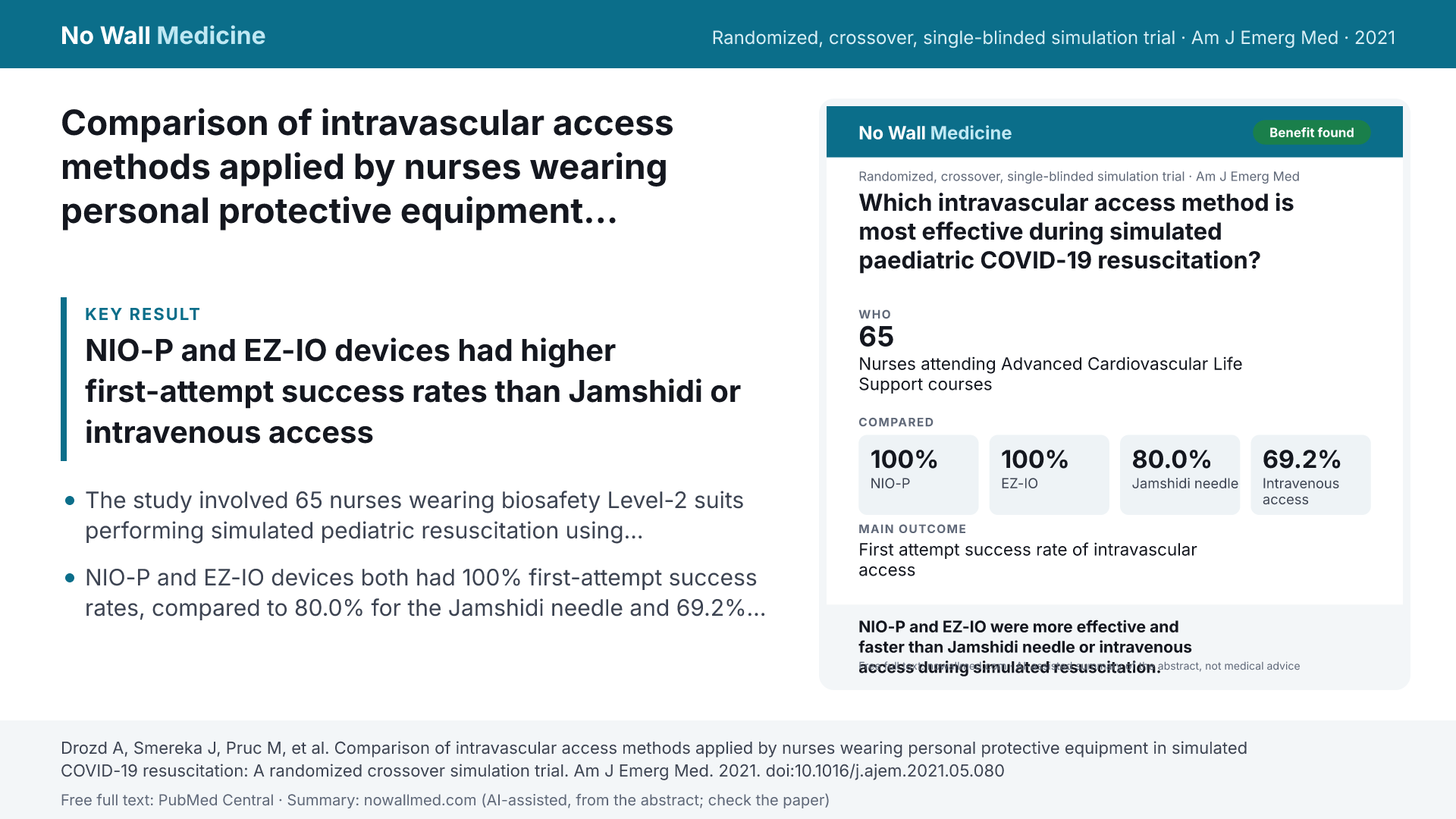
NIO-P and EZ-IO devices had higher first-attempt success rates than Jamshidi or intravenous access
Comparison of intravascular access methods applied by nurses wearing personal protective equipment in simulated COVID-19 resuscitation: A randomized crossover simulation trial
Randomized, crossover, single-blinded simulation trialBenefit found
Which intravascular access method is most effective during simulated paediatric COVID-19 resuscitation?
Who
65
Nurses attending Advanced Cardiovascular Life Support courses
Compared
100%NIO-P
100%EZ-IO
80.0%Jamshidi needle
69.2%Intravenous access
Main outcome
First attempt success rate of intravascular access
Bottom line: NIO-P and EZ-IO were more effective and faster than Jamshidi needle or intravenous access during simulated resuscitation.
Am J Emerg Med · 2021-06-03Download image
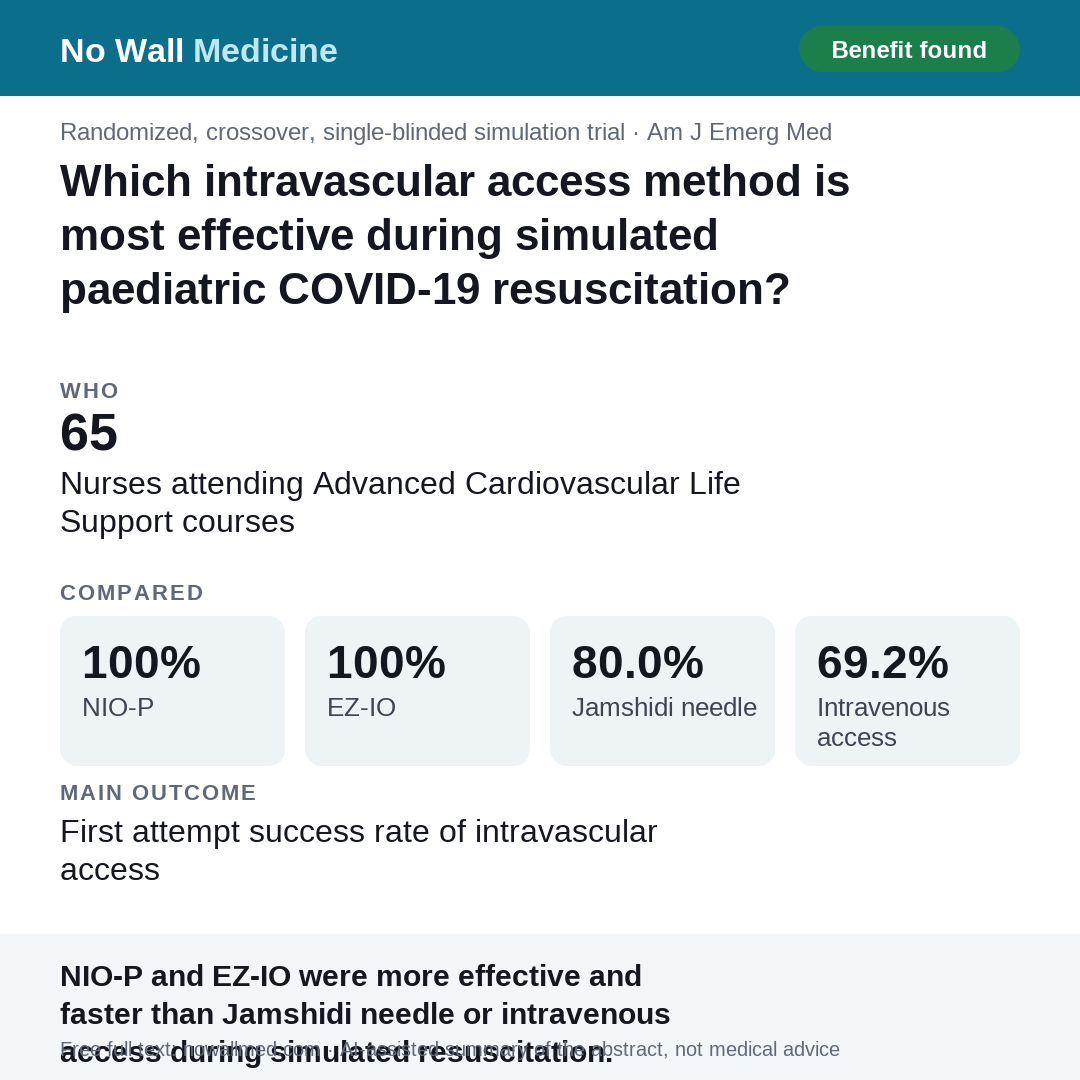
Clinical question: Which intravascular access method is most effective during simulated paediatric COVID-19 resuscitation?
Why it matters: It is unknown how wearing personal protective equipment affects the efficiency of different vascular access methods during pediatric resuscitation in a pandemic setting.
Key points
- The study involved 65 nurses wearing biosafety Level-2 suits performing simulated pediatric resuscitation using four different vascular access methods.
- NIO-P and EZ-IO devices both had 100% first-attempt success rates, compared to 80.0% for the Jamshidi needle and 69.2% for intravenous access.
- The time to connect infusion lines was 33 ± 4 s for NIO-P, 37 ± 6.7 s for EZ-IO, 43 ± 7 s for Jamshidi, and 98.5 ± 10 s for intravenous access.
Headline and key points written with AI from the paper’s abstract, with every number checked against it. Read the paper before relying on them.
Was this summary helpful?
Subject terms
Cite this article
Drozd A, Smereka J, Pruc M, Malysz M, Gasecka A, Sonmez LO. Comparison of intravascular access methods applied by nurses wearing personal protective equipment in simulated COVID-19 resuscitation: A randomized crossover simulation trial. Am J Emerg Med. 2021. doi:10.1016/j.ajem.2021.05.080
Spotted a mistake? Suggest a correction