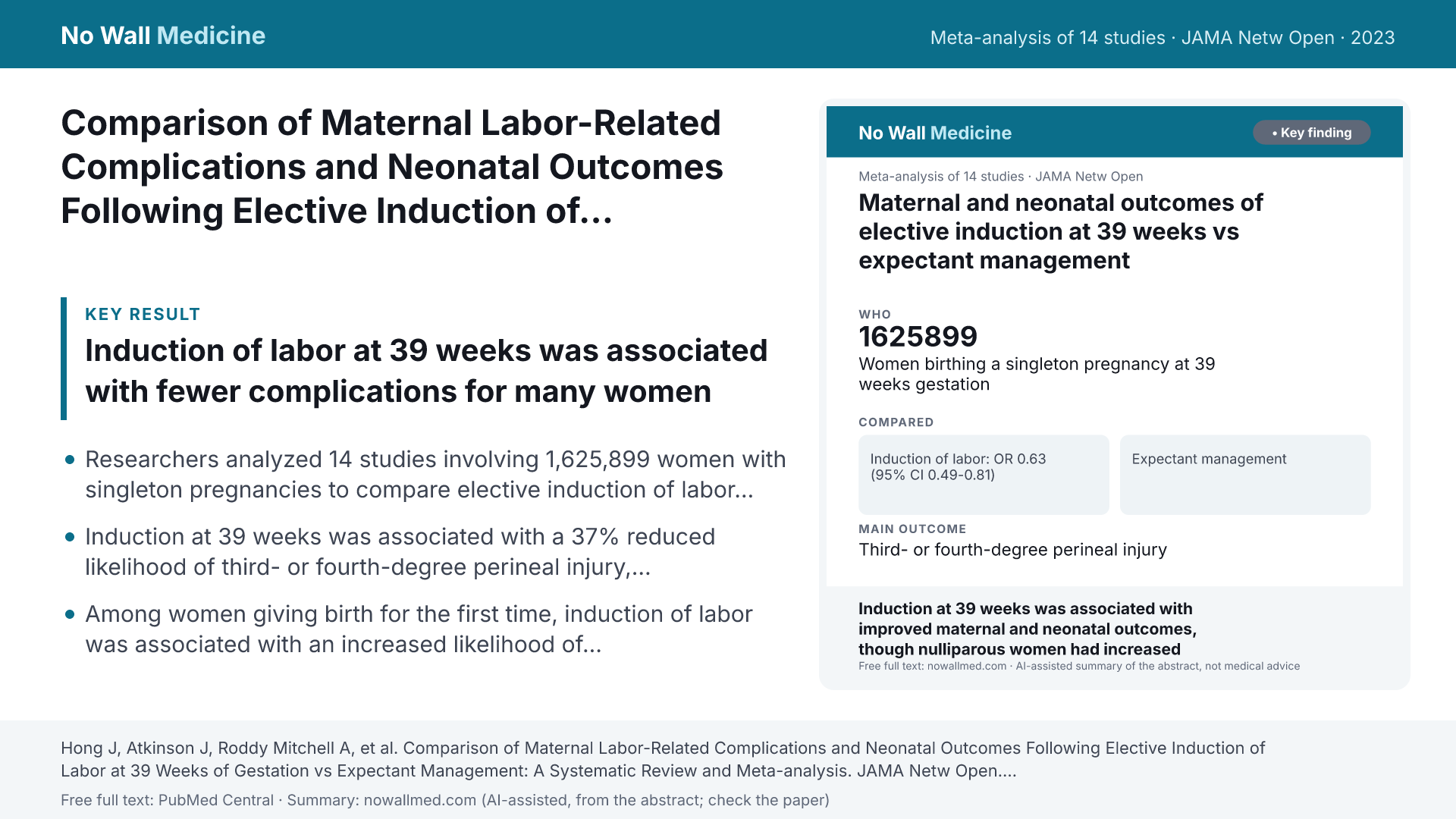
Induction of labor at 39 weeks was associated with fewer complications for many women
Comparison of Maternal Labor-Related Complications and Neonatal Outcomes Following Elective Induction of Labor at 39 Weeks of Gestation vs Expectant Management: A Systematic Review and Meta-analysis
Key points
- Researchers analyzed 14 studies involving 1,625,899 women with singleton pregnancies to compare elective induction of labor at 39 weeks to expectant management.
- Induction at 39 weeks was associated with a 37% reduced likelihood of third- or fourth-degree perineal injury, lower rates of operative vaginal birth, and lower rates of macrosomia.
- Among women giving birth for the first time, induction of labor was associated with an increased likelihood of shoulder dystocia, a condition where the baby's shoulder becomes stuck.
Headline and key points written with AI from the paper’s abstract, with every number checked against it. Read the paper before relying on them.
Was this summary helpful?
Subject terms
Cite this article
Hong J, Atkinson J, Roddy Mitchell A, et al. Comparison of Maternal Labor-Related Complications and Neonatal Outcomes Following Elective Induction of Labor at 39 Weeks of Gestation vs Expectant Management: A Systematic Review and Meta-analysis. JAMA Netw Open. 2023;6(5):e2313162. doi:10.1001/jamanetworkopen.2023.13162
Spotted a mistake? Suggest a correction