Early induction of labour for suspected large babies was not cost-effective to prevent shoulder dystocia
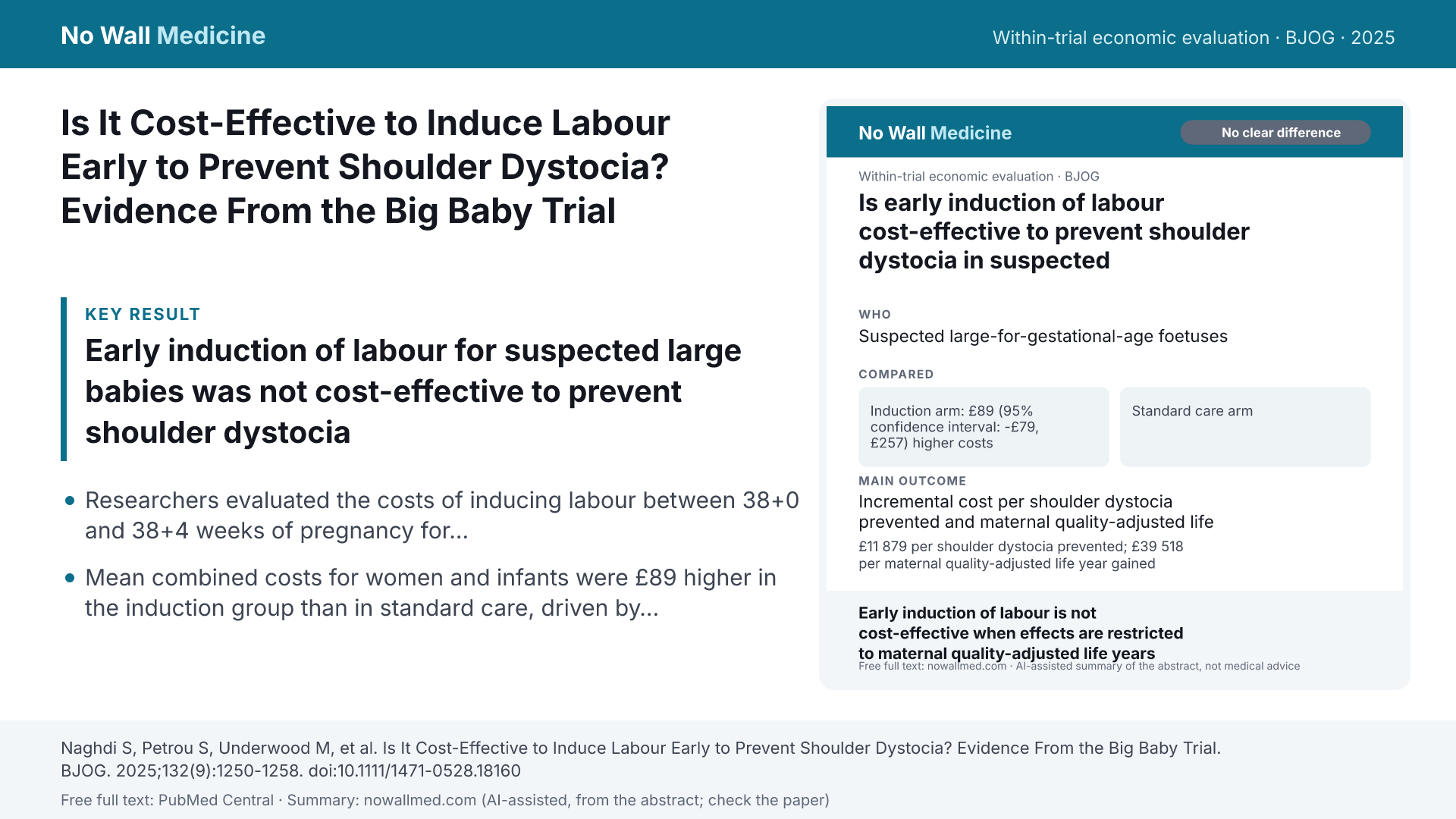
Is It Cost-Effective to Induce Labour Early to Prevent Shoulder Dystocia? Evidence From the Big Baby Trial
Obstetrics & GynecologyAdult and pediatric
Within-trial economic evaluationNo clear difference
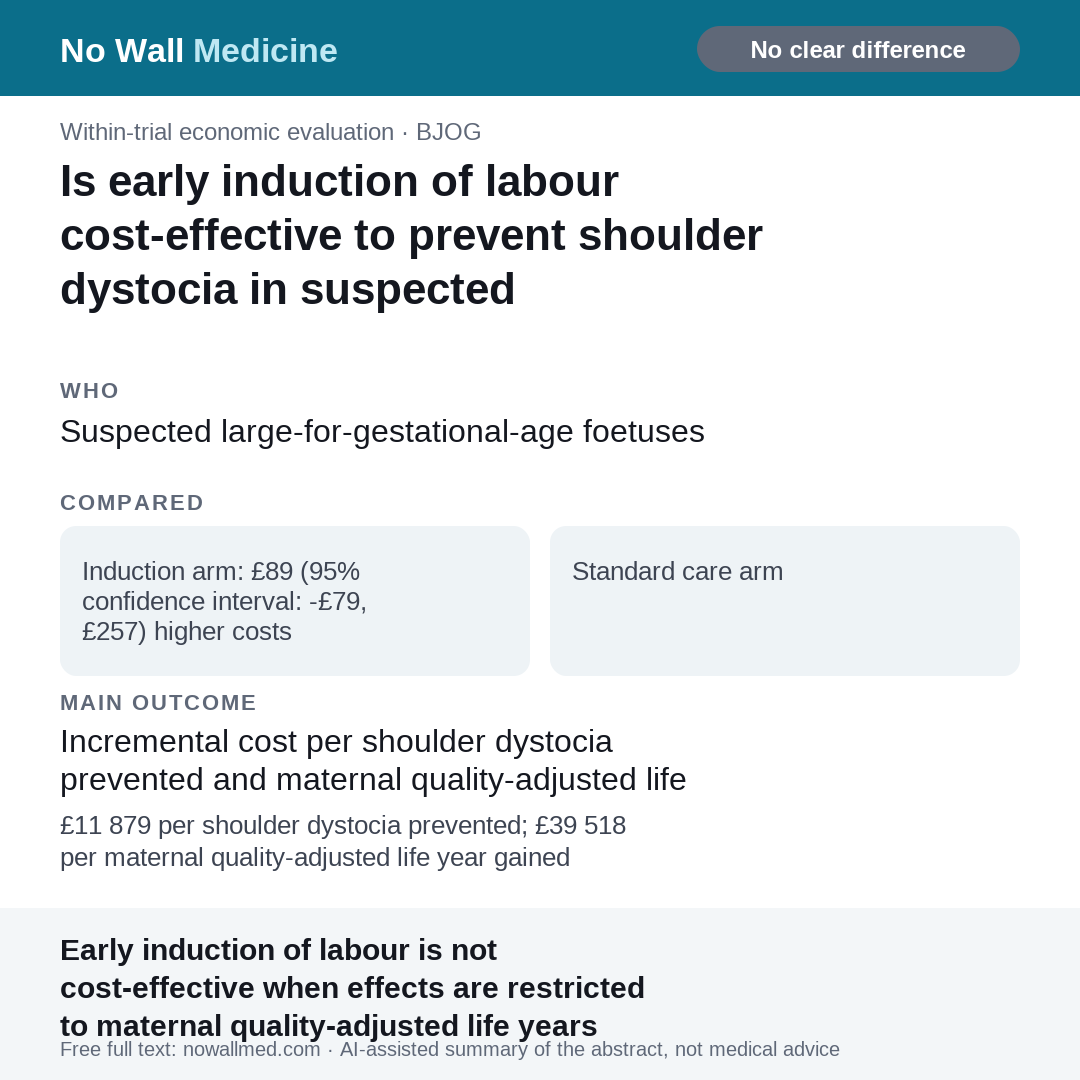
Is early induction of labour cost-effective to prevent shoulder dystocia in suspected large-for-gestational-age foetuses?
Who
Suspected large-for-gestational-age foetuses
Compared
Induction arm: £89 (95% confidence interval: -£79, £257) higher costs
Standard care arm
Main outcome
Incremental cost per shoulder dystocia prevented and maternal quality-adjusted life year gained
Result: £11 879 per shoulder dystocia prevented; £39 518 per maternal quality-adjusted life year gained
Bottom line: Early induction of labour is not cost-effective when effects are restricted to maternal quality-adjusted life years gained.
BJOG · 2025-05-01Download image
Clinical question: Is early induction of labour cost-effective to prevent shoulder dystocia in suspected large-for-gestational-age foetuses?
Why it matters: The cost-effectiveness of inducing labour early to prevent shoulder dystocia in suspected large-for-gestational-age foetuses is unknown.
Key points
- Researchers evaluated the costs of inducing labour between 38+0 and 38+4 weeks of pregnancy for suspected large-for-gestational-age foetuses.
- Mean combined costs for women and infants were £89 higher in the induction group than in standard care, driven by neonatal costs.
- The incremental cost to prevent one case of shoulder dystocia was £11 879, while the cost per maternal quality-adjusted life year gained was £39 518.
Headline and key points written with AI from the paper’s abstract, with every number checked against it. Read the paper before relying on them.
Was this summary helpful?
Subject terms
Cite this article
Naghdi S, Petrou S, Underwood M, Deshpande S, Quenby S, Ewington L. Is It Cost-Effective to Induce Labour Early to Prevent Shoulder Dystocia? Evidence From the Big Baby Trial. BJOG. 2025. doi:10.1111/1471-0528.18160
Spotted a mistake? Suggest a correction