Planned delivery for preeclampsia at 34 weeks reduces maternal morbidity but increases neonatal respiratory issues
Planned delivery or expectant management in preeclampsia: an individual participant data meta-analysis
Individual participant data meta-analysisMixed results
Does planned delivery versus expectant management improve outcomes in women with preeclampsia?
Who
1790
Women with singleton or multifetal pregnancies with preeclampsia from 34 weeks gestation
Compared
Planned delivery: maternal morbidity 2.6%
Expectant management: maternal morbidity 4.4%
Main outcome
maternal and perinatal mortality or morbidity
Result: adjusted risk ratio 0.59 (95% confidence interval, 0.36-0.98) for maternal morbidity
Bottom line: Planned delivery reduces maternal morbidity but may increase short-term neonatal respiratory morbidity in preeclampsia.
AJOG · 2022-04-26Download image
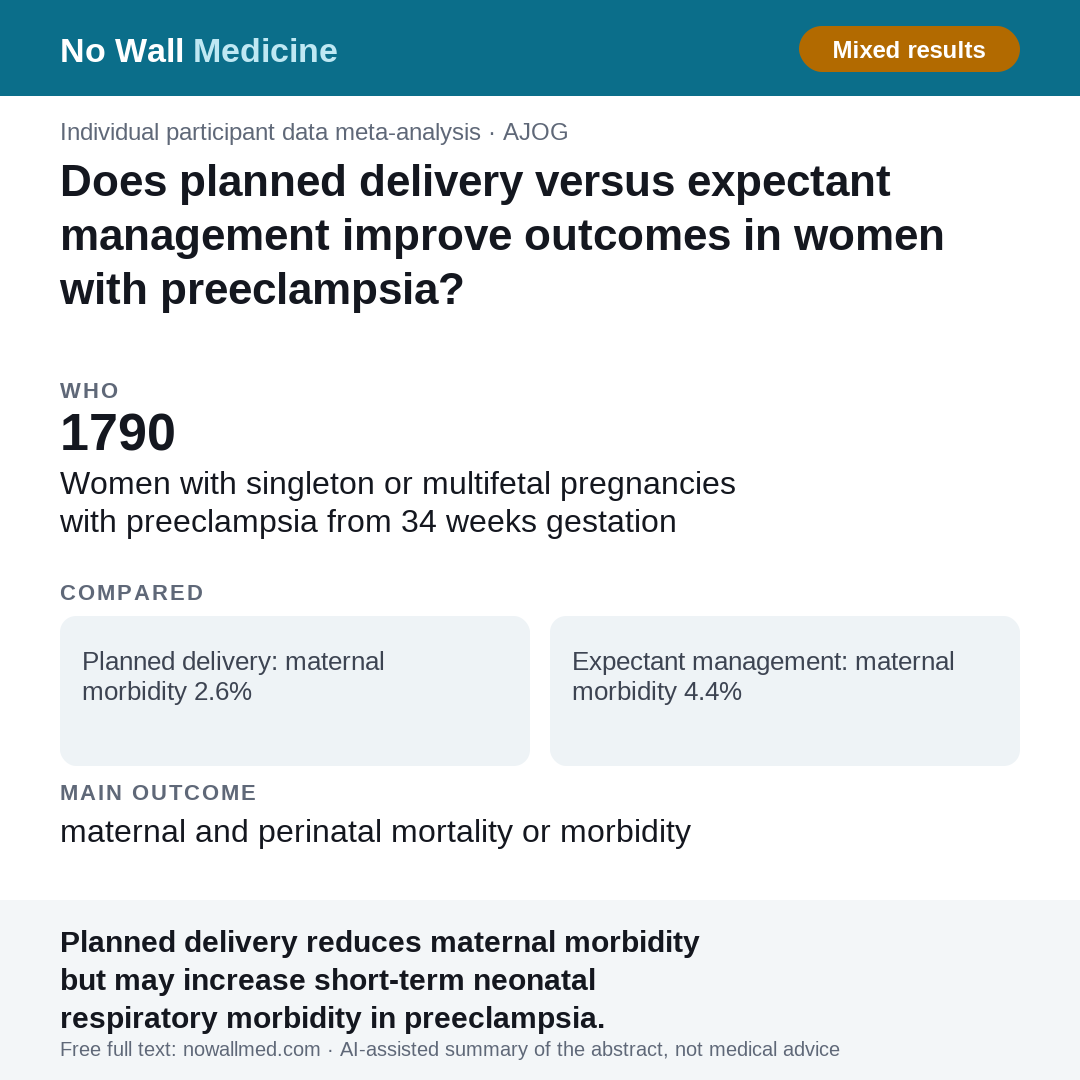
Clinical question: Does planned delivery versus expectant management improve outcomes in women with preeclampsia?
Why it matters: It is uncertain whether planned delivery reduces maternal complications without causing serious neonatal consequences for women with preeclampsia between 34+0 and 36+6 weeks gestation.
Key points
- Researchers analyzed 1790 participants from 6 trials to compare planned delivery against expectant management for women with preeclampsia from 34 weeks gestation onward.
- Planned delivery was associated with lower maternal morbidity at 2.6% compared to 4.4%, but increased perinatal morbidity at 20.9% compared to 17.1%.
- Infants in the expectant management group were more likely to be born small for gestational age at 10.6% compared to 7.8% in the planned delivery group.
Headline and key points written with AI from the paper’s abstract, with every number checked against it. Read the paper before relying on them.
Was this summary helpful?
Subject terms
Cite this article
Beardmore-Gray A, Seed PT, Fleminger J, Zwertbroek E, Bernardes T, Mol BW. Planned delivery or expectant management in preeclampsia: an individual participant data meta-analysis. AJOG. 2022. doi:10.1016/j.ajog.2022.04.034
Spotted a mistake? Suggest a correction
Top studies every Monday
The week’s key trials and guidelines in your specialties, plus any topics you follow. By email, free.
Get the weekly digest