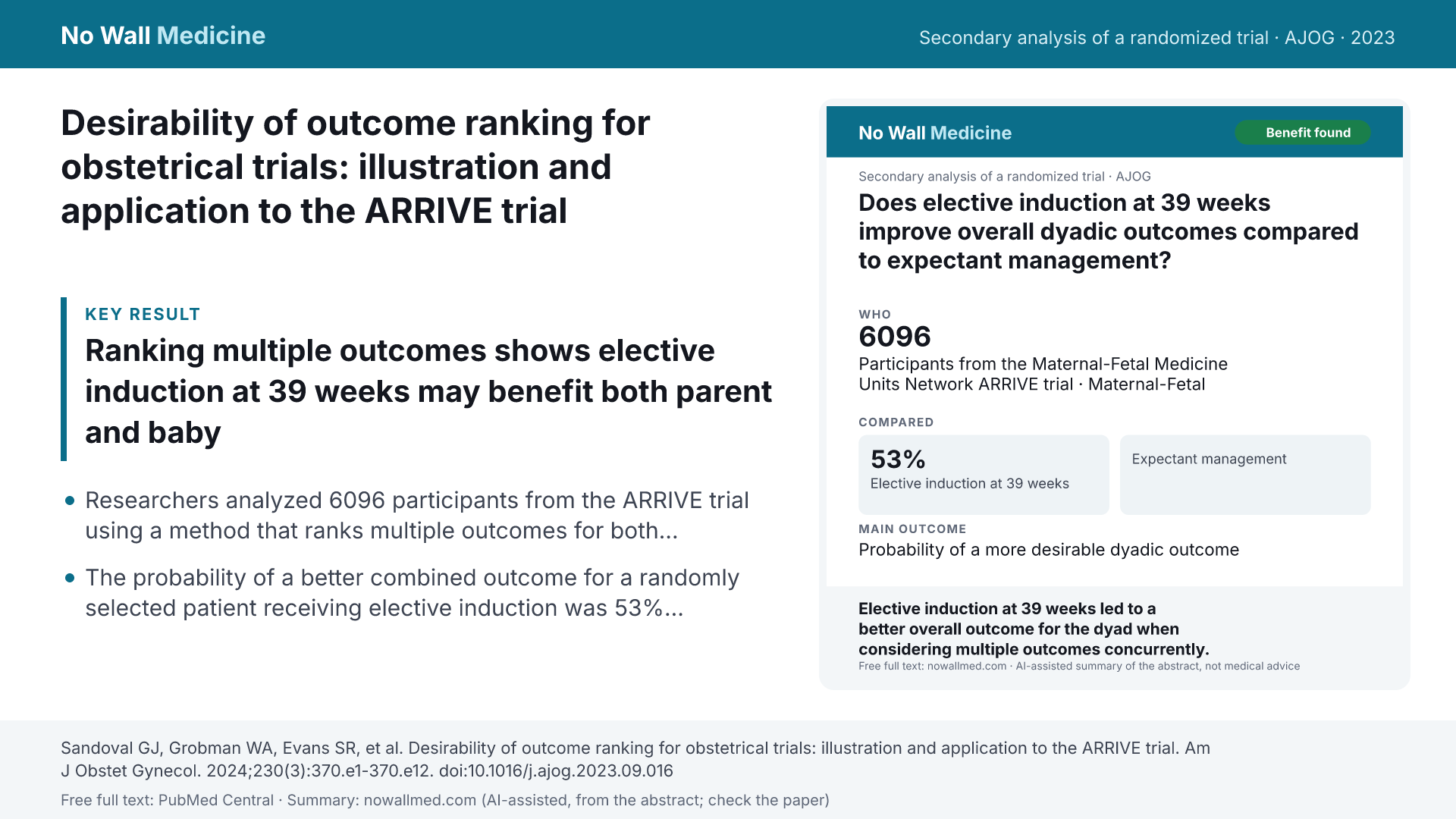
Ranking multiple outcomes shows elective induction at 39 weeks may benefit both parent and baby
Desirability of outcome ranking for obstetrical trials: illustration and application to the ARRIVE trial
Secondary analysis of a randomized trialBenefit found
Does elective induction at 39 weeks improve overall dyadic outcomes compared to expectant management?
Who
6096
Participants from the Maternal-Fetal Medicine Units Network ARRIVE trial · Maternal-Fetal Medicine Units Network
Compared
53%Elective induction at 39 weeks (95% confidence interval, 51-54)
Expectant management
Main outcome
Probability of a more desirable dyadic outcome
Result: 53% (95% confidence interval, 51-54)
Bottom line: Elective induction at 39 weeks led to a better overall outcome for the dyad when considering multiple outcomes concurrently.
AJOG · 2023-09-22 · Save PNG
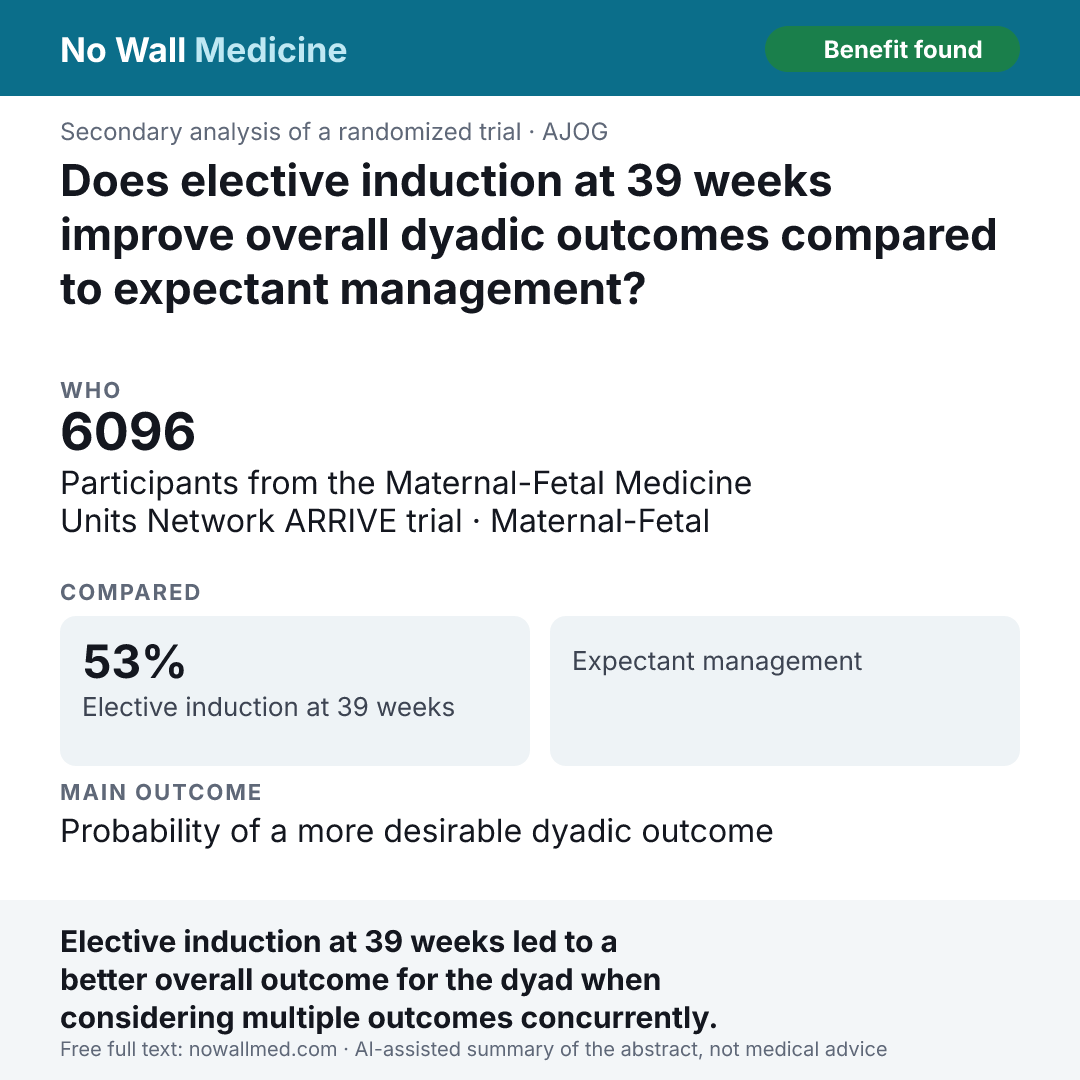
Clinical question: Does elective induction at 39 weeks improve overall dyadic outcomes compared to expectant management?
Why it matters: Standard trials often focus on a single primary outcome, which may not capture the complex, sometimes conflicting consequences an intervention has for both the parent and the child.
Key points
- Researchers analyzed 6096 participants from the ARRIVE trial using a method that ranks multiple outcomes for both the pregnant person and the infant.
- The probability of a better combined outcome for a randomly selected patient receiving elective induction was 53% (95% confidence interval, 51-54).
- The probability of avoiding a cesarean delivery through elective induction was 52% (95% confidence interval, 51-53) without causing poorer outcomes for the infant.
Headline and key points written with AI from the paper’s abstract, with every number checked against it. Read the paper before relying on them.
Was this summary helpful?
Subject terms
Headline, design, result, key points, caveat and citation as plain text.
Cite this article
Sandoval GJ, Grobman WA, Evans SR, et al. Desirability of outcome ranking for obstetrical trials: illustration and application to the ARRIVE trial. Am J Obstet Gynecol. 2024;230(3):370.e1-370.e12. doi:10.1016/j.ajog.2023.09.016
Spotted a mistake? Suggest a correction