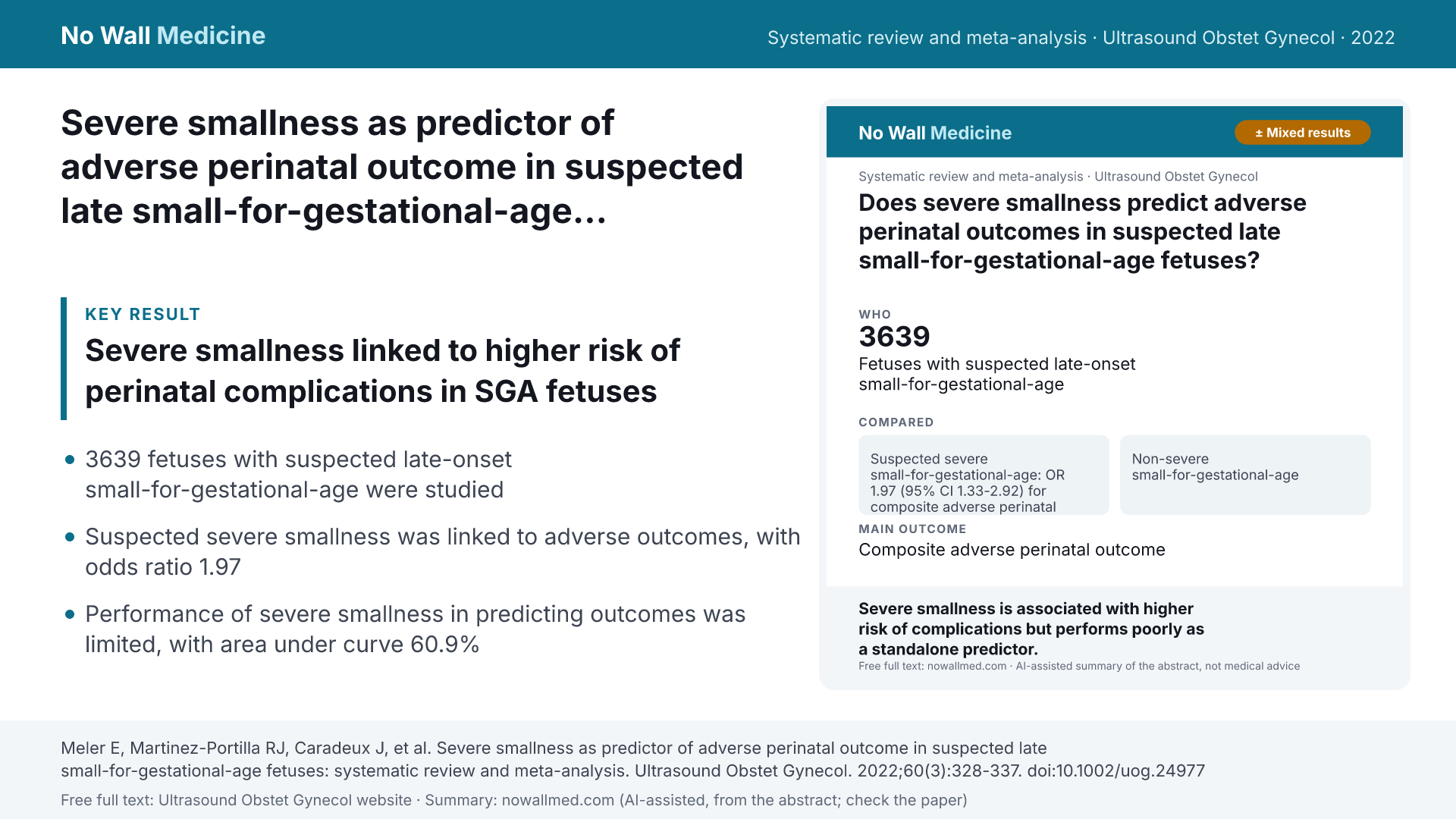
Severe smallness linked to higher risk of perinatal complications in SGA fetuses
Severe smallness as predictor of adverse perinatal outcome in suspected late small-for-gestational-age fetuses: systematic review and meta-analysis
Systematic review and meta-analysisMixed results
Does severe smallness predict adverse perinatal outcomes in suspected late small-for-gestational-age fetuses?
Who
3639
Fetuses with suspected late-onset small-for-gestational-age
Compared
Suspected severe small-for-gestational-age: OR 1.97 (95% CI 1.33-2.92) for composite adverse perinatal outcome
Non-severe small-for-gestational-age
Main outcome
Composite adverse perinatal outcome
Result: odds ratio 1.97 (95% CI 1.33-2.92)
Bottom line: Severe smallness is associated with higher risk of complications but performs poorly as a standalone predictor.
Ultrasound Obstet Gynecol · 2022-06-25Download image
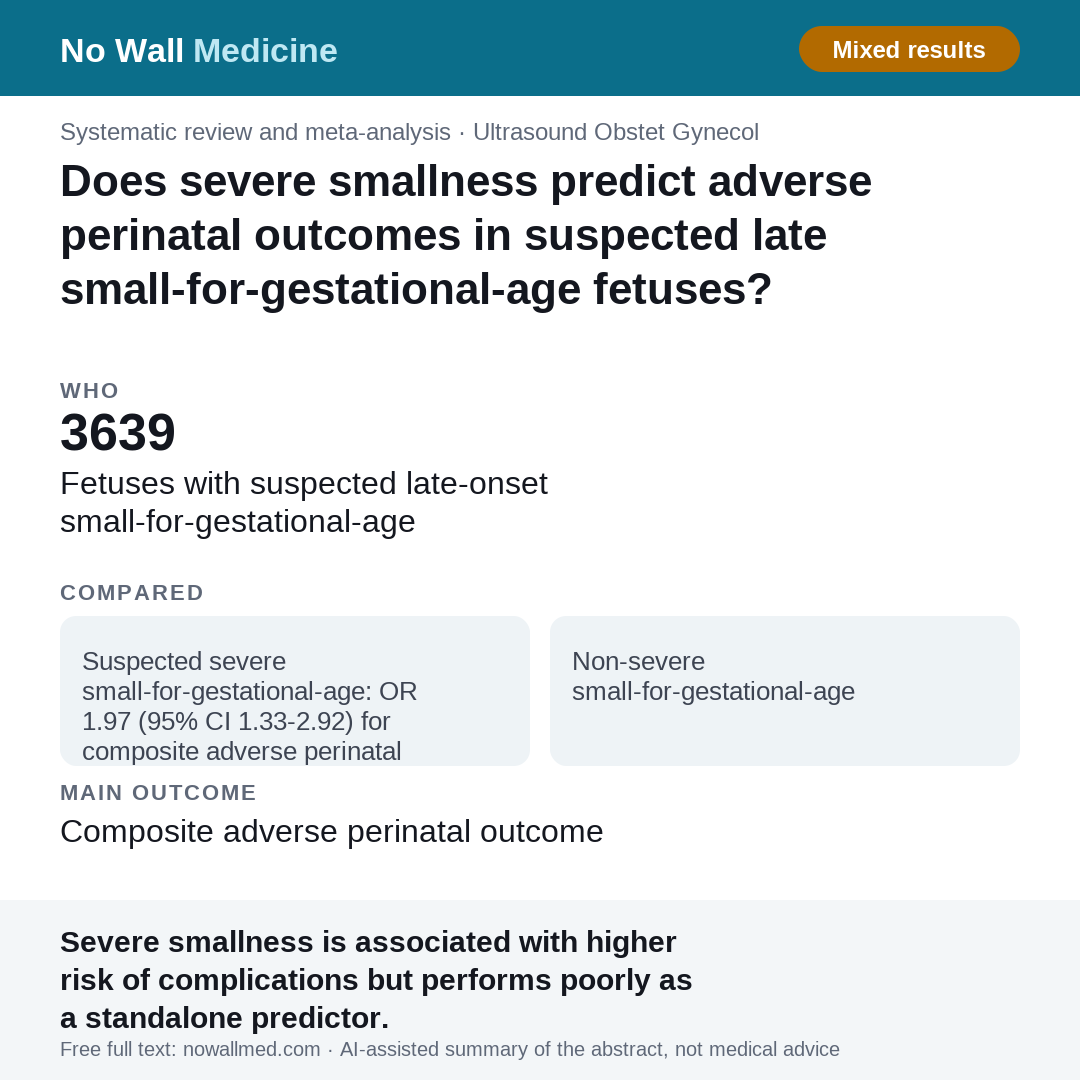
Clinical question: Does severe smallness predict adverse perinatal outcomes in suspected late small-for-gestational-age fetuses?
Why it matters: It was unknown how well severe smallness predicts adverse perinatal outcomes in suspected late small-for-gestational-age fetuses
Key points
- 3639 fetuses with suspected late-onset small-for-gestational-age were studied.
- Suspected severe smallness was linked to adverse outcomes, with odds ratio 1.97.
- Performance of severe smallness in predicting outcomes was limited, with area under curve 60.9%.
Limitation the authors note: The authors did not state a specific limitation in the abstract
Headline and key points written with AI from the paper’s abstract, with every number checked against it. Read the paper before relying on them.
Was this summary helpful?
Subject terms
Cite this article
Meler E, Martinez-Portilla RJ, Caradeux J, Mazarico E, Gil-Armas C, Boada D. Severe smallness as predictor of adverse perinatal outcome in suspected late small-for-gestational-age fetuses: systematic review and meta-analysis. Ultrasound Obstet Gynecol. 2022. doi:10.1002/uog.24977
Spotted a mistake? Suggest a correction